Democrats fighting to win back the Senate from the Republicans spent their summer sweating out a last-minute candidate switch in Maine and the emergence of an antiestablishment progressive in swing-state Michigan.
The two races remain central to Democrats’ hopes of winning back Senate control in the November elections as they try to navigate a narrow pathway to the majority. But even as flipping Maine and retaining Michigan look challenging, Democrats have made headway in defending Georgia, capturing North Carolina and competing in redder states including Alaska, Ohio, Iowa and Texas.
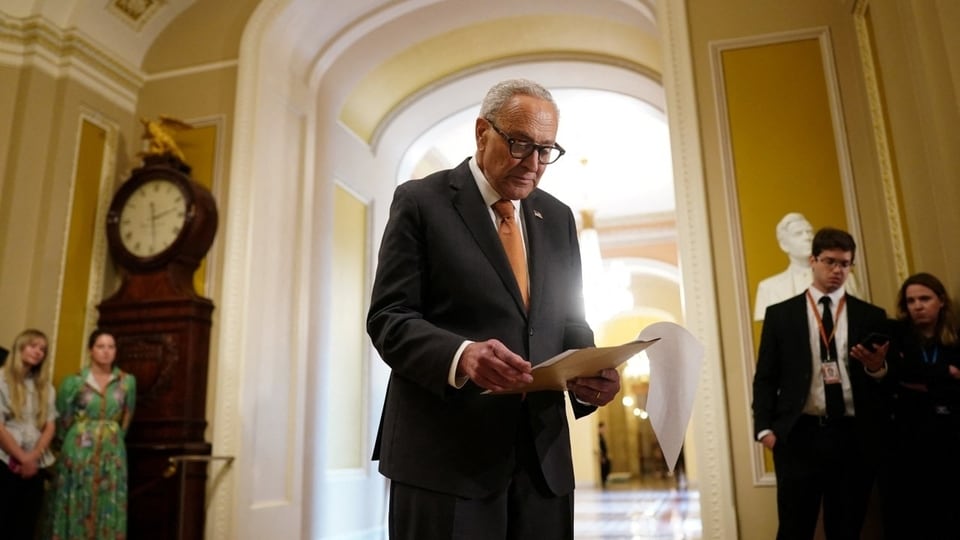
“We have a very good chance to take the majority back,” said Senate Minority Leader Chuck Schumer (D., N.Y.). He said Democrats had “expanded the map and have the strongest map we’ve had in years where many states that are purple or even red are now poised to go into the Democratic column.”
Still, the developments in Maine and Michigan have added some uncertainty to Democrats’ plans. A loss in Maine by replacement candidate Troy Jackson against GOP Sen. Susan Collins, long an elusive target for Democrats, would represent another missed opportunity in a state that then-Vice President Kamala Harris carried by seven points in 2024. If Democrat Abdul El-Sayed loses the race for the Senate seat in Michigan, it would force the party to flip multiple seats in Donald Trump country.
“Michigan is clearly the No. 1 pickup for Republicans, and that would really throw a wrench into Democrats’ math,” said Jessica Taylor, a Senate analyst for the Cook Political Report.
Republicans hold a 53-47 majority in the Senate, meaning Democrats must gain a net pickup of four seats to win back power during President Trump’s final two years in office. The president’s party typically suffers losses in midterm elections, and Republicans concede their candidates are facing a difficult environment, marked by high fuel prices, the war with Iran and Trump’s poor approval ratings. Prediction markets see the odds for control as about even.
Surveys show Democratic voters are more enthusiastic about voting in the midterms than Republicans. GOP candidates won’t have the benefit of Trump generating higher turnout among infrequent voters when he leads the ticket. And party insiders wonder how Trump might deploy roughly $400 million in his MAGA Inc. super PAC.
“We’ve got political headwinds at us, there’s no question about it, some frankly economic headwinds too that we’re facing,” Senate Majority Leader John Thune (R., S.D.) recently told reporters in South Dakota. “So it’s not going to be an easy cycle. But we’ve got really high-quality candidates. They will be well-resourced.”
In a sign of how the election could be tilting Democrats’ way, the Cook Political Report shifted the Senate campaigns in Texas and Iowa into the “tossup” column last week after listing them as “lean Republican.”
Republicans have blamed former President Joe Biden for entrenching high inflation while he was in office, and have warned that Democrats are beholden to far-left policies and the emergence of socialist lawmakers. Democrats want to make the campaign a referendum on Trump, pointing to his inability to rein in the cost of living, the Iran war and allegations of corruption.
Trump remains broadly unpopular. A Pew Research poll last month showed his approval rating at 34%—and the nation has been grappling with six months of war with Iran, which has driven up prices for gasoline, fertilizer and diesel fuel used by truck drivers and farmers who live in many of the Senate battlegrounds.
Trump defeated Harris in four Republican-leaning states prized by Democrats—Iowa, Ohio, Alaska and Texas—with at least 54.5% of the vote. Democrats said they were encouraged by Senate nominee Mary Peltola’s performance in last week’s Alaska open primary, finishing several points ahead of Republican incumbent Sen. Dan Sullivan. They will meet again in the fall.
Republicans have grown increasingly worried about Georgia, where Democratic Sen. Jon Ossoff entered the campaign cycle as one of the most vulnerable Democrats but has dominated Republican Rep. Mike Collins in fundraising and opinion polls.
In North Carolina, polls have shown former Democratic Gov. Roy Cooper with an edge over Michael Whatley, a former Republican National Committee chairman and Trump ally, in the race to succeed retiring GOP Sen. Thom Tillis.
GOP strategists, however, hope to counterpunch in New Hampshire, where Democratic Sen. Jeanne Shaheen is stepping down. Former Sen. John E. Sununu (R., N.H.) is the leading contender in the Sept. 8 GOP primary to face Rep. Chris Pappas (D., N.H.), the likely Democratic candidate.
Much of the fall campaign might hinge on the outcome in Maine. Democrats view the state as a top target, and party strategists contend they are in a stronger position with Jackson, the former state Senate president, as their nominee after an unusual July convention replaced Graham Platner on the ballot.
Recent polling has shown Jackson, a fifth-generation Mainer with deep union ties, with a slight lead. But Republicans often note that polling in previous Senate campaigns has underestimated Collins’s support. First elected in 1996, Collins has emphasized her clout as chair of the Senate Appropriations Committee, pointing to ways her position has helped local communities.
Republicans had planned to make Platner’s personal story, which included allegations of sexual assault and sexually explicit text messages, a focus of the campaign. He denied the assault allegations. They now plan to mine the voting record of Jackson, a longtime legislator.
“Jackson is a candidate who has all of the baggage of Graham Platner and none of the charisma,” said Alex Latcham, executive director of the Senate Leadership Fund, the leading GOP super PAC supporting Senate Republicans.
Schumer, whose initial pick for the Maine Senate race had been swamped by grassroots enthusiasm for Platner, saw his exit as a blessing.
“The only way Collins could win was by making the opponent the issue as opposed to her. And with Platner, there were many ways she could do that,” Schumer said. But Jackson “is so Maine, and so part of the fabric of the country, being a logger, coming from the North Country, being a union guy, she can’t do that.”
Republicans, meanwhile, view Michigan as a prime pickup opportunity, and intend to spend heavily to defeat El-Sayed, a progressive former public-health official, against former Rep. Mike Rogers, who served as House Intelligence chairman.
They intend to use the coming Sept. 11 anniversary to elevate antiterrorism policies and point to El-Sayed’s association with Hasan Piker, an influential online commentator who said that America “deserved 9/11,” according to people familiar with the plans. El-Sayed has called it a “dumb statement.”
Schumer and Democratic groups unsuccessfully threw their support behind Rep. Haley Stevens in the primary against El-Sayed, viewing her as the more electable candidate. But now, Schumer backs the nominee and predicted victory.
“We are really in very good shape,” Schumer said. El-Sayed “has brought in lots of new energy, new people into the party and a view that he can really get some good things done.”
Write to Ken Thomas at ken.thomas@wsj.com and Siobhan Hughes at Siobhan.hughes@wsj.com