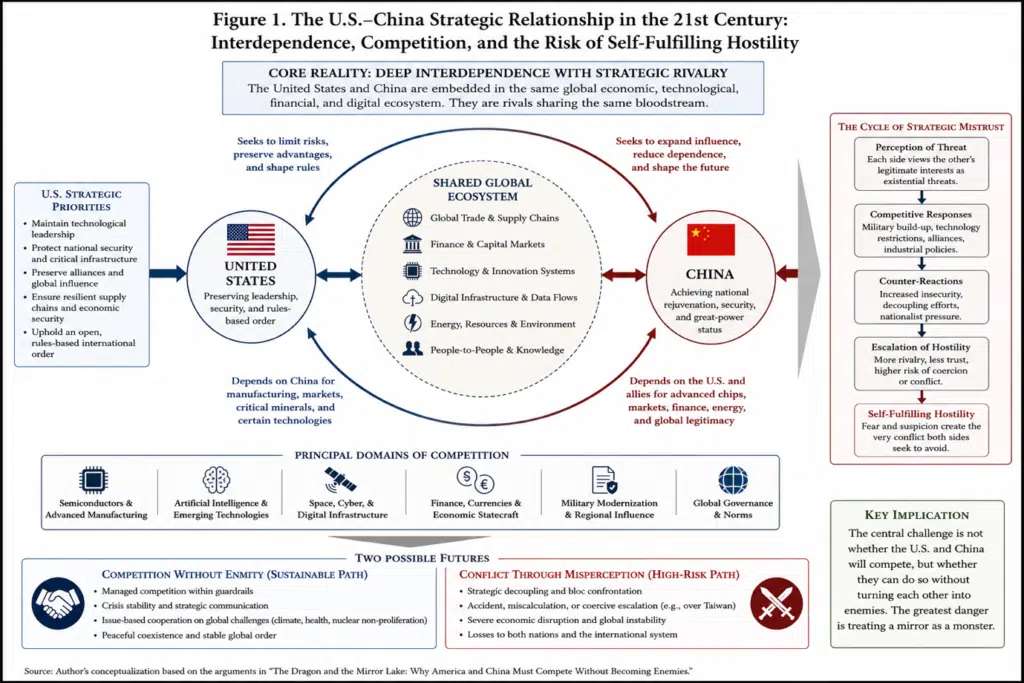
Modern geopolitics increasingly operates through perception rather than direct confrontation. During the Cold War, rival powers were separated by clearer ideological and economic boundaries.
Today, however, the US and China remain deeply interconnected through trade, finance, supply chains and advanced technology even as strategic competition intensifies. Some US policymakers argue that decades of engagement with China strengthened Beijing economically and technologically while failing to produce meaningful political liberalization. From this perspective, America’s openness inadvertently accelerated the rise of a strategic competitor now seeking to challenge US influence in Asia and reshape elements of the international order.
Danger lies not only in China’s growing power but also in the risk that both nations begin to interpret actions through the assumption of inevitable conflict. Rising tensions over semiconductors, artificial intelligence, industrial policy and Taiwan increasingly reinforce mutual suspicion. Republicans often emphasize the need for deterrence, military readiness and economic resilience to prevent strategic dependence on China, particularly in critical technologies and supply chains.
Yet history also demonstrates that great-power conflicts can emerge when fear hardens into permanent hostility, and policymakers lose the ability to distinguish genuine threats from reflections of their own anxieties. The challenge for the 21st century is therefore not simply to contain China, but to compete from a position of strength without allowing rivalry to evolve into irreversible confrontation.
The lake that reflected a monster
In an old Chinese story associated with the philosophical tradition of the Zhuangzi (an ancient Chinese text named for its author, the philosopher Zhuang Zhou), a dragon descended from the mountains during a season of drought in search of water. After days of wandering through burned forests and dry valleys, it finally found a still and perfectly clear lake hidden among the rocks. When the dragon leaned forward to drink, however, it suddenly froze in anger. Beneath the surface of the water was another dragon staring upward with equal hostility, its eyes burning with challenge and suspicion.
The dragon roared. The reflection roared back. The dragon struck the lake with its claws, shattering the surface into chaos. Only after the water settled again did the dragon realize that the enemy beneath the water had never existed at all. The monster it feared was its own reflection.
Great powers throughout history have often behaved this way. They mistake structural anxiety for existential threat, mirrors for enemies and competition for destiny. The tragedy is that once fear becomes institutionalized, states can amplify hostility until manageable rivalry grows out of control.
The modern relationship between the US and China increasingly resembles the dragon and the lake. Washington sees Beijing as an authoritarian challenger seeking to overturn the international order; Beijing sees Washington as a declining hegemon attempting to suppress China’s natural rise.
Understanding an adversary’s strategic logic does not require morally flattening political systems or pretending all exercises of power are equivalent. Liberal societies and authoritarian states organize authority, dissent, surveillance and individual liberty according to profoundly different principles, and these distinctions shape how each side interprets security, legitimacy and order. Both narratives contain elements of truth, yet both are incomplete in ways that make the relationship far more dangerous than either side fully understands.
Yet not all fear is illusion. Strategic competition between the US and China is not merely the product of misunderstanding or psychological projection. Liberal democratic systems and centralized authoritarian systems often produce fundamentally different relationships between the state, the individual, information, markets and political power itself. These differences generate genuine strategic tensions even in the absence of deliberate hostility. The danger is allowing rivalry to harden into civilizational fatalism.
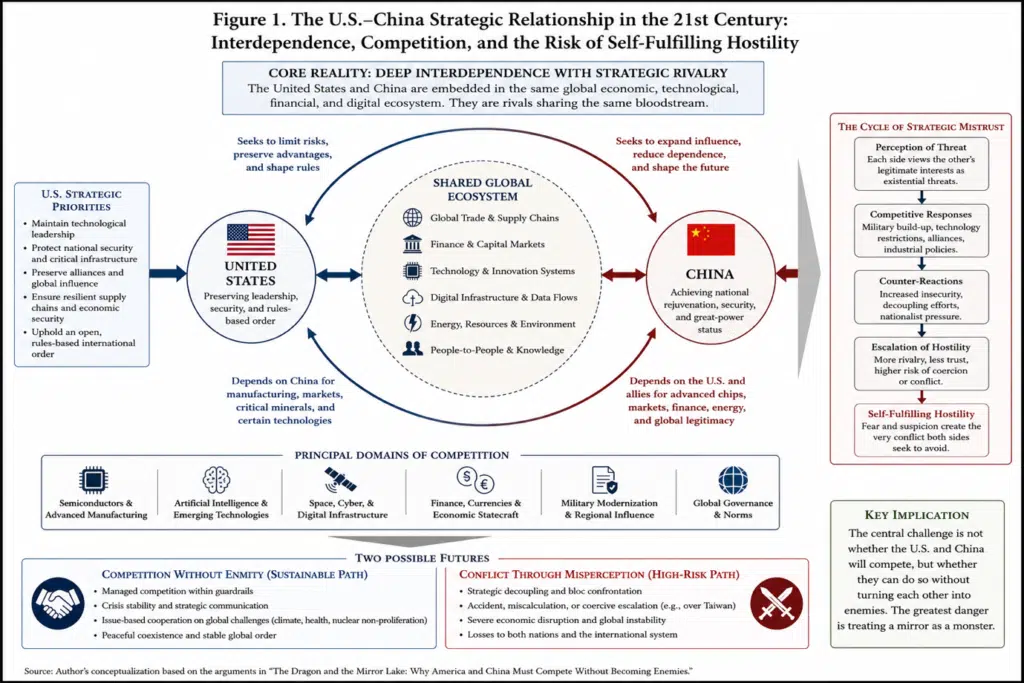
The most important reality is that the 21st century has fundamentally transformed the structure of rivalry itself. America and China are not two isolated empires confronting each other from opposite sides of the world. They exist inside the same financial, technological, industrial and digital ecosystem. They are rivals sharing the same bloodstream.
The end of classical geopolitics
Much contemporary analysis of US–China relations still relies on 20th-century frameworks. Some analysts compare the situation to the Cold War, while others invoke the “Thucydides Trap,” arguing that war becomes likely whenever a rising power threatens an established hegemon. These frameworks are intellectually attractive because they simplify complexity into familiar historical patterns. Unfortunately, they also risk blinding policymakers to how profoundly the structure of global power has changed.
The ancient rivalry between Athens and Sparta unfolded in a world where economies were largely territorial. The Cold War operated through two largely separate economic systems. Even Britain and Germany before World War I remained significantly less integrated than today’s globalized networks. The US and China, however, are embedded within one another’s economic existence in ways unprecedented in human history.
American consumers depend upon Chinese manufacturing capacity. Chinese growth depends upon access to global markets and dollar liquidity. American technology companies rely on supply chains that extend through Taiwan, South Korea, Japan, Southeast Asia and mainland China. Chinese industrial systems depend on global semiconductor architecture and Western financial systems, even as they attempt to reduce those dependencies.
This creates an extraordinary paradox. The more integrated the two powers become, the more vulnerable they become to one another’s leverage. Economic interdependence does not eliminate rivalry. Instead, it transforms rivalry into something infrastructural and systemic rather than purely military.
Globalization did not abolish geopolitics. It digitized it.
The new battlefield
In previous centuries, power was measured primarily through territory, industrial output and military force. Today, power increasingly emerges from control over systems that connect the global economy. The battlefield of the 21st century is therefore not limited to aircraft carriers and missile systems. It extends into semiconductors, artificial intelligence, satellite networks, reserve currencies, cloud computing infrastructure, energy grids, rare earth processing, payment systems and digital standards.
This transformation explains why contemporary tensions between Washington and Beijing increasingly center on technology rather than ideology alone. Artificial intelligence, semiconductor fabrication, quantum computing, telecommunications infrastructure and advanced manufacturing have become the strategic high ground of the modern age. Whoever controls these systems may shape not only economic productivity but also military capability, financial influence, surveillance architecture and even political legitimacy itself.
China understands this clearly. President Xi Jinping’s industrial strategy is no longer simply about economic development. It is about reducing strategic vulnerability while increasing systemic leverage. Beijing seeks technological self-sufficiency not because it rejects globalization entirely, but because it no longer trusts globalization to remain politically neutral.
Washington, meanwhile, increasingly interprets technological dependence on China as a national security risk. Semiconductor restrictions, export controls, sanctions and industrial subsidies are all symptoms of the same realization: Economic integration has become a source of geopolitical exposure.
The result is a strange historical condition in which globalization continues to deepen even as trust collapses. Nations remain economically intertwined while psychologically preparing for confrontation. The system becomes more connected and more fragmented simultaneously.
Taiwan and the geography of intelligence
No issue illustrates this transformation more clearly than Taiwan. For decades, Taiwan was treated primarily as a geopolitical flashpoint involving sovereignty, democracy and military deterrence. While those factors remain important, Taiwan has acquired a far greater significance in recent years because it occupies the center of the global semiconductor ecosystem.
Taiwan Semiconductor Manufacturing Company, or TSMC, produces the overwhelming majority of the world’s most advanced semiconductors. Yet the true importance of Taiwan extends far beyond fabrication alone. The island dominates critical ecosystems surrounding advanced chip packaging, testing, memory integration, and manufacturing optimization that are essential for artificial intelligence systems.
Artificial intelligence is often discussed as though it were abstract software existing somewhere in cyberspace. In reality, AI is deeply physical. It depends upon fabs, server farms, cooling systems, lithography chains, energy infrastructure and highly specialized manufacturing ecosystems accumulated over decades. Taiwan, therefore, functions not merely as an island but as the industrial nervous system of the emerging AI economy.
This reality changes the strategic meaning of Taiwan for both China and the US. For Beijing, Taiwan is no longer only about historical reunification or national dignity. Control over Taiwan would provide enormous influence over the infrastructure underpinning the future intelligence economy. For Washington, Taiwan is no longer merely about democratic solidarity or alliance credibility. It is increasingly tied to America’s technological leadership itself.
The danger is that both narratives are simultaneously rational. This makes compromise psychologically and politically difficult because each side increasingly interprets Taiwan not as a negotiable issue but as structurally essential to its long-term security.
Strategic ambiguity begins to erode
For decades, the Taiwan issue remained relatively stable because the US maintained a carefully engineered policy of strategic ambiguity. Washington neither formally supported Taiwanese independence nor accepted Beijing’s timetable for reunification. Ambiguity itself became the stabilizing mechanism because all parties remained uncertain about the precise limits of American intervention.
The framework established through the “strategic ambiguity” of the One China Policy, artfully crafted by former US Secretary of State Henry Kissinger more than four decades ago and later defended by realist statesmen such as James A. Baker III, was never intended to produce a final resolution to the Taiwan issue. Rather, its purpose was to preserve stability through calibrated uncertainty, allowing Washington sufficient flexibility to deter conflict while avoiding direct confrontation with Beijing over its most sensitive national question.
The essence of the policy rested on ambiguity: Beijing could not be certain the US would intervene militarily, while Taipei could not be certain Washington would support a unilateral declaration of independence. Stability, therefore, emerged not from clarity, but from carefully managed uncertainty.
Kissinger understood that Taiwan represented the central obstacle to normalization between Washington and Beijing during the Cold War realignment of the 1970s. The diplomatic architecture established through the Shanghai Communiqué (a document issued by the US and China on February 27, 1972, outlining steps to improve relations and address mutual concerns) and later reinforced by the Taiwan Relations Act (which allowed the US to continue economic, cultural and security relations with Taiwan) created a deliberately flexible structure capable of adapting to changing geopolitical realities without forcing either side into immediate confrontation.
Policymakers such as Baker later defended this approach because they recognized that abandoning strategic ambiguity in favor of ideological rigidity or “strategic clarity” could transform manageable competition into catastrophic great-power conflict. As tensions surrounding semiconductors, artificial intelligence and Taiwan intensify, the erosion of this carefully balanced architecture risks undermining one of the most successful mechanisms of geopolitical crisis management in modern diplomatic history.
Today, this architecture is weakening. Chinese military pressure around Taiwan continues to intensify. Taiwanese identity grows increasingly distinct from that of mainland China. American congressional politics increasingly encourages symbolic gestures in support of Taiwan. Domestic politics in all three societies now push toward harder positions rather than strategic restraint.
US President Donald Trump’s supporters often praise his unpredictability as strategic brilliance, while critics condemn it as recklessness. Both interpretations miss something important. Trump does not think about geopolitics through the traditional framework of American grand strategy: He approaches foreign affairs transactionally, not historically. However, it would be unwise to underestimate his political instincts. He appears adept at navigating and exploiting moments of strategic ambiguity.
Xi thinks in terms of civilizational continuity, national rejuvenation and historical destiny. Trump thinks in terms of leverage, bargaining and immediate tactical advantage. This asymmetry in strategic psychology creates enormous risks because each side increasingly misunderstands how the other interprets signals, commitments and ambiguity itself.
The most dangerous conflicts in history often emerge not from deliberate aggression but from incompatible assumptions about how the other side thinks.
Deterrence and restraint
Yet strategic misunderstanding alone does not explain geopolitical stability. A durable equilibrium between great powers also depends upon credible deterrence. Competition without sufficient military, technological and economic strength can invite opportunistic coercion, particularly when rival states believe the balance of power is shifting in their favor.
At the same time, deterrence without diplomatic restraint can accelerate escalation by convincing both sides that delay increases vulnerability. Sustainable stability, therefore, requires a delicate balance between capability and restraint: enough power to discourage aggression, yet enough strategic discipline to prevent rivalry from becoming existential.
The original architecture of strategic ambiguity surrounding Taiwan functioned precisely because it balanced these forces simultaneously. Ambiguity deterred unilateral escalation while preserving uncertainty regarding the thresholds of conflict. Stability emerged not through trust, but through calibrated restraint reinforced by credible power.
China’s industrial civilization
Western analysis frequently underestimates the scale and coherence of China’s industrial strategy because it still assumes Beijing operates within the logic of traditional market economics. In reality, Xi has transformed Chinese industrial policy into something historically unique. It is no longer limited to selected strategic sectors. It increasingly resembles an attempt to engineer an entire civilization-scale production system.
China now targets advanced semiconductors, artificial intelligence, electric vehicles, batteries, drones, quantum systems, renewable energy, biotechnology, telecommunications, advanced chemicals, robotic, and even mature manufacturing industries simultaneously. The objective is not simply growth. It is resilience, technological sovereignty and systemic leverage.
This creates enormous tension with free-market economies. Western firms operate under pressure for profitability and shareholder returns. China, by contrast, can tolerate industrial overcapacity and prolonged financial losses if they generate long-term strategic dominance.
Chinese solar manufacturers, for example, often destroy industry profitability globally while simultaneously increasing China’s market share and geopolitical leverage.
This explains why many traditional Western economic assumptions increasingly fail when confronting China. Market efficiency and strategic resilience are not always compatible objectives. Beijing prioritizes resilience even when efficiency suffers, while free-market democracies often prioritize efficiency until strategic vulnerability suddenly becomes visible. From this perspective, tariffs may not be desirable from a purely economic standpoint, but they can nevertheless be understood as strategic instruments intended to reduce dependency and strengthen national resilience.
The result is a growing recognition throughout the West that decades of deep economic integration have unintentionally strengthened the geopolitical capabilities of a state operating according to fundamentally different assumptions about economics, sovereignty and political control.
Artificial intelligence and the new arms race
Artificial intelligence has accelerated these tensions dramatically because AI increasingly resembles not merely a technological innovation but the operating infrastructure of future civilization. AI systems may shape military planning, cyber operations, financial markets, scientific research, logistics, education, medicine and political surveillance simultaneously. This creates enormous strategic anxiety in both Washington and Beijing.
Yet artificial intelligence is not merely software plus semiconductors. It is electricity, cooling systems, mining capacity, logistics networks, shipping infrastructure, manufacturing ecosystems and technically skilled labor operating in parallel at a continental scale. The emerging AI competition is therefore also a competition over energy systems, industrial depth, maritime trade routes and physical supply chains.
American policymakers fear that Chinese AI systems integrated into global infrastructure could expand Beijing’s geopolitical influence. Chinese policymakers fear that US restrictions on semiconductors and AI technologies represent attempts to permanently freeze China below the technological frontier.
Meanwhile, AI investment itself increasingly resembles a speculative geopolitical mobilization. American hyperscalers are investing hundreds of billions of dollars annually into AI infrastructure, data centers and semiconductor ecosystems. Financial markets increasingly revolve around AI narratives. Taiwan’s geopolitical importance rises accordingly. Labor markets experience anxiety over automation even before large-scale displacement fully materializes.
AI, therefore, becomes simultaneously a technology, a financial bubble, a military asset and a psychological force shaping public consciousness.
The danger is not simply technological competition itself. The danger is that AI intensifies the perception that geopolitical rivalry has become existential. Once states believe technological leadership determines civilizational survival, compromise becomes difficult, and escalation becomes easier to justify.
The cat between the tiger and the bear
For middle powers such as Japan, South Korea and many Southeast Asian nations, the emerging rivalry produces a deeply uncomfortable reality. Their economies depend heavily upon China, while their security frameworks remain closely tied to the US. They increasingly resemble what one Japanese observer described as “the cat trapped between the tiger and the bear” — too economically connected to one side and too strategically dependent on the other to fully align with either power without significant risk.
Japan in particular faces a profound strategic dilemma. Tokyo depends upon American military guarantees while simultaneously remaining economically integrated with China. Japanese political culture generally prioritizes stability, predictability and institutional continuity precisely when the international environment is becoming more fragmented and improvisational.
This is precisely why inflammatory rhetoric surrounding Taiwan often proves counterproductive. Statements by politicians such as Japanese Prime Minister Sanae Takaichi may attract domestic political attention, but they contribute little to strategic stability and instead risk further complicating an already fragile regional environment. For countries like Japan, the objective should not be rhetorical escalation, but careful crisis management designed to prevent strategic competition from evolving into military conflict.
From Tokyo’s perspective, the ideal outcome is obvious. Competition between the US and China should remain confined to tariffs, industrial policy, technology restrictions and diplomatic rivalry rather than escalating into military confrontation. Yet even this hope may underestimate how deeply structural tensions have become embedded inside the international system.
It is within this broader geopolitical context that Chinese criticism of Japan’s recent security reforms must be understood. Beijing and Pyongyang increasingly characterize Tokyo’s defense modernization — including higher defense spending, expanded alliance coordination with the US and the relaxation of arms export restrictions — as evidence of a so-called “new militarism” (“新型軍国主義”). Chinese officials argue that Japan is gradually abandoning its postwar pacifist orientation and positioning itself for a more active military role in regional contingencies, particularly regarding Taiwan.
Tokyo strongly rejects this characterization. Following reports that Xi criticized Takaichi during the recent US–China summit as representing a “revival of new militarism,” Japanese Chief Cabinet Secretary Minoru Kihara reiterated that the country’s fundamental postwar security doctrine remains unchanged. He emphasized that Japan continues to adhere to the principle of exclusive self-defense, maintaining only the minimum level of military capability necessary for national defense, and rejected China’s accusations as “entirely unfounded.”
The real issue is no longer simply a bilateral dispute between Washington and Beijing. The deeper question concerns the future organization of the international economic and strategic order itself.
Will the world continue to operate through relatively integrated markets and shared economic rules despite growing political tensions? Or will states increasingly reorganize trade, technology, finance and supply chains around strategic security considerations and geopolitical alignment?
That is the real contest now unfolding beneath headlines about tariffs and Taiwan.
The dragon and the shattered lake
The most dangerous idea in geopolitics is inevitability. Once leaders convince themselves that conflict cannot be avoided, they begin behaving in ways that make conflict more likely. Fear becomes self-fulfilling. Suspicion hardens into doctrine. Rivalry transforms into identity.
Yet strategic paranoia is not the only danger. Strategic naïveté can also invite coercion. Stable coexistence requires neither hysteria nor passivity, but disciplined realism capable of balancing deterrence with restraint.
This is why the growing tendency in both Washington and Beijing to describe the other side as a civilizational enemy is so dangerous. China is not Nazi Germany. America is not a collapsing empire preparing for inevitable war. Both countries remain internally dynamic, adaptive, innovative and deeply interconnected with one another.
China is not America’s “possible enemy” in the traditional sense. It is something far more complicated. China is simultaneously America’s competitor, customer, supplier, technological challenger, financial counterpart, manufacturing partner and strategic rival.
The relationship is not bipolar in the Cold War sense. It is a symbiotic rivalry inside a shared system.
This distinction matters profoundly because coexistence remains not only possible but necessary. The future international order will not be decided solely through military deterrence or technological dominance. It will also depend upon whether the world’s two largest powers can learn to compete without psychologically transforming one another into existential monsters.
Donald Trump and the eagle of the coming age
In another Chinese fable, a dragon sorceress descended from the mountains during an age of storms and knelt beside a silent black lake hidden beneath the clouds. Gazing into the still water, she whispered: “Mirror upon the water’s face, who shall command the coming age?”From the depths of the lake, the reflection answered: “Dragon, your fire can shake the earth, but the eagle still commands the heavens.”
In an age of geopolitical transformation, the US seeks to preserve the financial, technological and institutional foundations of the international order. The dragon staring into the lake ultimately feared its own reflection. The tragedy of history is that great powers often recognize this only after the water has been shattered.
The decisive question of the coming century is not whether one civilization permanently triumphs over another, but whether great powers can preserve competition within limits that avoid destroying the system they both inhabit.
The US presidency remains the most powerful political office in the modern international system. Whether the eagle continues to command the skies will depend not only upon strength, but also upon wisdom, restraint and the ability to adapt before rivalry becomes catastrophe.
[Kaitlyn Diana edited this piece.]
The views expressed in this article are the author’s own and do not necessarily reflect Fair Observer’s editorial policy.