The festive period is typically a time for careful squad management in the Premier League.
Games come even thicker and even faster than during the regular domestic churn, with managers and head coaches acutely aware of their players’ fitness levels before they kick things into the second half of the season.
Notwithstanding those who suffer a spate of injuries, different teams will take different approaches to squad use within a season.
Those battling relegation will often seek out consistency by naming a near-unchanged side each week as they fight to stay in the league.
Meanwhile, clubs also playing in a midweek European competition will delve deeper into their options and manage players’ minutes — delicately adding and removing individuals from the starting line-up like a game of human Jenga, desperately hoping that squad fitness does not come crashing down all at once.
Then you have the edge cases.
This season, that applies to Crystal Palace, with Oliver Glasner preferring to retain a settled side despite fighting on multiple fronts — so much so that their Carabao Cup quarter-final against Arsenal has had to be postponed until next week due to their participation in the Conference League.
Under the pressure of two games within 48 hours tonight (Thursday) and Saturday, Glasner might be forced to play an entirely different starting XI in this evening’s European tie with Finnish side KuPS.
The Austrian does not have the depth of squad he might like, considering Palace are competing in four competitions (potentially five with the FA Cup coming early next month too), but he might be forced into greater rotation. Losing wing-back Daniel Munoz and midfielder Daichi Kamada to injury at the same time will be a big blow to their attacking approach. Ismaila Sarr’s imminent participation in the Africa Cup of Nations could keep him away from club football until the end of January, too.
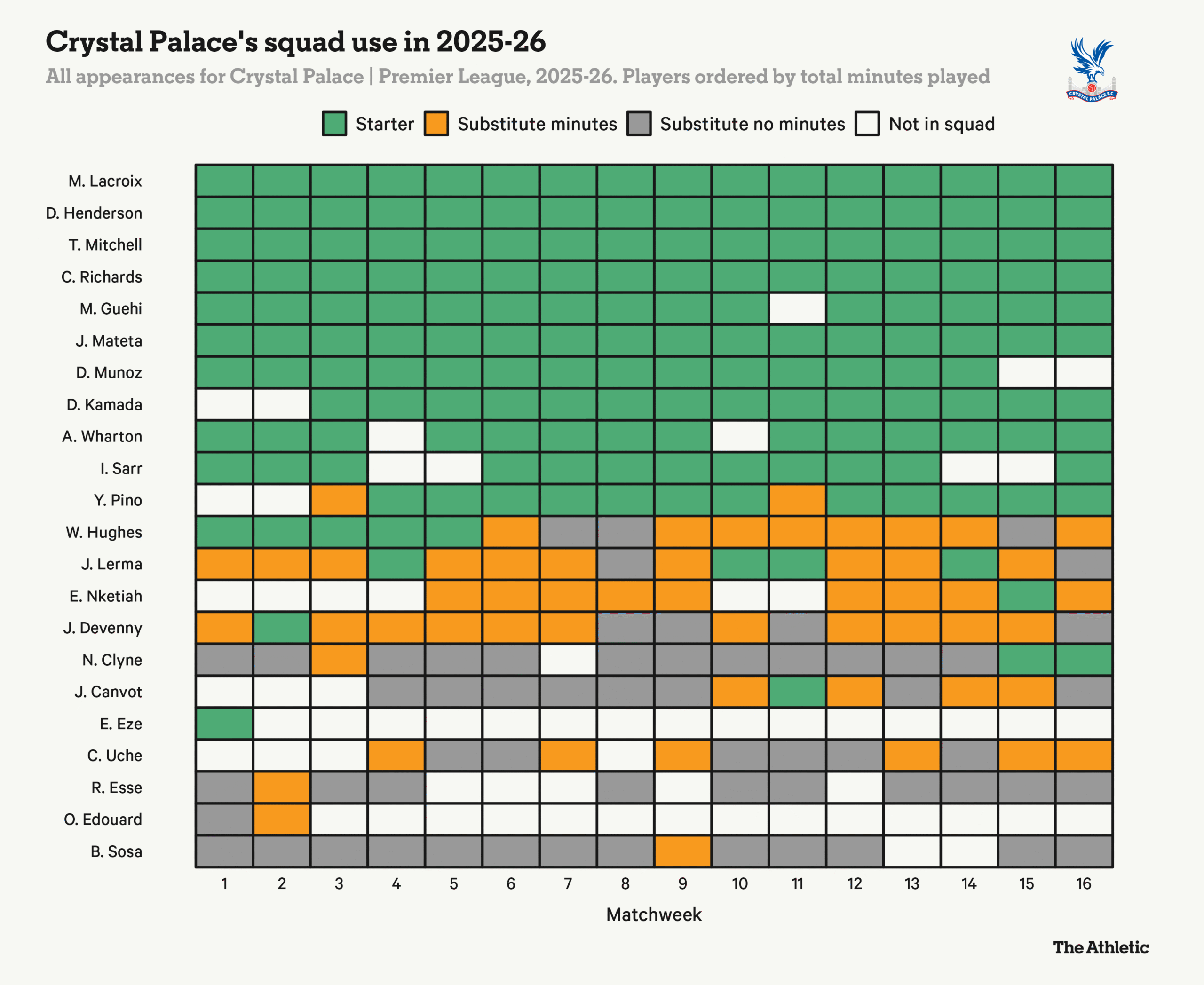
Looking at Glasner’s squad use in the Premier League this season — including starting and substitute minutes — we can see just how often he has called upon the same core group of 15 players.
No Premier League side have made fewer changes to their starting XI than Palace’s 15, with Will Hughes, Jefferson Lerma, Eddie Nketiah and Justin Devenny as Glasner’s trusted lieutenants to come off the bench and make an impact.
Note that those substitutes don’t hoover up a ton of playing time, though. When taking into account all of the substitutions Glasner makes in a match, the average time they are made is in the 76th minute — the latest in the Premier League. With just five per cent of available minutes played by Palace’s subs, no bench is kept warmer than the home one at Selhurst Park.
Quantifying this consistency in squad minutes across the league is where things can get fun.
Based on a previous analysis from The Athletic’s Ryan Best, we can create a “squad stability rating” that measures how reliably each club distribute their minutes across starting players and substitutes within a season. Put simply, a higher figure shows more of a settled side, while a lower one suggests a manager is chopping and changing his players more frequently.
Mapping this out across the Premier League shows how Palace have the most consistent use of players this season — edging out Everton, Burnley and Sunderland.

With some clubs having bigger squads than others, it is unsurprising to see that six of the lowest 10 sides in the above graphic — denoting greater squad rotation — are playing European football.
The outliers would be Wolves, who are already adrift at the bottom of the league table with two points from the first 16 games and are desperately rotating their players in an attempt to find a formula that sparks a positive performance.
The greatest variability in squad minutes is seen from Chelsea, with Enzo Maresca’s rotation policy being a carefully curated attempt to manage his side ahead of a potential 67-game season.
The Italian has called upon 25 players in the league, with no top-flight club making more than his 47 starting line-up changes. With only goalkeeper Robert Sanchez in the team for all 16 matches, a glance at Chelsea’s squad use below shows a little more… diversity in their share of minutes played.

Injuries have also played their part in that inconsistency, and Chelsea’s league-low squad stability rating (74.7 per cent) is also likely to be influenced by their disciplinary record when measuring the balance of minutes. A division-leading five red cards (including Sanchez’s fifth-minute dismissal away at Manchester United in September) in the 16 games mean Maresca has been forced into rotation more often than he would like during games, with no single player having played every league minute this season.
Add in the fact that Chelsea had a shortened pre-season after winning the Club World Cup in the United States in July, and their low stability rating can be easily understood — even if it has been called into question in recent weeks.
Comparing different teams across the league this season is one thing, but how have clubs changed their approach over time?
Glasner’s insistence on a settled side at Palace is made starker when tracking their squad stability rating for the previous five completed seasons. While 2024-25 featured a notable dip in stability after a steady rise in the prior four, this campaign has brought the most consistent squad use anywhere in the Premier League since 2018-19.

What are the reasons behind such a lack of rotation? For Glasner, the answer is remarkably simple.
“Players who are performing well, who are fit and available, they deserve to play — not just rotate and give someone a gift, that’s not the right thing,” he told reporters in November. “If I think we need six changes, we’ll make six changes. Once at (previous club) Wolfsburg, we played the same starting XI seven times in a row, and we won seven times, so why change it? Just changing to change, I don’t see any reason for it.”
Glasner’s Manchester City counterpart Pep Guardiola is typically known for his tinkering tendencies but this season has brought a notable move away from his usual rotation policy. Guardiola has named an unchanged starting XI on four occasions already. For context, that is more in 16 games than in the previous three completed seasons combined — 114 Premier League fixtures.
A trusted spine of Gianluigi Donnarumma, Ruben Dias, Nico Gonzalez and Erling Haaland has served City well for much of the season to date — with Phil Foden, Bernardo Silva, Nico O’Reilly, Josko Gvardiol and Matheus Nunes also all starting the past seven league games in an unusually settled side.
Mapping City’s squad use over time shows just how much Guardiola’s approach has shifted compared with the five previous campaigns.

Perhaps City’s manager has been scared off any further wholesale rotations after such a disappointing Champions League performance against Bayer Leverkusen in November, when he retained only one starter from City’s previous match for what turned out to be a 2-0 loss at home.
“Too many changes. I believe (with) the long seasons, games every two or three days, everyone has to be involved,” Guardiola said after the game. “Maybe it was too much, seeing the result. I think they (his selected team) played looking to not make mistakes and not to do what they have to do.”
As Guardiola would attest, there is no perfect science to squad management.
Injuries, suspensions, and player load management all go into the melting pot before a head coach or manager even thinks about individual form when naming a starting XI. And as of this weekend, the 2025 Africa Cup of Nations will see more than 30 Premier League players leave their clubs to compete in a tournament that runs until late January.
A manager will rarely have all his squad options to choose from in a given gameweek, but a consistent line-up does not always guarantee success — and the numbers back that up: a simple correlation between squad stability and points earned shows there is no statistical relationship between the two across the past five full Premier League seasons.
Player quality will always be the most important factor in a team’s fortunes. While squad rotation does ensure that you can keep your key assets available for longer, we often reverse-engineer our narrative when discussing it in the context of team performance.
A settled squad in good form get praised for having built relationships across the pitch — with networks of players understanding each other’s game and working on autopilot. An unchanged squad who are out of form can be accused of being fatigued and in need of fresh legs to inject some energy into their play.
The truth lies somewhere in between, and what works for some does not work for all.
Just two points separate Chelsea in fourth and Palace in fifth in the current table, yet their respective approaches to squad rotation could not have been more different in the season’s first five months.