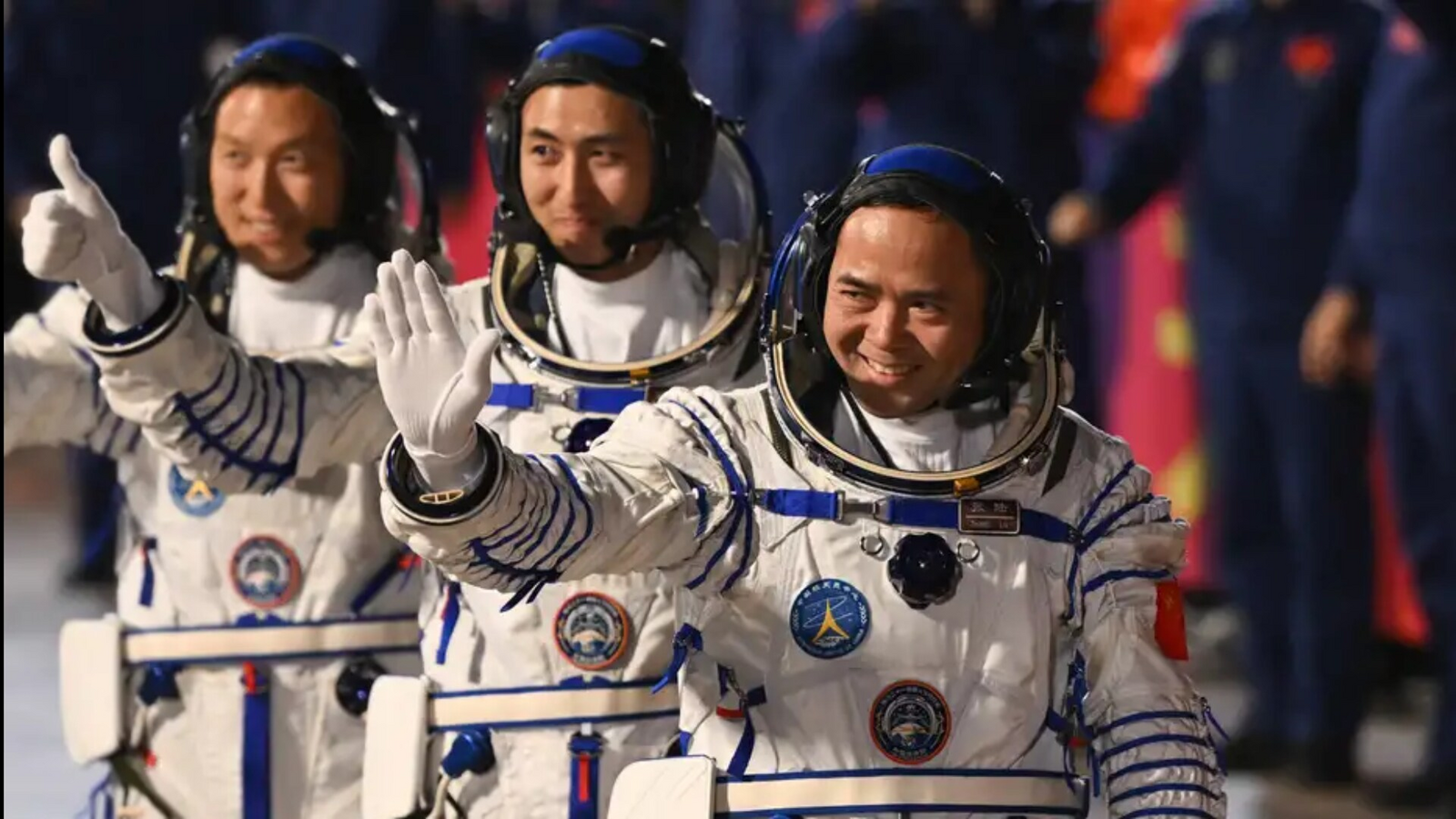
A crew of three Chinese astronauts — including the country’s youngest ever — successfully docked with the Tiangong space station early on Saturday. They were joined by an unusual group of passengers: four laboratory mice.
According to news agency AFP, the Shenzhou-21 spacecraft linked up with Tiangong at 3:22 a.m. (1922 GMT Friday), around three and a half hours after lifting off from the Jiuquan Satellite Launch Centre in northwest China aboard a Long March-2F rocket.
Beijing has made no secret of its ambition to land astronauts on the Moon by 2030 and eventually build a permanent lunar base, aiming to compete with long-established programmes run by the United States and Russia.
The Tiangong station, which houses rotating teams of three astronauts every six months, is considered the centrepiece of China’s space programme — a project that has received billions of pounds in investment.
About Tiangong space station
The Tiangong space station, also known as “Heavenly Palace”, is the crown jewel of China’s space programme.
The country has invested billions of dollars in it in an effort to catch up with the United States and Russia, following its exclusion from the International Space Station due to US national security concerns over the Chinese space programme’s direct link to the People’s Liberation Army.
Who makes up the new crew?
This latest crew includes first-time astronauts Zhang Hongzhang and Wu Fei, the latter aged just 32, making him China’s youngest astronaut to travel into space. They are led by Commander Zhang Lu, who previously served on a mission two years ago.
Why are mice part of the mission?
The four mice are part of an experiment to study how weightlessness and confinement affect animal behaviour. They were chosen from 300 candidates after more than 60 days of training, Xinhua said.
The crew will also carry out 27 scientific experiments, covering biotechnology, space medicine, and materials science.
How does this fit into the space race?
The mission comes amid renewed competition in the global space race. “Our fixed goal of China landing a person on the moon by 2030 is firm,” Zhang Jingbo, a spokesperson for the China Manned Space Agency was quoted as saying by DW.
Built entirely by China after being excluded from the International Space Station, Tiangong has cemented Beijing’s role as a major space power.
Earlier this week, SpaceX announced that it had proposed a “simplified” plan to NASA to return American astronauts to the Moon before China completes its own crewed lunar mission.
