‘Wall Street Does Indeed Mistake Debt for Creativity’
Uncategorized
‘Wall Street Does Indeed Mistake Debt for Creativity’
08 mins
The investor who predicted the 2008 housing crash had been quietly building a case for GameStop (GME). Then GameStop went and made the boldest move of its post-meme era.
And just like that, Michael Burry walked away.
More News from Barchart
On May 5, 2026, Burry revealed in a Substack post that he had sold every share of his GameStop position. The trigger? GameStop’s stunning, unsolicited $55.5 billion bid to acquire eBay (EBAY).
“Wall Street does indeed mistake debt for creativity, and does so constantly,” Burry wrote in his post. “I of all people should have known.”
www.barchart.com
Why Burry Was Bullish on GameStop in the First Place
To understand the selloff, you first need to understand the bet.
In January 2026, Burry publicly disclosed he had been buying GameStop shares, calling it a long-term value play.
His thesis, which he dubbed the “Instant Berkshire” idea, was simple on the surface. He believed GameStop CEO Ryan Cohen could use the company’s massive cash pile to acquire real, growing businesses and transform GameStop into something resembling Berkshire Hathaway (BRK.A) (BRK.B) the holding company run by Warren Buffett.
“I believe in Ryan, I like the setup, the governance, the strategy as I see it,” Burry wrote at the time.
It was not a bet on meme stock speculation. Burry made it clear that he was betting on Cohen’s capital allocation instincts.
GameStop had earned that credibility.
Under Cohen’s leadership since January 2021, the company swung from a $381 million net loss to $418 million in net income as of fiscal 2025.
Selling, general, and administrative expenses fell by roughly $800 million, or 47%, over the same period.
The company also raised $4.2 billion in long-term debt at a 0% coupon rate, an almost unheard-of borrowing cost, leaving it with roughly $9.4 billion in cash as of January 2026.
Cohen’s compensation structure reinforced that confidence. He takes no salary, no cash bonuses, and no guaranteed stock. His entire pay package is performance-based, tied to hitting $100 billion in market capitalization and $10 billion in cumulative EBITDA (earnings before interest, taxes, depreciation, and amortization).
That kind of alignment matters to a value investor like Burry.
The eBay Bid That Changed Everything
On May 3, 2026, GameStop submitted a non-binding proposal to acquire 100% of eBay at $125 per share in cash and stock, according to a company statement. The offer placed eBay’s aggregate equity value at roughly $55.5 billion. That is a 46% premium to eBay’s unaffected closing price on Feb. 4, 2026, the day GameStop began building its position in the e-commerce platform.
The deal structure calls for a 50-50 split between cash and GME stock, with shareholders having election rights over which form of consideration they receive.
GameStop said it secured a highly confident letter from TD Securities for up to $20 billion in financing.
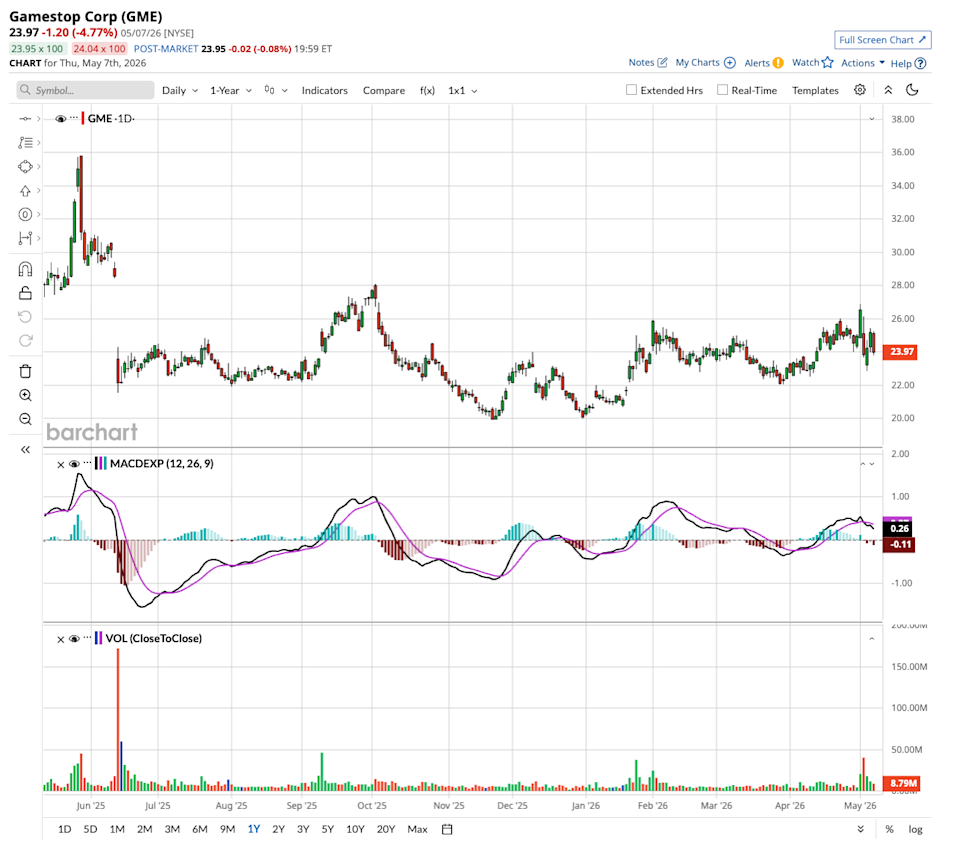
There is one glaring problem: GameStop’s own market cap sits below $12 billion. The math between what it has and what it would owe is stark.
GameStop shares fell about 10% the Monday of the announcement, reflecting investor skepticism around how this deal could realistically be funded.
Cohen addressed some of those concerns in a CNBC interview that same day but directed most questions back to the company’s published materials rather than laying out a clear financing path. He did indicate that GameStop has the flexibility to issue new equity.
Burry’s Verdict: Too Much Debt, Too Little Sense
Burry’s concern is about leverage. He said the more likely outcome of this deal, at the proposed valuation, would push GameStop’s debt to roughly 7.7 times EBITDA. That is a level he described as bordering on distressed.
Burry said that no amount of cost-cutting would change the fundamental problem. GameStop has outlined roughly $2 billion in annualized cost reductions across the combined company, including about $1.2 billion in sales and marketing and $500 million in general and administrative expenses. On paper, that would lift eBay’s diluted earnings per share from $4.26 to $7.79 in year one.
But Burry was unmoved. He also pushed back on the idea that a combined GameStop-eBay could compete with Amazon (AMZN), which he noted has “been investing in itself at a breakneck pace for decades.”
The bottom line for Burry was simple. His “Instant Berkshire” thesis was never built for this level of indebtedness. When the deal crossed that line, he sold.
“GME is the first sale since I started this Substack,” he wrote.
On the date of publication, Aditya Raghunath did not have (either directly or indirectly) positions in any of the securities mentioned in this article. All information and data in this article is solely for informational purposes. This article was originally published on Barchart.com