What lessons did the agency learn from developing its latest tech tool?
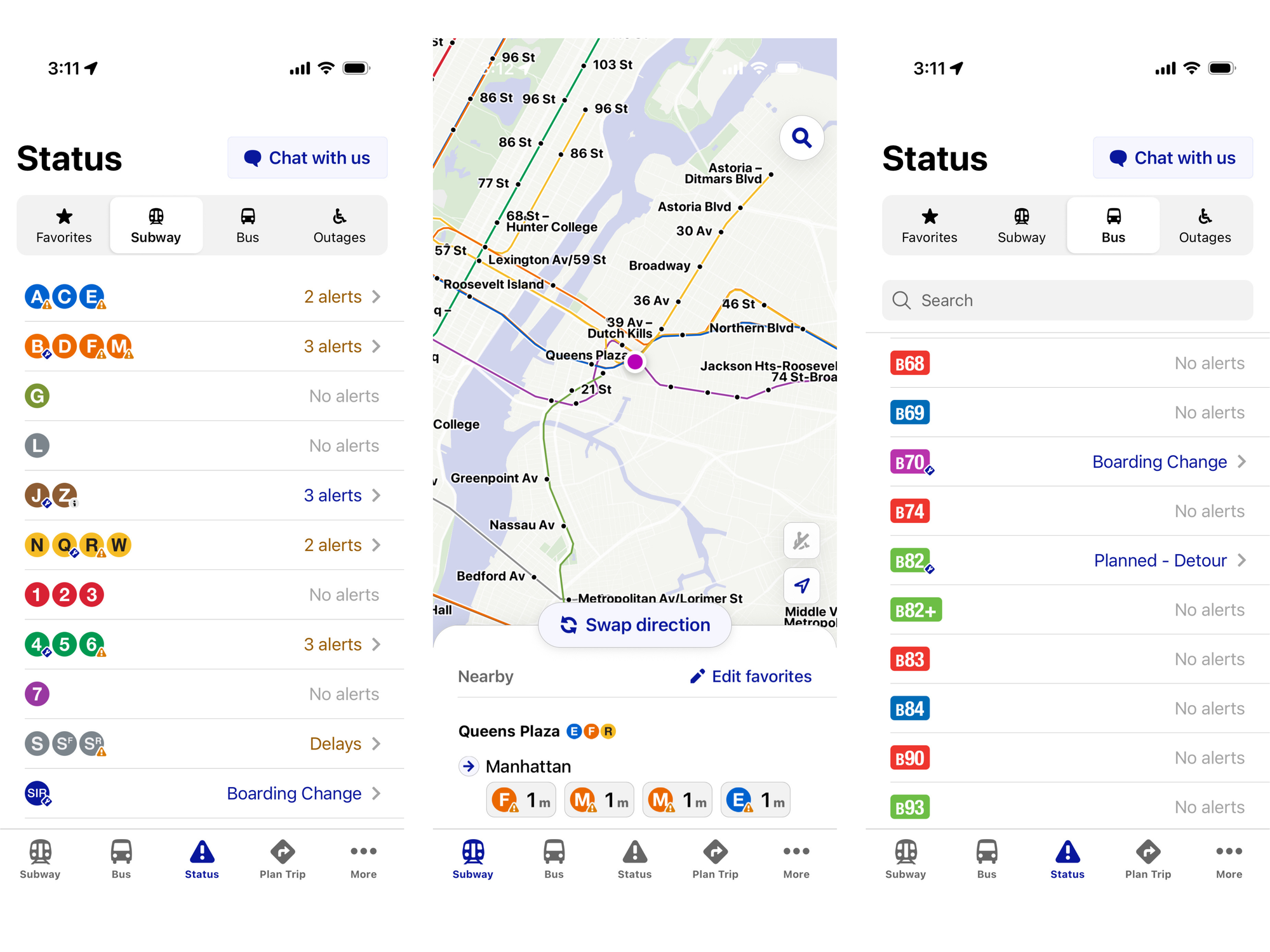
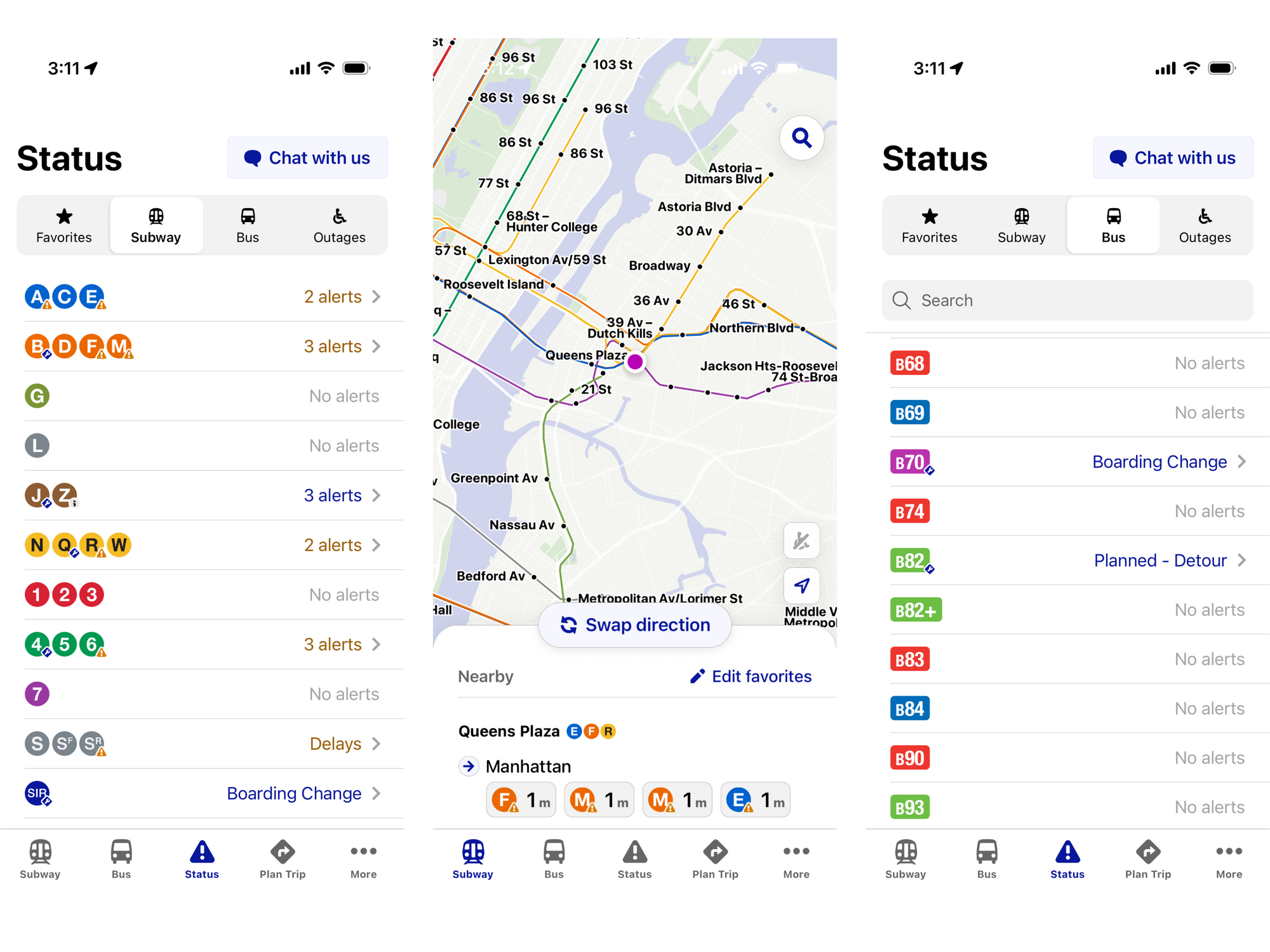
Last month, the state-controlled Metropolitan Transportation Authority released its new map and schedule app for subways and buses. In contrast to many public-sector attempts to build tech tools, the elegantly named MTA App is fast and simple, enabling a user to learn when a subway or bus near her is coming on the first screen she sees, rather than forcing her to tap multiple times. The MTA App is easily on par now with — or even superior to — the tech-industry competition.
What went right? It’s a question we should ask more often, because we never forget to ask what went wrong when mistakes are made. Vital City sat down with three of the people behind the app: Chief Customer Officer Shanifah Rieara, Deputy Chief Customer Officer Kevin Call and Head of Product Jen Chen — to understand what the MTA App does for riders, how the agency built it with an in-house team rather than depending on outside contractors, and what the experience might signal about the future of government technology.
Nicole Gelinas: It’s been almost 14 years since the MTA announced its first Subway Time app, which covered just six numbered lines. Now the MTA is offering zero-tap information on real-time subway and bus arrivals across the whole system. What’s the first thing people will notice about this app — and why should they download it rather than just use Google or Apple Maps?
Shanifah Rieara: This is built for New York City Transit by transit riders, and that’s what we want to convey. The zero-tap feature gives you a countdown clock in your pocket. It works in low-connectivity environments, which matters as we’re still wiring up the system. You get real-time bus tracking, transfer options, key service alerts, a 24/7 customer service chat — and more is coming.
Gelinas: What’s the one thing people really wanted that you were able to deliver?
Kevin Call: Speed. It was the biggest drawback of the predecessor — the information was there, but you’d have to sit and wait for it to load. This is New York. Seconds matter, especially if you’re on a local trying to decide whether to get off and wait for an express. This app is optimized to work in low-data environments, so it loads fast. The other major apps are primarily driving apps with some transit added on. We can offer something incredibly customized to the experience of riding the subway and bus.
Gelinas: How are you getting the word out?
Rieara: We’re taking a two-pronged approach. Everyone who had the previous app got a push update — they didn’t have to go to the app store. To complement that, we’ve embarked on a marketing campaign using our 10,000 digital screens across the system, along with social media and rolling outreach. The rollout a couple of weeks ago generated a lot of positive reaction and news coverage. We want to build on that.
Gelinas: Let’s talk about the decision to build in-house. Back in 2012, the MTA signed an $800,000 contract with an outside vendor to handle web development. What was the reasoning for bringing it back?
Rieara: In the past, we relied on consultants who lived in every corner of the country or the world to develop a product for us. They’d create it, and then we were left finding capacity and funding to maintain it. As part of the new MTA, we’ve done a robust job of recruiting amazing talent — Jen came to us from Google. Having that capacity in-house means we can build it, maintain it and update it. As we get feedback from customers, it gets integrated by our team. We’re not shelling out hundreds of thousands of dollars. This is a homegrown product.
Call: This generation of MTA leadership is confident that we can attract the best talent and deliver a digital experience New Yorkers deserve. Previously, the agency just wasn’t confident, so they went the consulting route. There’s nothing in place of having folks in the building who take the system, who know the quirks inside and out. As problems arise, we get into a room and hammer out a solution in real time, versus getting on the phone with a team in a different country that may never have been to New York.
Gelinas: Jen, why did you leave Google for the MTA?
Jen Chen: I wanted a job where I could have a positive impact on the community around me. I spent eight years on Google Maps — I know all about scale and launching across hundreds of countries. But the MTA gave me an opportunity to work on something for the city where I live and dive into details you don’t get at that scale. With this app, I can model West 4th Street with its upper and lower levels. I can tell you that yes, Times Square gives you a free in-system transfer to the A-C-E, but it’s a bit of a walk. These details really make or break a customer’s experience.
Gelinas: Tell us about the team. How big is it, and how did it come together?
Chen: We try to operate as a startup within the MTA and really bring what it means to build software to the transit agency. We began with a few engineers who wanted to build a better ticketing experience for the Long Island Rail Road. That project became TrainTime, which — at least for a while — was my favorite government-issued transit app. From that success, we realized we could build something in-house that’s really good and set a new standard for what it means to be a government app. Then we took on the challenge of subway and buses, which is a different level of complexity compared to the commuter railroads. We also built the digital signage you see rolling out across stations. We probably reached 20 people last year.
Call: That’s across products — the mobile apps, website and digital screens.
Chen: I think we’ve reached a good size for the products we support. And of course, as a product manager, I’m never going to say no to more people.
Gelinas: What would be the ballpark cost versus what it would have cost to contract this out?
Call: That one I might have to get back to you on. There were several vendors involved with the last app that we’ve over time sunset — some of these services have shut down or are in the process of shutting down, so it’s not easy to make an apples-to-apples comparison.
Gelinas: Does bringing it in-house bring challenges? Do you have to convince people to be paid less than they’d make at Google?
Rieara: None of us who work for a government agency will ever be rich. But we’re drawn to this because we believe in good government. We’re here to apply our skill sets and make effective change. And there’s no shortage of areas at the MTA where we can be innovative. Kevin has been instrumental in setting up text and email alerts so riders can get real-time service information — and that’s now folded into the app. This will also complement the Weekender. There are other things these talented individuals can focus on, because we have a lot of systems that are antiquated and long overdue for overhaul.
There’s also a flexibility advantage. When we procure with vendors, it’s done through the lens of a particular job scope. When we onboard talent in-house, we get people who are jacks of all trades. Kevin doesn’t come in and do one job and wrap his day up. We don’t have the luxury of operating that way — and that ends up being a strength.
Chen: I find a lot of people are excited about working for the MTA, but they don’t know how to get in. This isn’t a career track the MTA has traditionally recruited for. The people we get tend to be a bit later in their career and want to bring private-sector experience to the MTA, or a bit earlier and want to have a really big impact. There’s a real desire in tech right now to work on things that are mission-driven. It’s just not something government has been traditionally well-suited to do, and that’s what we’re trying to change.
Gelinas: Did you use AI in building the app?
Chen: We use AI development tools as standard now. But every code change has been reviewed by a human. Some of our best work is what we now call “hand-coded,” because there are things only a human eye can do. But AI makes a lot of work go faster — it can create a debug interface in minutes that would normally take a day.
Gelinas: Where does the walking-directions data come from? Do you have to buy that?
Chen: In the app, we link to Apple Maps or Google Maps for walking directions. It’s just a link to their service.
Gelinas: And they don’t charge for that?
Chen: No, because we’re sending traffic to them.
Gelinas: A kind of non-monetary trade — you own the subway and bus feeds, which are very valuable. When you do contracting, you have goals for MWBE — minority- and women-owned business enterprises. According to research from McKinsey and others, Black people are underrepresented in top tech jobs. Will there be workforce development goals for the in-house staff?
Rieara: We have a diverse team from all walks of life and different backgrounds. I’m very proud to work at an agency that every year reaches the platinum level for MWBE, with a billion dollars in spend annually. Chairman Lieber pushes every department to procure from and do business with MWBE vendors. When we recruit and onboard, all of that is factored in.
Gelinas: There are features in the app for customer safety. Would you ever consider something where a rider could drop their location and send a message — someone smoking in a subway car, for example?
Call: We already have a couple of features for that. There’s a link to the feedback form, and we also offer 24/7 live-agent customer care, where you can connect with someone and submit a report — something broken, feeling unsafe, needing assistance.
Rieara: To complement that, in every subway car, and now on buses, we have announcements — digital on screen-equipped cars, posters on others — letting customers know they can text us 24 hours a day, seven days a week, at 212-MTA-Info.
Call: And the chat team is in the real control center, sitting next to the comms desk, next to NYPD. When you contact them, you’re going direct to the source.
Gelinas: What about the physical infrastructure that underpins this? You couldn’t have the tech without the countdown clocks, which were a big achievement for a previous generation.
Call: This ties to why the CBTC signaling project is so important. The B Division currently uses a beacon system, which tracks a train as it moves through a station. When CBTC is more widely online, we’ll know train locations within a centimeter, which will make predictions even better.
Chen: We know customers really like seeing live vehicle locations on a map — it builds trust. So we increased the GPS polling rate for buses from every 30 seconds to every five seconds. You can watch the bus live as it comes down the street.
Gelinas: You’ve said you’ll integrate OMNY trip history into the app. Do you envision in-app payments eventually?
Call: Coming later this year, we’ll have trip and charge history in the app. To follow, the ability to add, edit and remove payments, and digital closed-loop OMNY cards — meaning if you have a transit benefits card that doesn’t have the RFID chip, you’ll be able to link it to a digital OMNY card and use your phone.
Gelinas: Would you ever have one app for all MTA agencies?
Rieara: That’s something we’re constantly talking about. Right now, we want to get the MTA App where it needs to be — all the functions and features our customers want, attracting riders who haven’t downloaded it yet. Then we’ll reevaluate.
Gelinas: How often do you expect to update it?
Chen: Right now, weekly, because we’re getting so much feedback and trying to iterate quickly. I don’t expect it to always be weekly — maybe every two weeks.
Gelinas: What kind of feedback have you responded to?
Chen: As we’ve scaled out our Android deployment, Android has such a diverse variety of hardware and operating systems — much more so than iOS. Scaling out has helped us see our performance on different devices and find places where we could optimize.
Gelinas: Can you support it on any phone, even one that’s very old?
Chen: That can be tricky, depending on the manufacturer’s support for operating systems. At some point, Apple and Google stop releasing security updates. It depends on our software development kits as well. But we’re aiming to support as much as we reasonably can.
Gelinas: There’s always discussion about whether the MTA should do more of its big projects in-house — mega-projects like the Second Avenue Subway extension. Have you learned any lessons from building this app that might apply?
Rieara: What we’ve shown is that we have credibility now in these spaces — in delivering something in-house. Look at the platform barriers: when there was a need and concerns around customer safety, those were done in-house by an amazing group of transit workers. There are countless examples where we have the talent to do it ourselves. Under the direction of the chairman, we’ve been doing fiscal re-baselining exercises, and we’ve set goals in annual cost savings, initially $500 million. We’re continuously looking at how to be innovative but more efficient. And when repairs or updates are needed, we don’t have to wait for an external vendor — we deploy the army of the willing that’s here.
Gelinas: The public’s experience with government tech — whether it’s federal, state or local — is often not great compared to private-sector products. Why is that, and does this app provide lessons for other government entities?
Call: In the public sector, you might have people who focus on the back end and neglect the front-end experience. In the private sector, you don’t just have a developer — you have UX resources and a designer working together. We’ve tried to replicate that here.
Chen: Part of the challenge for government agencies is attracting talent, because big tech companies and startups have a natural funnel. When we do bring people in-house, you get really passionate people who bring a level of quality you can’t get from a vendor. Government hasn’t traditionally been well-suited to do this. That’s something we’re trying to change.
Rieara: We are proud of the product we’ve launched. We’ve done this in-house, with an amazing group of talented individuals invested in New York City. Download the app if you don’t have it already, use it and give us feedback. It’s a product for New Yorkers, by New Yorkers.