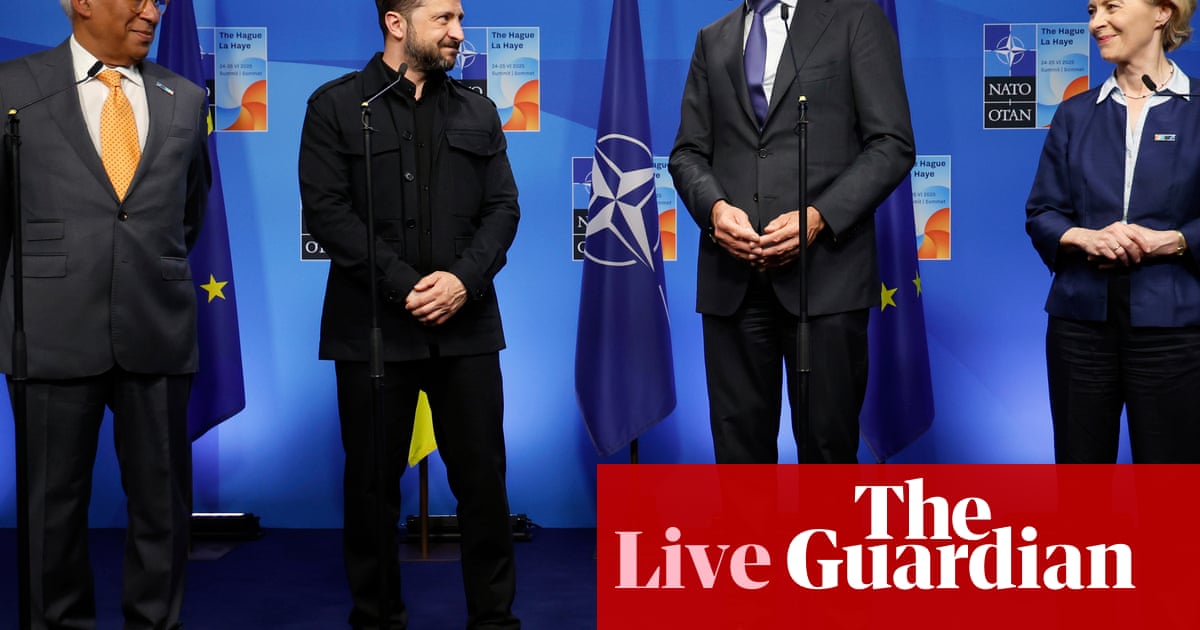
Unthinkable that Russia should be able to outproduce us, Nato’s Rutte says
Following Brekelmans, Nato secretary general Mark Rutte repeats his call about the need to push for more military investment and production.
“There is an ancient Roman saying, if you want peace, prepare for war. It’s a simple idea, make your defences so strong that no one dares to attack you. Today, NATO’s military edge is being aggressively challenged by rapidly rearming Russia, backed by Chinese technology and armed with Iranian and North Korean weapons. We need to unite, innovate and deliver and that’s exactly what this forum is all about.”
In stark words, he says:
We need to do more. We need to do it better and together, and we need to do it now.
It is simply unthinkable that Russia, with an economy 25 times smaller than Nato’s, should be able to outproduce and outgun us.
We must spend more to prevent war. We must win this new war of production. That’s what this summit is all about.
Key events
-
Nato summit expected to be triumphant for Trump and deflating for Ukraine – analysis
-
Nato members willingly increasing defence spending amid rising threat from Russia, says Rutte
-
Russia will be capable of testing our defences by 2030, EU’s von der Leyen says, calling for ‘new ways how to do things’
-
Future of Europe is written on Ukrainian frontline and in defence factories, EU’s von der Leyen says
-
Unthinkable that Russia should be able to outproduce us, Nato’s Rutte says
-
Middle East crisis ‘underscores growing instability’ facing Nato, Dutch defence minister says
-
We cannot expect to go back to calmer times soon, Merz says
-
EU should simplify regulations, push to strike trade deals, Merz says
-
Merz hails Nato summit ‘historic’ with spending rise to prepare for threats
-
Russia shows no interest in peace and should face stricter sanctions, Merz says
-
Merz signals criticism of Israel’s actions in Gaza; calls for stability in the Middle East
-
Germany, Europe need to respond to challenges, show strength and reliability, Merz says
-
Meloni says higher defence spending must benefit Italian firms
-
US Nato representative hints at Trump’s remarks on expectations for alliance, lauds his Middle East actions
-
‘Most consequential moment’ for Nato, US representative says, as he insists ‘US isn’t going anywhere’
-
Russia criticises Nato’s ‘rampant militarisation’
-
Zelenskyy plans to meet Trump on sidelines of Nato summit
-
European allies should ‘stop worrying so much’ about US, Rutte says
-
Train disruption on Nato summit day ‘could be sabotage’, Dutch minister says
-
Zelenskyy says Nato spending ramp up is ‘slow,’ warns of possible Russian attack on Nato within five years
-
Zelenskyy urges Nato to sanction companies providing components for Russian missiles
-
Morning opening: Nato summit day 1
Nato summit expected to be triumphant for Trump and deflating for Ukraine – analysis
Dan Sabbagh
Donald Trump is heading to the Nato summit in The Hague on Tuesday to perform a victory lap. After decades of complaining about European defence spending, with the help of Mark Rutte, Nato’s new secretary general, allies are ready to sign up to a target to raise, in most cases, core defence spending to 3.5% of GDP by 2035.
Barring a dramatic breakdown in that ceasefire, Trump is likely to arrive in a self-congratulatory mood, which most Nato leaders are unlikely to want to puncture at a cut-down summit, designed for leaders with short attention spans.
It will begin with a dinner hosted by the Dutch king, Willem-Alexander, on Tuesday evening, to be followed by a single working meeting on Wednesday morning with press conferences thereafter.
Concerns from earlier this year about whether Trump would reject Nato, withdraw US troops from Europe, abandon Ukraine and pursue a close relationship with Moscow have eased, though none have gone away.
Ukraine’s president, Volodymyr Zelenskyy, is invited to the dinner, but not to a working meeting with Nato leaders, reflecting the softening US support for Kyiv, where fresh military aid has been halted under Trump.
Jamie Shea, a former Nato spokesperson and deputy assistant secretary general, said the meeting would be “disappointing for Ukraine, especially as most allies would have wanted much stronger language on support, the open door for Ukraine’s Nato membership and a clearer path on sanctions against Russia”.

Damien Gayle
Damien Gayle reports on the environment for the Guardian, he writes:
Europe risks choosing militarism over social and environmental security, economists have warned, as the head of Nato said all 32 members had agreed to increase weapons spending.
Analyses drafted in anticipation of the Nato summit warned of the opportunity cost that higher military spending would pose to the continent’s climate mitigation and social programmes, which are consistently underfunded.
The alliance’s leading member, the US, and its Dutch secretary general, Mark Rutte, expect members to agree to proposals to dramatically raise defence spending targets from 2% to 5% of GDP.
But critics say the focus on military spending, which comes on top of big increases by European countries over the past few years, overlooks the risks to security posed by environmental breakdown and social decay.
“Europe’s public finance debate has never been about what we can afford, but what governments choose to prioritise,” said Sebastian Mang, senior policy officer at the New Economics Foundation (NEF).
“Having already committed to higher defence budgets, plans to raise spending even further expose the double standard applied to investment in climate, housing and care.
“If extraordinary sums can be mobilised for the military, with far lower economic returns and much lower social benefits, then the refusal to fund a just transition and stronger public services is clearly political, not economic.”
According to the Nato proposals, members would increase spending to 3.5% of GDP for “hard defence” such as tanks, bombs and other military hardware, while devoting a further 1.5% to broader security, including cyber threats and military mobility.
An analysis by NEF found the 5% GDP target would require Nato’s EU members alone to increase spending by €613bn a year – a sum considerably higher than the annual shortfall in meeting the bloc’s green and social goals, estimated at €375bn to €526bn.
The UK prime minister Keir Starmer has said Labour would “stick to our manifesto commitments” on tax while increasing defence spending to 5% of GDP.
Speaking after his arrival in the Netherlands and before attending the Nato summit, Starmer denied higher defence spending would be paid for by tax rises. “Every time we’ve set out our defence spending commitments … we set out precisely how we would pay for it, that didn’t involve tax rises,” he said.
“Clearly we’ve got commitments in our manifesto about not making tax rises on working people and we will stick to our manifesto commitments.”
Nato members willingly increasing defence spending amid rising threat from Russia, says Rutte
Mark Rutte, Nato’s secretary general, said it was “not a difficult thing” to get members to agree to raise defence spending to 5% of GDP because of the rising threat from Russia – and stressed that Trump remained “absolutely” committed to supporting the alliance.
In an interview on the eve of the western alliance’s summit, Rutte told the Guardian that all 32 members had agreed to increase defence spending because “there is so much at stake” after Moscow’s invasion of Ukraine.
Under the planned agreement, Nato members would commit to raising defence spending to 3.5% of GDP, with an additional 1.5% allocated to broader security-related investments, including cybersecurity and intelligence.
Rutte said: “The security situation has changed so much, and people know that when the call comes [in the event an attack on a Nato member] … you now need to deliver to the collective endeavour, what you promised, that you better have your stuff there.”
It is a critical moment for the alliance, with the war in Ukraine now in its fourth year after Russia’s 2022 invasion, and the risk of a worsening conflict in the Middle East despite Donald Trump’s declaration of a ceasefire between Iran and Israel.
Speaking in his home town of The Hague, Rutte, the former Dutch prime minister, described Russia as “the most significant and direct threat” to Nato, warning that Moscow could be capable of launching an attack on alliance members within three to five years.
“It’s clear that they [Russia] want to extend their territory,” Rutte said. “For a couple of years now, they’ve been reconstituting themselves rapidly.”
A senior minister in the UK government has said the British prime minister Keir Starmer is at the Nato summit and is “expected to agree a new commitment to grow spending on national security to 5% of GDP by 2035.”
McFadden says the money contains “a projected split of 3.5% on core defence spending and 1.5% on broader resilience and security spending.”
He continues by saying:
Nato’s member countries meet at a time when the security situation is more in flux than at any time in a generation, a time when Ukraine is in its fourth year of resisting Russia’s invasion, a time when we in Europe are being asked to do more secure our defence, a time when security can no longer be thought of just as the traditional realms of air, sea and land, but also of technology, of cyber, of the strength of our democratic society.
There is more detail on that in our UK politics live blog.
A White House official has confirmed to Reuters earlier posts here and here that US president Donald Trump is scheduled to meet Ukrainian president Volodymyr Zelenskyy during the Nato summit.
Russia will be capable of testing our defences by 2030, EU’s von der Leyen says, calling for ‘new ways how to do things’
EU’s von der Leyen also promises to create “conducive, right conditions” for better procurement, both within the EU, but also with candidate countries and other key partners, like the UK.
She warns:
“We know that Russia will be capable of testing our mutual defence commitments within the next five years.
By 2030 Europe must have everything it needs for credible deterrence … but this requires a new mindset for all of us.
We must be ready to leave our comfort zone. We must be ready to explore new ways how to do things, bringing together the tech and the defence, the civilian and the military in Europe, and of course, beyond the European Union.”
Future of Europe is written on Ukrainian frontline and in defence factories, EU’s von der Leyen says
European Commission president Ursula von der Leyen opens by paying tribute to the defence industry by saying “the future of Europe is being written on the frontline in Ukraine, but not only, it is also being written in your factories.”
“In record time, you have managed to open new lines and step up production.
You’re adapting to the new reality of a full scale war right here on European soil, and just like your industry, all of Europe is facing a changing international landscape.
As we’ve just heard, rightly so, the security architecture that we relied on for decades can no longer be taken for granted. It is a once in a generation tectonic shift.”
Praising amended, ramped-up defence plans and calls for on-going modernisation of the European armies and more support for dual-use projects, she declares:
“The Europe of defence has finally awakened.”
Unthinkable that Russia should be able to outproduce us, Nato’s Rutte says
Following Brekelmans, Nato secretary general Mark Rutte repeats his call about the need to push for more military investment and production.
“There is an ancient Roman saying, if you want peace, prepare for war. It’s a simple idea, make your defences so strong that no one dares to attack you. Today, NATO’s military edge is being aggressively challenged by rapidly rearming Russia, backed by Chinese technology and armed with Iranian and North Korean weapons. We need to unite, innovate and deliver and that’s exactly what this forum is all about.”
In stark words, he says:
We need to do more. We need to do it better and together, and we need to do it now.
It is simply unthinkable that Russia, with an economy 25 times smaller than Nato’s, should be able to outproduce and outgun us.
We must spend more to prevent war. We must win this new war of production. That’s what this summit is all about.
Middle East crisis ‘underscores growing instability’ facing Nato, Dutch defence minister says
Another side event, The Nato Summit Defence Industry Forum, is starting now, where we should hear some of key European leaders before the summit proper gets under way later tonight.
Dutch defence minister Ruben Brekelmans is delivering the welcome address.
He says “within the next 24 hours, we expect all 32 Nato allies to agree on the 5%” as part of “The Hague defence investment pledge.”
“This week’s events in the Middle East have only underscored the growing instability in the world and the urgent need to strengthen our defence and scale up our defence industry.”
On that earlier report that Zelenskyy was hoping to see Trump on the sidelines of the summit (11:19)…
We are now hearing from a senior source in the Ukrainian presidency that the pair are indeed expected to meet.
AFP noted that Zelensky’s top aide Andriy Yermak said he had discussed preparations for the upcoming meeting with US secretary of state Marco Rubio.
We cannot expect to go back to calmer times soon, Merz says
Closing, Merz warns that “we cannot expect the world around us to return to calmer times anytime soon,” but says it is right to prepare for this new reality.
He ends by repeating the point about “ensuring that Germany regains its strength, both internally and externally.”
EU should simplify regulations, push to strike trade deals, Merz says
On EU policy, Merz welcomes the European Commission’s push to simplify its regulations and says it is “a first step, which must be followed by many more” and baked in “a new culture of restraint in regulation.”
He also calls for simplifying EU trade policies to not expect the world to align with its regulations and standards, avoiding “years-long, gruelling” adoption processes.
He says he hopes for a swift resolution of the trade dispute with the US “by the beginning of July,” but says the EU will defend its interests.
He then moves to a domestic bit, stressing the need to kickstart growth, including by removing “the bureaucractic burden” on companies.
Merz hails Nato summit ‘historic’ with spending rise to prepare for threats
Turning to Nato, Merz says “it is no exaggeration to call this summit historic” given its importance to increasing defence spending among the members of the alliance.
He says allies are “not doing this, as some have claimed, to do the US and its president a favour,” but in recognition of genuine threats they face, primarily from Russia.
He also highlights the German plan to ramp up defence spending with the aim of making the Bundeswehr “the strongest conventional army in Europe,” ready to defend Germany and support allies.
“For far too long we in Germany have ignored the warnings of our Baltic neighbors about Russia.
We have recognised this error. There is no turning back from this realization.”
Making a point about a recent deployment of troops to Lithuania, he says:
“The security of Lithuania is also the security of Germany.”
Russia shows no interest in peace and should face stricter sanctions, Merz says
Moving on to Ukraine, Merz says that by taking advantage of the shift in global focus to the Middle East and continuing his attacks on Ukraine, Russia’s Vladimir Putin shows no genuine interest in pursuing peace.
He stresses that “a real, lasting peace requires a willingness … on all sides,” and the signals coming from Russia are showing “it is currently not ready for peace; quite the opposite.”
He urges EU allies to back the 18th sanction package to “hit the shadow fleet that Putin is using to finance his war machine,” and he says he repeatedly lobbied the US administration to follow the suit.
“I remain confident that the American government will follow this path,” he says.
Merz signals criticism of Israel’s actions in Gaza; calls for stability in the Middle East
On Israel, Merz stresses “Israel has a right to defend its existence and the security of its citizens,” and Germany will stand united with it.
But he then appears to signal his criticism of the Israeli actions in the Gaza Strip, saying he is “questioning what goal Israel is trying to achieve” there.
He calls for “human dignity” for the residents of Gaza and says the moment has come to agree a ceasefire.
On Iran, he makes it very clear that “Iran must not possess nuclear weapons,” and praises Israeli and US strikes on targets there – but adds the time is now for a ceasefire there, too.
He says “we will consult with our American and European partners” on the sidelines of the Nato summit “on how the situation can now be further stabilised.”
Germany, Europe need to respond to challenges, show strength and reliability, Merz says
Opening his speech, Merz says Germany and Europe must face a number of threats from Russia’s war of aggression against Ukraine, Hamas’s attack on Israel, and the Iranian plans to develop its nuclear weapons programme.
He says this is the new reality to which democracies need to respond, using all formats of the European Union, G7, and Nato.
He says the fact these groups are meeting three times within two weeks show both the gravity of the challenges ahead, but also “the opportunities for Germany and Europe” to shape the future.
“We need strength and reliability, both internally and externally,” he says to the applause from lawmakers.

Jakub Krupa
Meloni is not the only national leader addressing their parliament before going to The Hague.
German chancellor Friedrich Merz is speaking in the Bundestag right now.
I will bring you the key news lines here.
Meloni says higher defence spending must benefit Italian firms
Meanwhile, Italian prime minister Giorgia Meloni told the Italian parliament that if the country spends more on defence to meet its international commitments, the extra outlays should benefit Italian companies rather than foreign ones.
Her comments come just before the Nato summit in The Hague, where leaders are expected to agree to the increased 5% GDP spending on defence.