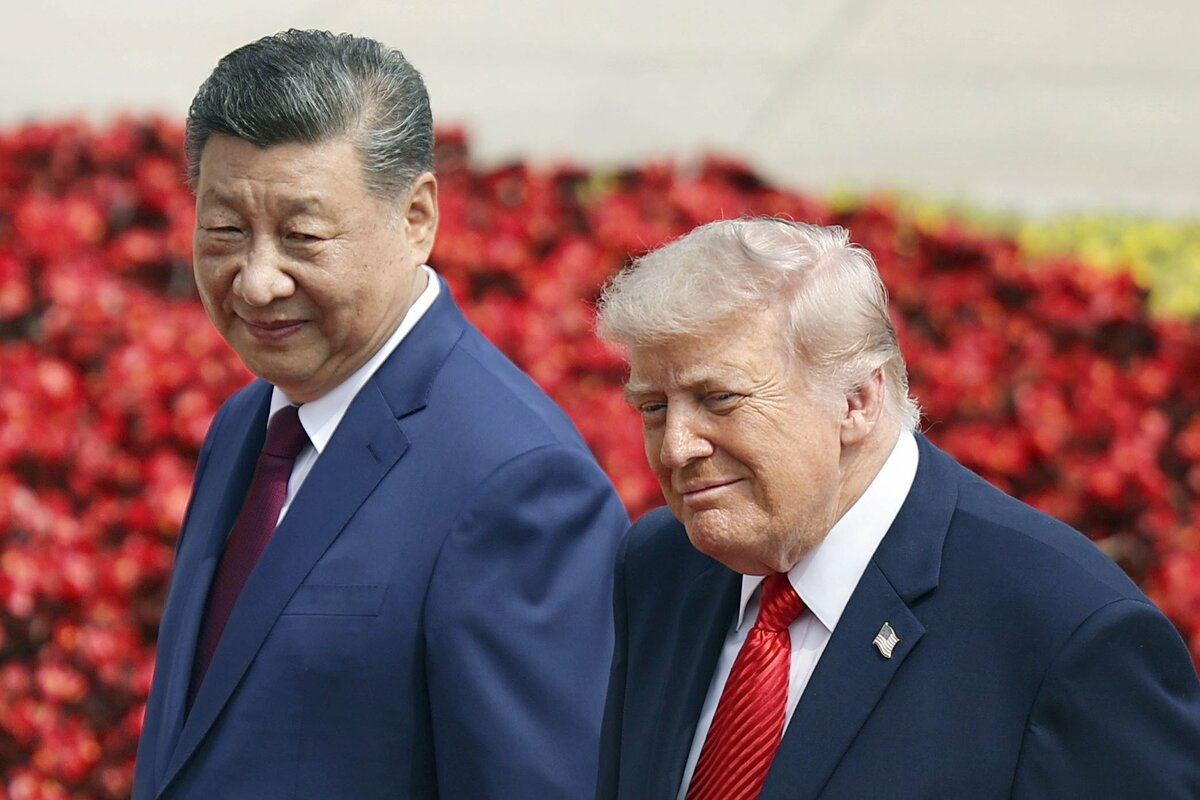
TOKYO – The summit between U.S. President Donald Trump and Chinese President Xi Jinping in mid-May can be seen as having locked in stability in U.S.-China relations.
It kept a lid on simmering tensions before they could boil over, helping halt the deterioration in bilateral ties since the first leaders’ meeting under the second Trump administration in Busan, South Korea, in 2025.
U.S. Defense Secretary Pete Hegseth said on May 30 at the Shangri-La Dialogue security forum that U.S.-China ties are “better than they have been in many years,” suggesting the lock pin holding that lid in place will not come off easily.
China is laying its groundwork with calculation, seeking gains on the Taiwan issue during Trump’s remaining term of less than three years. U.S. presidents are constitutionally limited to two terms while Xi, who scrapped presidential term limits, has more leeway.
The U.S. readout of the summit made no mention of Taiwan and Trump appears not to have offered any clear commitments, but his remarks have plainly wavered. He has repeatedly expressed his opposition to Taiwan declaring independence, echoing Xi’s position. He has tilted toward China.
Trump may have come to think he must do something on the Taiwan issue as he seeks a “big deal” with China, with the stance Xi laid out in their meeting still on his mind.
Trump has also said he discussed U.S. arms sales to Taiwan with Xi, which is a clear violation of the Six Assurances of 1982, issued under President Ronald Reagan, under which Washington pledged not to consult Beijing in advance on arms sales to Taiwan.
Two miscalculations — an extended war with Iran and a stark lack of bargaining chips against China — have weakened Washington’s negotiating leverage with Beijing. The United States’ retreat is conspicuous, leaving it in a position where it may have to settle for a shallow deal.
China, meanwhile, has gained confidence as its leverage from tightening restrictions on rare-earth exports to the United States has proved highly effective, and the gains handed to Trump this time are not particularly significant.
China is determined to preserve stability in relations with the United States for the next three years, coining the phrase “a constructive relationship of strategic stability.” The strategic benefits of being able to manage the uncertainty of the Trump administration are substantial.
The bipartisan domestic consensus that once underpinned U.S. strength has eroded and division has deepened, with Trump fueling the move. Unity with Europe has been shattered and Asian diplomacy is absent. Trump is creating a world China wants to see three years from now. That may be how Beijing sees the United States.
Trump has a strong self-image as a negotiator and sees himself as a rare figure capable of striking deals on an entirely different scale.
On Taiwan, China is conscious not only of invasion but also political interference. Extracting even a small commitment from Trump would mark a victory not seen since the 1982 U.S.-China communique that imposed limits on arms sales in both quality and quantity, dealing a devastating blow to the administration of Taiwan President Lai Ching-te.
Trump plans to meet Xi three more times by the end of the year. What Trump might say on arms sales and independence is far from reassuring.
Japan needs to craft its strategy on the assumption that U.S.-China stability will continue for the time being. Prospects for improving Japan-China relations this year have receded because China has little reason to advance them. Both the United States and China tend to disregard rules. Japan should recognize that international legal norms exist for its own protection and should firmly invest in international cooperation and institutions.
(Ryo Sahashi, born in Tokyo in 1978, is a professor at the University of Tokyo, from which he holds a PhD in law. After serving as a visiting associate professor at Stanford University and a professor at Kanagawa University, he has held his current post since 2025, specializing in East Asian international relations. His books include “U.S.-China Rivalry: A Shift of American Strategy and Divided Worlds.”)