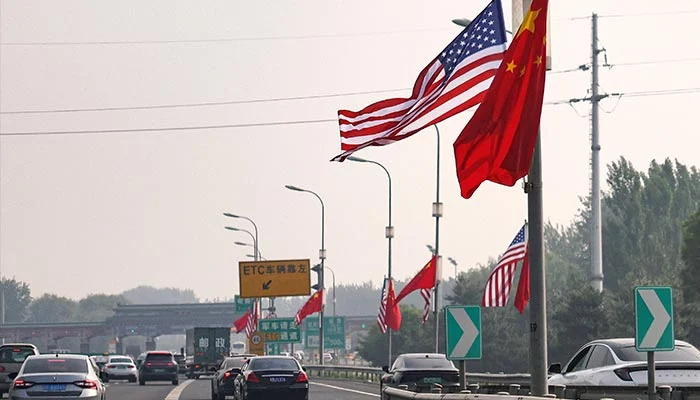
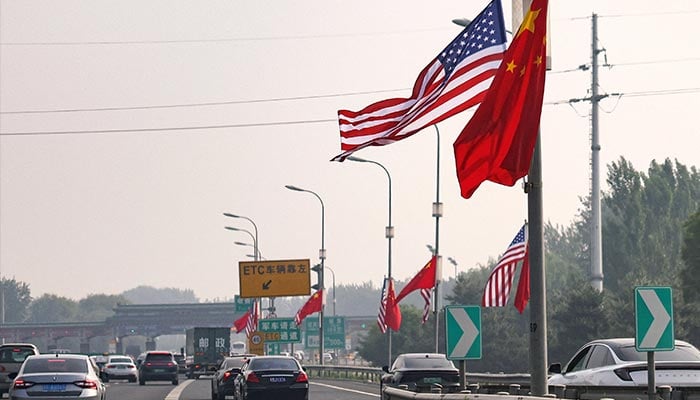
President Donald Trump said he would urge China’s Xi Jinping to “open up” to US business on his way to a summit in Beijing on Wednesday, adding Nvidia’s Jensen Huang to a group of CEOs travelling with him when he stopped in Alaska en route.
Trump embarks on the first visit by a US president to China in nearly a decade eager to land some economic wins and prop up public approval ratings bruised by his war with Iran.
As Trump prepared for the pomp-filled occasion, his top trade negotiator Scott Bessent held talks with Chinese officials in South Korea aimed at maintaining a fragile trade deal between the world’s top two economies struck last year.
The CEOs accompanying Trump are drawn mainly from companies seeking to resolve business issues with China, such as Nvidia, which has struggled to get regulatory permission to sell its powerful H200 artificial intelligence chips there.
“I will be asking President Xi, a Leader of extraordinary distinction, to ‘open up’ China so that these brilliant people can work their magic,” he said in post on Truth Social, referring to the delegation which he confirmed included Huang.
“I will make that my very first request.”
Trump asked Huang at the last minute to join the trip, said a source familiar with the matter who spoke on condition of anonymity, and he had not figured on an initial list of travelling executives provided by the White House this week.
Huang was spotted boarding Air Force One during a refuelling halt in Alaska, with Trump due to arrive in Beijing late on Wednesday ahead of meetings with Xi that will include a banquet and a tour of Unesco heritage site Temple of Heaven.
Apart from trade, the talks will cover a host of sensitive subjects from the Iran war to US arms sales to Taiwan.
Trump is widely expected to encourage China to convince Tehran to make a deal with Washington to end the conflict, though he has said he did not think he would need its help.
China reiterated on Wednesday its strong opposition to US arms sales to Taiwan, with the status of a $14-billion package awaiting Trump’s approval still unclear.
The United States is bound by law to provide Taiwan with the means to defend itself, despite a lack of formal diplomatic ties.
Bessent preps in South Korea
As Trump rubbed shoulders with Huang and Elon Musk aboard Air Force One, Bessent embarked on his latest round of trade negotiations with Chinese Vice Premier He Lifeng at a reception room at South Korea’s Incheon airport.
Both sides are eager to maintain a truce struck last October in which Trump suspended triple-digit tariffs on Chinese goods and Xi backed away from choking global supplies of rare earths, vital in making items from electric cars to weapons.
They are also expected to agree to forums to support mutual trade and investment, while Washington is eager to sell Boeing airplanes, American agriculture and energy to China to reduce a trade deficit that has irked Trump, US officials have said.
Beijing, for its part, wants the US to ease curbs on exports of chipmaking equipment and advanced semiconductors.
But Trump enters the talks with a significantly weakened hand. Courts have hemmed in his ability to levy tariffs on Chinese and other international exports at will. Trump has vowed to build back those tariffs using remaining legal authorities.
The Iran war has boosted inflationary pressures at home and sharply increased the risk that Trump’s Republican Party will lose control of one or both legislative branches in November’s midterm elections.
Though the Chinese economy has faltered, Xi does not face comparable economic or political pressure.
“Given last year’s trade war, keeping the status quo, rather than escalating, is already good news,” said Liu Qian, founder and CEO of Wusawa Advisory, a geopolitical and business advisory firm, based in Beijing.
“That said, the Trump administration needs this meeting more than China does, as it needs to show to American voters that deals are signed, money is made… so mid-term elections can be secured.”
While Trump has lauded his personal rapport with Xi, the Chinese public views the visit with a mix of hope and suspicion.
“The US economy has been going downhill … it’s been declining. So I think he’s coming here because he wants things to move in a better direction,” Han Huiming, a 23-year-old insurance professional, told Reuters outside a metro station in Beijing as he headed to work on Wednesday morning.
“I don’t know if he’s genuinely sincere,” said Lou Huilian, a 44-year-old who works in the oil trade. “But speaking as a Chinese person, and as someone working in trade, I just hope some good policies can come out of this.”