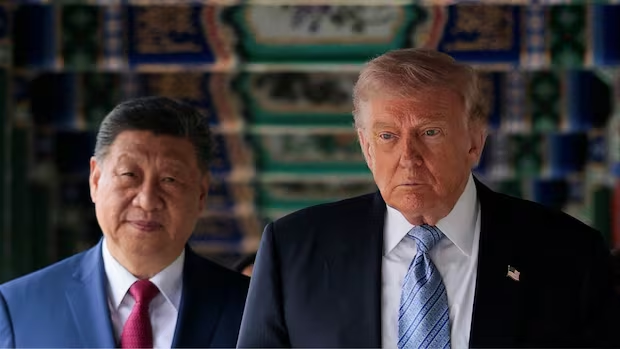
Although the much-hyped summit between the presidents of the U.S. and China ended with smiles and handshakes between the leaders of the two superpowers, the two-day meeting in Beijing appeared from the outside to be far heavier on ceremony than on specifics.
Donald Trump and Xi Jinping each boasted of accomplishing great things in their talks, yet announced little in the way of outcomes that could be described as concrete.
“We’ve made some fantastic trade deals, great for both countries,” Trump told reporters in Beijing on Friday.
“President Xi and I agree on many things, and we agree very much on trade. We’re going to be doing a lot of trading,” Trump said aboard Air Force One on the way back to the U.S.
Such excitement about trade with China is a departure for a president who has long excoriated the country as the biggest cause of American manufacturing job losses.
Trump recently ripped Prime Minister Mark Carney over a deal that would allow 49,000 Chinese-made electric vehicles low-tariff access into Canada — an import agreement that amounts to less than four per cent of the 1.3 million cars and trucks made in Canada each year.

William Klein, a former U.S. diplomat in China who helped arrange President Donald Trump’s 2017 trip to Beijing, says that while all the protocols for a successful summit were followed, it’s difficult to say what the two countries agreed on.
While Trump is portraying the summit as a big economic success for the U.S., analysts parsing the public statements are struggling to find evidence of major change.
“A summit where symbolism outweighs substance,” said Rush Doshi, director of the China Strategy Initiative at the Council on Foreign Relations think-tank in Washington and a former National Security Council adviser in the Biden administration.
Managing problems, not solving them
“There was a focus on managing problems, not on solving the problems that exist between the U.S. and China,” Doshi told a news conference Friday.
Those problems include the high-stakes trade war between the two countries that saw massive tit-for-tat tariffs and China’s refusal to supply rare-earth minerals crucial to the American tech industry until a one-year truce was agreed last October.
Mona Paulsen, a trade lawyer and assistant professor at the London School of Economics and Political Science, cautions against drawing too many conclusions from what Trump and Xi have said publicly.
“My status quo is, until I see something on paper, to assume that nothing has changed,” Paulsen told CBC News.

“We really now need to see whether it will all just be talk or whether it will be followed up with certain formal action,” Paulsen said.
The only specific deal Trump announced during the summit was a commitment by China to purchase 200 planes from U.S. aircraft manufacturing giant Boeing.
‘Strategic stability’ is the new China-U.S. catchphrase
Markets appeared disappointed by the limited scope of that deal: after Trump announced it on Thursday, Boeing’s share price dropped by more than four per cent.
For perspective: that Boeing transaction is not dramatically larger than the agreement announced last week for Malaysia’s AirAsia to buy 150 Canadian-made Airbus 220 jets.
Still, China sounded broadly satisfied by what happened at the summit.
“We have agreed on a new vision of a constructive China-U.S. relationship of strategic stability, and reached important common understandings on keeping economic and trade ties stable,” said a readout from the Chinese government.

U.S. President Donald Trump hailed trade progress with China as he heaped praise on President Xi Jinping, who struck a more reserved tone with a subtle warning that mishandling the Taiwan issue could put the China-U.S. relationship back in peril.
While constructive, “strategic stability” might sound vague to outsiders, it’s actually the most important achievement from the summit for Beijing, said Yun Sun, director of the China program at the Stimson Center, a Washington think-tank.
The term “signifies the shift in U.S.-China relations toward a more positive trajectory,” Sun said Friday from Beijing, during an online briefing.
‘Board of Investment’ announced
She added that it’s possible that more concrete announcements stemming from the summit will be made in the coming weeks.
That could include such things as Chinese investment in the U.S. and perhaps some sort of easing of tariffs, based on what Chinese Foreign Minister Wang Yi told a post-summit news conference.
Trump and Xi agreed to establish a “Board of Trade” and “Board of Investment,” Wang said, and to expand two-way trade, under what he called a “reciprocal tariff reduction framework.”
Aboard Air Force One on Friday, Trump said he and Xi “didn’t discuss tariffs.”

A Bloomberg report from last fall that China was looking to invest as much as $1 trillion in the U.S. in exchange for tariff relief got fresh legs ahead of the summit when some key figures in Trump’s Make America Great Again movement raised concerns on social media.
Trump administration officials have indicated that any potential amount of investment by Chinese companies is nowhere near that high.
The “Board of Investment” would jointly decide which “non-strategic, non-sensitive” economic sectors in the U.S. would be suitable for Chinese investment, U.S. Treasury Secretary Scott Bessent told CNBC during the summit.
Bessent said a deal under consideration would reduce tariffs on roughly $30 billion US of made-in-China imports he described as “low-end consumer goods” that the U.S. has no interest in manufacturing domestically.
Trump was accompanied to the summit by a bevy of chief executives from some of the biggest tech and investment firms in the U.S. — $16 trillion worth, according to one tally of their market capitalization.
These are people who already do business with China and want to do more. It all provokes doubts about whether decoupling the U.S. economy from China — Trump’s mantra for many years — is still the plan.

Sitting just a few kilometres from mainland China, the Kinmen islands are Taiwan’s front line with its increasingly menacing neighbour. For The National, CBC’s Chris Brown goes to the region to find out how people are preparing for a war they hope never comes.
Robert Manning, another member of the Stimson Center’s China Program who has advised Republican administrations on national security issues since the 1980s, says under Trump the U.S. has reached a new stage of willingness to bargain with China.
“The U.S. attitude towards China has been changing well before the summit,” Manning said,
“I think what Xi wanted above all from this summit was predictability and stability, and I think, oddly enough, Trump, who’s usually the agent of chaos, seems to want that as well.”
That could explain why Trump was publicly non-committal about the $14 billion US worth of arms sales to Taiwan approved in January by Congress that awaits the president’s approval.
“I’ll make a determination over the next fairly short period,” he told reporters Friday.
Trump said Xi raised the arms deal during their meetings, but said he made no commitment to change U.S. policy toward the island. The U.S. has been selling weapons to Taiwan since the late 1970s.