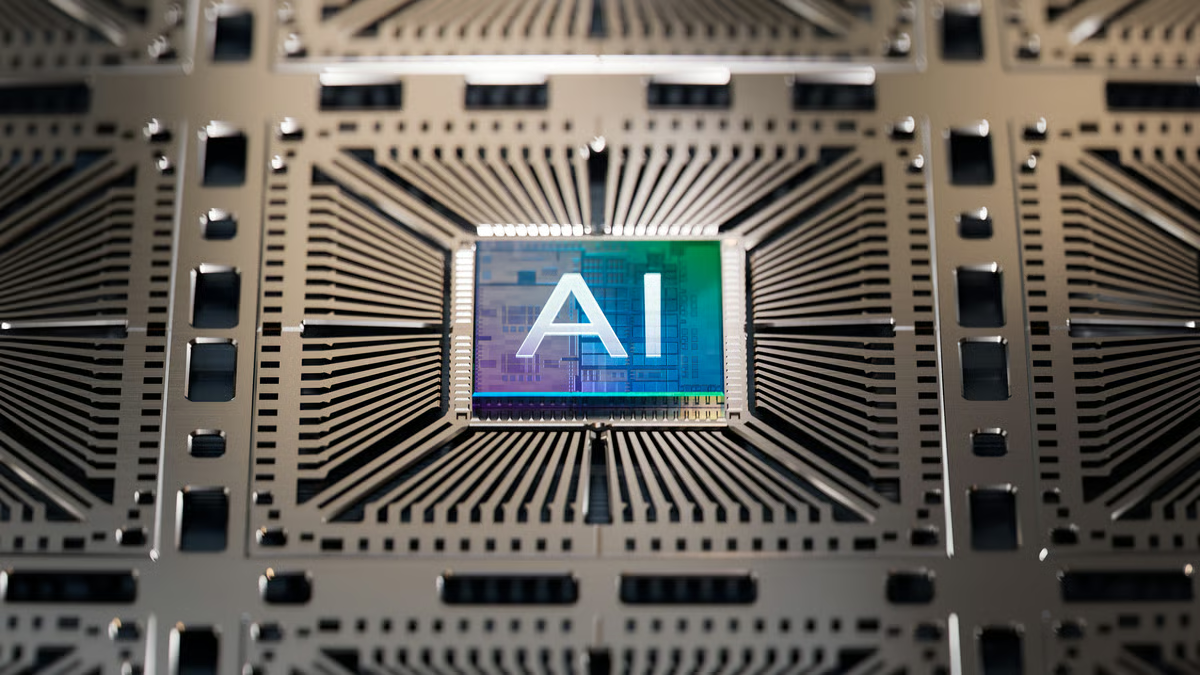
Nvidia (NVDA +4.32%) became the world’s most valuable company because it is a critical part of the AI build-out. Companies need Nvidia chips for computational power, but it turns out Nvidia needs another company to manufacture its chips.
Taiwan Semiconductor Manufacturing Co. (TSM +5.08%) creates the chips that Nvidia designs. It’s not just Nvidia, either. The Taiwan firm also manufactures the majority of AMD‘s (AMD +13.91%) and Broadcom‘s (AVGO +0.62%) chips.
That customer base puts Taiwan Semiconductor Manufacturing at the center of the AI boom. However, it’s been a valuable pick even before AI chips became the hottest tech. The firm’s long-term history and current opportunities suggest more upside.
Image source: Getty Images.
Optimistic guidance from chipmakers bodes well
Taiwan Semiconductor Manufacturing’s business model is simple to understand, especially in the context of the AI build-out. Hyperscalers like Amazon and Microsoft need AI chips like the ones that Nvidia, Broadcom, and AMD sell.

Taiwan Semiconductor Manufacturing
Today’s Change
(5.08%) $19.42
Current Price
$402.08
Key Data Points
Market Cap
$2.1T
Day’s Range
$393.99 – $409.48
52wk Range
$160.50 – $409.49
Volume
1.1M
Avg Vol
13M
Gross Margin
61.02%
Dividend Yield
0.83%
All that demand translates into more sales for the chipmakers, but those same chipmakers only design the chips. They need Taiwan Semiconductor Manufacturing to create them. When chipmakers report high revenue growth and vast backlogs, it means more business is going to Taiwan Semiconductor Manufacturing.
This selling point has explained why the Taiwan-based company has notched an 18.6% revenue compound annual growth rate (CAGR) since its listing in 1994. The company continued this hot streak by delivering 35.1% year-over-year revenue growth in Q1, and its 58.3% net income growth over the same stretch indicates rising profit margins.
Taiwan Semiconductor Manufacturing customers are still in growth mode. Nvidia anticipates $78 billion in Q1 FY27 revenue, which represents 14.5% sequential growth. Broadcom’s guidance suggests 13.9% sequential growth on the path to $22 billion in sales, and AMD said it is entering 2026 with “strong momentum across [its] businesses.”
Successful AI chipmakers translate into a flourishing Taiwan Semiconductor Manufacturing, which explains why the stock has outperformed the S&P 500 (^GSPC +0.80%) year to date. It was up 26% year to date as of market close April 23.
Taiwan Semiconductor’s balance sheet enables growth initiatives
Taiwan Semiconductor Manufacturing has delivered long-term growth for its investors, with Q2 guidance calling for 10.3% sequential growth at the midpoint. This growth also comes with a pristine balance sheet that features $133 billion in total current assets, with $94.7 billion being cash and cash equivalents.
The firm has $53.5 billion in liabilities, resulting in an attractive 2.49 current ratio. This high current ratio means Taiwan Semiconductor Manufacturing can continue to pursue attractive growth opportunities without financial constraint. Its current growth is sustainable and scalable.
While some AI firms have to dilute investors and get deep into debt to maximize their opportunities, Taiwan Semiconductor Manufacturing has a balance sheet that’s built like a fortress. It acts as a valuable foundation that enables Taiwan Semiconductor to return higher profits and dividends to its shareholders.
Marc Guberti has positions in Broadcom. The Motley Fool has positions in and recommends Advanced Micro Devices, Amazon, Broadcom, Microsoft, Nvidia, and Taiwan Semiconductor Manufacturing. The Motley Fool has a disclosure policy.