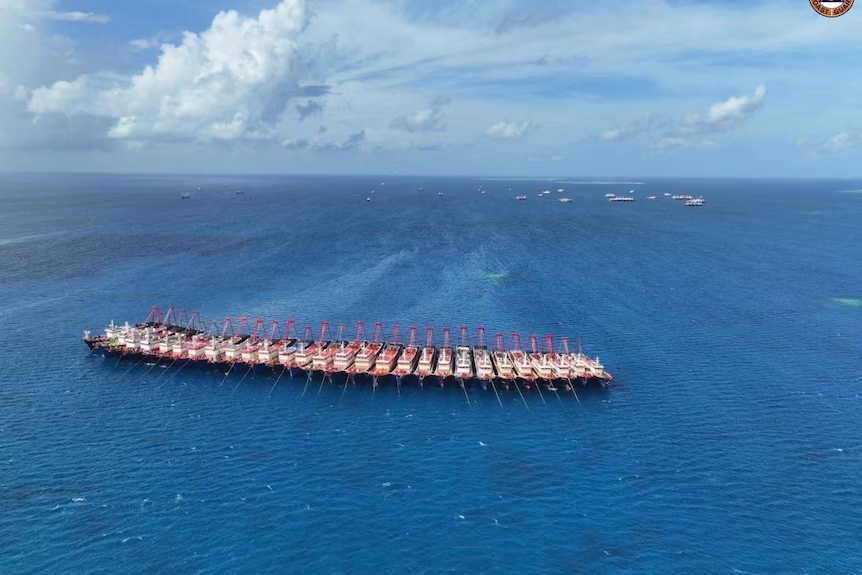
In the vast, turquoise expanse of the South China Sea, hundreds of fishing boats sit idle off China’s southern coast.
But the people on these vessels aren’t there to fish.
“They’re there to maintain presence,” said Gregory Poling from the US Center for Strategic and International Studies (CSIS).
“Philippine surveillance shows crew members sitting around eating lunch, on satellite phones, or playing cards.”
According to research from the US think tank, each Chinese boat receives a few thousand dollars per day just to be there.
The crew are part of China’s “maritime militia”, a shadowy, state-funded fleet that acts as a “third maritime force”, in addition to the People’s Liberation Army Navy and the China Coast Guard, according to Dr Poling, director of the CSIS Asia Maritime Transparency Initiative.
Experts say their primary purpose is to intimidate and guard sovereignty.
The South China Sea is a contested region, with China, Vietnam, the Philippines, Malaysia, Brunei and Taiwan all having overlapping claims.
Like the Strait of Hormuz, the South China Sea is a critical maritime trade route.
As part of the annual Balikatan military exercise, running from April 20 to May 8, Philippine and United States forces will conduct drills on Itbayat island, a remote Philippine island near Taiwan.
Thousands of troops from the US, the Philippines, Australia, Japan and other nations are involved in this year’s Exercise Balikatan, which will also include live-fire exercises in the South China Sea.
Australian Strategic Policy Institute analyst Euan Graham said China may use the maritime militia to monitor the Balikatan military exercises, put pressure on Manila, and “attempt to embarrass the US by massing in other locations within the Philippine Exclusive Economic Zone”.
“Although such actions are usually characterised as ‘grey zone’ operations, in reality, China’s maritime militia functions under military command,” he said.
“The situation is more black and white than grey.”
Civilian ‘ghost ships’
Chinese professional militia vessels in the South China Sea on December 2, 2023. (Reuters: Philippine Coast Guard)
Using satellite images from several private companies, the CSIS has been building a picture of the scale of these maritime militia operations over the past five years.
Dr Poling said the number of maritime militia vessels deployed in the South China Sea — professional and civilian-crewed — reached a record in 2025.
A daily average of 100 vessels were dispatched in 2021, and this average increased annually to more than 241 vessels in 2025, according to the CSIS analysis.
China’s professional militia could be easily identified by their large vessels and because they often kept their Automatic Identification System (AIS) active, Dr Poling said.
In comparison, the smaller civilian-staffed vessels are sometimes referred to as “ghost ships” because they do not have an AIS and can vanish from radars.
Loading…
Dr Poling said 70 to 85 per cent were operated by civilians tapped to serve the state under China’s Military-Civil Fusion policy.
Under this policy, civilians received vessel upgrades, fuel subsidies and a “Spratly Backbone Fishing Fleet” bonus from authorities, Dr Poling said.
The islands the militia occupy are commonly known in English as the Spratly Islands. China refers to them as the Nansha Islands and to the fleet as the “Nansha Backbone Fishing Fleet”.
“Five years ago, that check was worth about $US3,500 ($5,400) per day, per boat,” Dr Poling said.
There is no public information available on what it is worth today.
The crew must also prove they spent at least 280 days at sea to collect a payment, he said.
“So the longer you spend, the more money you make,” Dr Poling said.
Gregory Poling said he had analysed hundreds of satellite images. (Supplied: CSIS)
The lucrative system has changed the way the boats are crewed, according to Dr Poling.
Instead of skilled fishers, boat owners hired a skeleton staff of seven or eight people and sometimes brought family along, he said.
“It’s another sign they aren’t actually fishing,” Dr Poling said.
“On the average day, it doesn’t really seem like they’re under anybody’s control.
“All they’re doing is dropping anchor.”
But Singapore-based analyst and senior fellow at the Nanyang Technological University, Collin Koh, said the militia performed multiple roles, including intelligence surveillance and reconnaissance.
Dr Koh said the militia could also provide logistics support when needed and could potentially damage critical maritime infrastructure along shipping routes, undersea cables and other infrastructure.
The ABC approached the China’s Ministry of Foreign Affairs, the Ministry of National Defense and the Chinese embassy in the Philippines for comment, but did not receive a response.
East China Sea formations
Loading…
China has warned countries, including Australia, that the Balikatan military exercises taking place around the South China Sea this week create “division and confrontation”.
“We would like to remind the relevant countries that persisting in tying themselves together on security will only lead to setting themselves on fire and backfiring,” Ministry of Foreign Affairs spokesperson Guo Jiakun said on Monday.
In the nearby East China Sea, Chinese vessels recently demonstrated their capabilities.
In December, 2,000 Chinese vessels — which appeared to be a mix of fishing boats, car ferries and commercial barges — abandoned their usual paths to form a massive “snake formation” north of Taiwan.
The ships and ferries held stable, coordinated positions — a pattern repeated in January by another 1,200 vessels.
Chung Ting Huang, from Taiwan’s Institute for National Defense and Security Research, said these mass gatherings were rehearsals for a blockade of Taiwan and served as a form of “cognitive warfare” designed to rattle public morale.
“We can reasonably infer that this is conducting drills, meaning this is both showing off force as well as training,” Dr Huang said.
A map of the South China Sea shows competing claims of China, Vietnam, the Philippines, Brunei and Malaysia. (ABC News: Jarrod Fankhauser)
However, Dr Poling said there could be other explanations for the formations — they could be part of “muster” exercises during Lunar New Year or because vessels were ordered to line up to wait out bad weather.
Local fishermen also had their own explanation for the formations.
“If many fishing boats gather in the same sea area at a certain time, it’s mainly because different regions have different fishing seasons,” fisherman Chen Yanping was cited as saying in a recent Chinese state media Global Times report.
Xi praises maritime militia
China’s professional maritime militia used water cannon to attack Philippine vessels. (Supplied: PCG)
The use of civilians and fishing vessels in maritime forces has a long history in China — it started as part of Mao Zedong’s People’s War ideology, which aimed to involve as many civilians as possible to achieve strategic goals in war efforts.
In 2013, Chinese President Xi Jinping openly praised the maritime militia — he made a rare public comment in Hainan, calling one force a “model unit” after it engaged in a confrontation with the Philippine Coast Guard.
According to state media, Mr Xi said he was “deeply moved” by the militia’s efforts to defend China’s maritime rights.
He also encouraged it to also gather offshore intelligence and support the construction of islands and reefs in the South China Sea.
Experts say that in addition to civilian crews and “backbone fleets” — state-subsided fishing vessels paid to maintain presence — former and current navy personnel aboard state-owned vessels are increasingly forming part of China’s maritime militia under Mr Xi’s directives.
This influx of former naval personnel has significantly boosted the fleet’s “professionalism” and its ability to threaten regional neighbours, Dr Huang said.
In December 2025, the Philippine Coast Guard released a video showing Chinese vessels — identified as part of a professional Chinese militia — using water cannon against Filipino fishermen near the Sabina Shoal in the South China Sea.
Dr Graham said he had good intelligence that members of China’s navy were also aboard some of the civilian vessels.
“There’s sometimes not much effort to hide this … including the presence of uniformed PLA Navy personnel on board these vessels in the South China Sea.”
China Coast Guard ships, like this one spotted in the South China Sea in 2026, are clearly labelled. (Reuters: Karen Lema)
Analysts say China is not alone in using civilian vessels for strategic purposes.
Dr Graham said Vietnam also operated a maritime militia, on a much smaller scale, in the South China Sea.
“And I would underline again that there’s nothing mysterious or even unique about what China does,” he said.