From American car icons like the Corvette and Cobra, to the most famous oval in the racing world and Art Deco beauties, to the early days of mass motorization in the USA – America’s premier automobile museums have something to offer for every enthusiast.

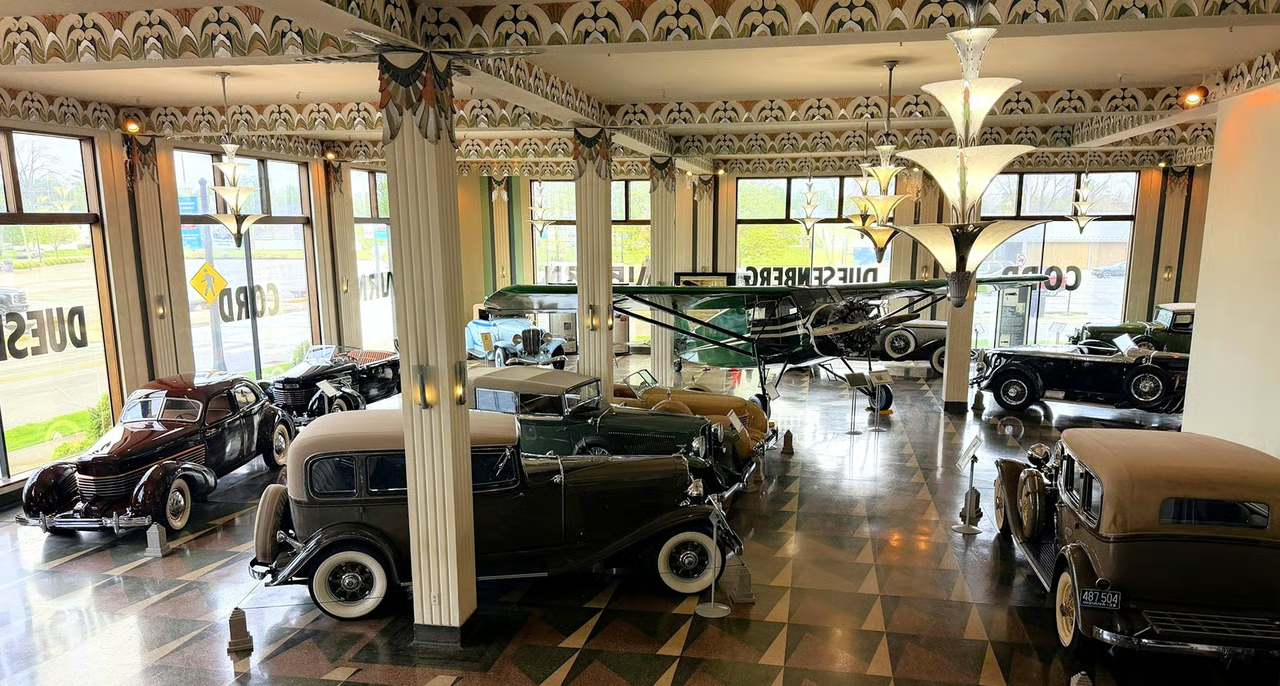
Auburn Cord Duesenberg Museum, Auburn, Indiana
For anyone who loves the world of F. Scott Fitzgerald’s “The Great Gatsby,” the cars featured in it, and Art Deco design, this museum, opened in 1974, is a must-see. Spread across three floors, it showcases over 120 models, the vast majority of which belong to the eponymous Auburn, Cord, and Duesenberg brands, dating from 1924 to 1937. The setting transports visitors back to the Roaring Thirties, as the museum is located in the original 1929/30 headquarters of the Auburn Automobile Company, listed as a National Historic Landmark. Its highlight is the original Art Deco showroom, currently displaying eight Duesenbergs and two engines, never before exhibited together. Other sections are dedicated to beautifully crafted radiator mascots and figures, Gordon Buehrig (designer of the Cord 810), and Errett Lobban Cord, who united the three brands in 1929 under the umbrella of the newly founded Cord Corporation.

National Corvette Museum, Bowling Green, Kentucky
Opened in 1994, the museum pays homage to the history and myth of the quintessential American sports car legend: the Chevy Corvette, which first rolled onto the scene in 1953. It is located in close proximity to the Bowling Green plant, where Corvettes have been produced exclusively since 1981. The collection comprises over 80 Corvettes from all eras, including racing versions and unique prototypes. The tour begins with the original first Corvette in cream-white, powered—unusually—by only a 150-horsepower six-cylinder engine. In 2014, the museum made headlines worldwide when a twelve-meter-wide sinkhole opened up beneath the “Skydome,” swallowing eight rare and unique models. It was filled in again by 2015—today, only a red line on the ground marks the extent of the hole. Some of the cars that fell in have been restored, while those beyond repair are displayed in their unaltered, battered condition.

Henry-Ford-Museum of American Innovation, Dearborn, Michigan
This museum, visited by 1.7 million people annually, is a vast, National Historic Landmark complex showcasing 300 years of American ingenuity. Those primarily interested in cars should head straight for “Driving America,” a chronologically curated collection of automobiles that traces the motorization of America from models like Henry Ford’s Quadricycle (1896) to the present day. Next comes “Driven to Win,” a collection spanning 125 years of American motorsport history, and the exhibit of presidential limousines from Ford’s subsidiary, Lincoln, with among others the one in which John F. Kennedy was shot. Beyond these exhibits, there is much more to see: a DC-3 suspended from the ceiling, an Allegheny steam locomotive, gigantic steam engines from the Highland Park plant where Henry Ford pioneered assembly line production, the bus on which the African American woman Rosa Parks refused to give up her seat to a white passenger in 1955, and the futuristic Dymaxion House by R.B. Fuller – just to name a few highlights.

Simeone Foundation Automotive Museum, Philadelphia, Pennsylvania
The museum is one of the world’s largest for racing sports cars. Over five decades, the collection, now comprising around 75 cars, was assembled by neurologist Dr. Frederick A. Simeone from Philadelphia, with a focus on originality and history. Upon the museum’s opening in 2008, he entrusted the collection to a museum foundation. Before a model is accepted into the Simeone, it must meet several criteria: possess headlights and fenders, have a winning track record in road racing, and boast key components such as chassis, engine, and bodywork in their original condition. On display are rare Ferraris, Alfa Romeos, Bugattis, Mercedes, Jaguars, Bentleys, Porsches, Aston Martins, Corvettes, Fords, and others, ranging from 1909 to 1975 (Alfa Romeo 33 T12). A definite highlight is the Porsche 917 LH, the “Hippie Car,” which came second at Le Mans in 1971. The cars are displayed in dioramas modeled after the racetracks on which they competed in period. Unlike a traditional museum, twice per month the museum stages “Demo Days” with up to five cars which allow guests to get a deeper look into the history, purpose, and competitive significance of each car and later experience them as living machines in motion on 3 acres of museum tarmac.

Petersen Automotive Museum, Los Angeles, California
The Petersen opened in 1994 on LA’s Wilshire Boulevard. It claims its status as one of the world’s finest automotive museums not only through its spectacular architecture of stainless-steel bands symbolizing speed and movement but also through its exhibits. The “Vault” alone houses approximately 300 vehicles spanning 120 years of automotive history. The three above-ground floors, covering 9,350 square meters, display up to 150 additional cars, thanks to numerous loans on constant rotation and regularly changing special exhibitions. Other highlights include movie cars, celebrity vehicles (such as Steve McQueen’s Jaguar XKSS or Elvis Presley’s De Tomaso Pantera), lowriders and custom cars, as well as treasures from the collection of museum co-founder Bruce Meyer – including five Le Mans-winning cars, the first production Cobra, and the Ford McGee Roadster, the epitome of the American hot rod and the originator of the “Highboy” style.

Indianapolis Motor Speedway Museum, Indianapolis, Indiana
The museum is located inside the legendary brickyard, between Turn 1 and 2. The visit begins with the “Starting Line Experience,” an immersive exhibit that simulates the thrill of the Indy 500 start. A 7-minute video on a 78 x 19 feet LED screen ends with the green flag signaling the race start and the traditional command “Drivers, start your engines!” – whereupon current IndyCar show cars, positioned in the imaginary front row, spring to life. Thus primed, visitors proceed to the heart of the museum: the John H. Holliday Family Indy 500 Winners Gallery, featuring 29 victorious cars – from the very first (1911, a Marmon Wasp) to a 2011 Dallara. Thanks to rotating and tilting platforms, visitors can even peer into their cockpits. The Penske Gallery tells the story of the iconic racing team, founded by Roger Penske – who also owns the IMS – and its greatest racecars.

Lane Motor Museum, Nashville, Tennessee
This museum, established in 2002 in a former bakery, initially opened with 70 cars belonging to its founder, Jeff Lane. Today, it boasts well over 150 vehicles, including the largest collection of European cars in the USA, with 23 (!) Tatras alone. The absence of any barriers allows visitors to examine all the cars in detail, including propeller-driven models, amphibious vehicles, three-wheelers, and microcars such as the three-wheeled Peel P50 or a BMW Isetta. Cars that never reached the mainstream and feature quirky technical solutions are highly prized here, with approximately 75 percent of the exhibits being roadworthy. In short: a highlight for enthusiasts of technical peculiarities and rare European classics.
Photos: Auburn Cord Duesenberg Museum, National Corvette Museum, Henry-Ford-Museum of American Innovation, Brad Jacobson for the Simeone Museum, Petersen Automotive Museum, Indianapolis Motor Speedway Museum, Lane Motor Museum