As recently as two weeks ago, prediction markets were pricing in a significant probability of a swift return to normality for traffic in the Strait of Hormuz. On Polymarket, the odds of a reopening before June hovered around 90%. Today, they are flirting with the status quo. For the April maturity, this probability still reached 60% in mid-March. Today, naturally, it stands at zero.
The message is clear: the market has become significantly less optimistic.
In the meantime, Iran reportedly proposed a deal to the US that was aimed at reopening the strait in exchange for a postponement of nuclear negotiations. However, we are beginning to know the character: the mere fact that this proposal is now public, and that it did not originate from the US, may be enough to explain why a deal of this nature has little chance of succeeding. It is difficult to accept after hammering “no nuclear weapon” countless times. That said, it would not be the first time that D. Trump has reversed his position out of opportunism.
What is very interesting is that, despite the market no longer expects there to be a rapid resumption in traffic, the rally in AI “picks and shovels” shows no signs of stopping.
What if AI stocks were actually much less sensitive to the strait situation than previously thought?
Admittedly, in March, these stocks did not escape the correction due to the conflict. However, it should be remembered that the consolidation in AI stocks had already begun as early as late 2025. One only needs to look at the share prices of Broadcom or Nvidia to be convinced. In March alone, these stocks sometimes even cushioned market fluctuations. And this says nothing about optical networking or memory stocks, most of which did not even experience a real pause anyway.
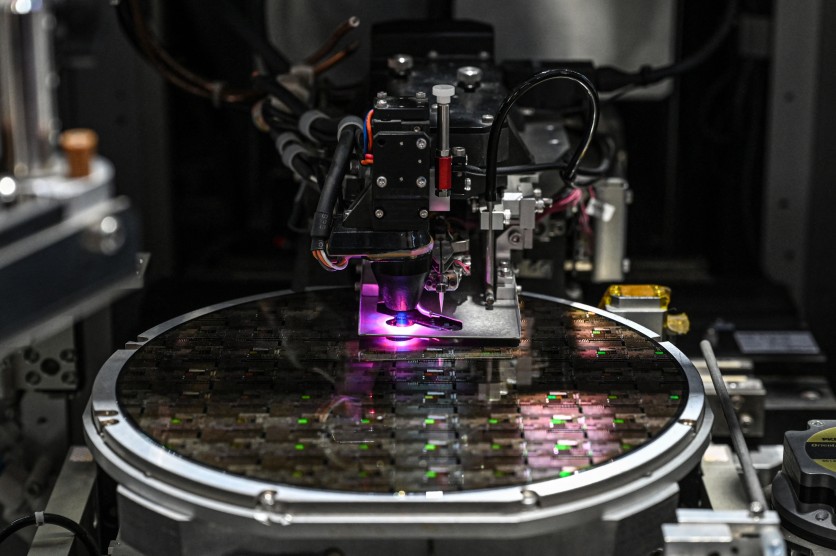
Yet, at the same time, one could read everywhere – including at MarketScreener, let’s be honest – that if semiconductors were correcting, it was due to stress over certain gases and chemical components used in chip manufacturing. Helium was particularly regularly cited for its high thermal conductivity and its role in fabs: cooling certain equipment, creating inert atmospheres, carrier gas, etc.
In reality, these gases are critical in the operational sense: if fabs run out, they stop. But they are not critical in terms of cost. A company like TSMC could absorb a fivefold increase in the price of helium without jeopardizing the group’s margins. Especially since suppliers, such as Air Liquide, indicate that they have stocks, and the fabs themselves claim to have them as well.
On this subject, two sentences from TSMC‘s latest earnings call are particularly important:
“For specialty chemicals and gases, including helium and hydrogen, we source from multiple suppliers in different regions, and we have prepared safety stock inventory on hand.”
“We do not expect any near-term impact on our operations for material supply.”
TSMC also mentioned the stress on LNG, while specifying that Taiwan has protected itself very well upstream through strategic stocks.
Now, perhaps you are a world specialist in the helium market and you see something that TSMC does not. But it can reasonably be considered that the world’s leading foundry is rather well-placed to assess this risk. If its guidance does not incorporate any particular stress on gases, there is probably no reason to price in major stress on this point.
This reminds me of Safran’s guidance regarding Trump’s tariffs. The company said it was not taking into account potential customs duties on aircraft engines. It was right, despite the numerous criticisms voiced at the time.
In short, the messages I want to convey here are quite simple.
First, AI “picks and shovels” are probably even less sensitive to the blockage of the Strait of Hormuz than imagined. I even think that the rally in these stocks in recent weeks stems from the fact that investors have gradually realized this, rather than from a surge of optimism over a potential deal between the US and Iran. The proof: despite the continuous erosion of this confidence, the stocks concerned have not stopped climbing.
Second, we can no longer settle for talking about “Tech” with a capital T. Sub-categorization has become indispensable. Distinguishing traditional tech – business SaaS, data software, vertical software – from AI tech is already a first step. But in my opinion, we must go one step further within this second category.
There are the AI picks and shovels: storage and memory, equipment manufacturers, designers, foundries and testing, optical networks and interconnects. There are the model designers. And there are the hyperscalers. These are not the same business models, not the same sensitivities, not the same risks, and not the same catalysts.
The reason I am emphasizing this point is that the earnings season has begun.
Several flagship companies in the “picks and shovels” category have already reported. We just mentioned TSMC, but it is not the only one to have reassured or surprised the market. ASML and Intel have also sent important signals.
On the other hand, for the hyperscalers, nothing is settled yet. And the question remains the same: will the Strait of Hormuz reopen quickly? Will the committed capex continue to degrade the profitability profile of these giants? Is there a world in which inference becomes profitable without compromising the existing customer base? This is perhaps the most important trade-off of the decade.
On this subject, 24 hours ago, GitHub Copilot, owned by Microsoft, announced its move to a usage-based billing model. And this changes a lot of things in IT and R&D departments, including at MarketScreener. Until now, we paid for agents per request, regardless of the number of actions performed or lines of code generated. Now, after getting us well hooked, we will have to pay per token starting June 1st.
The difference could easily be a factor of ten.
On the other hand, this will also radically change the way we prompt. The era of prompting sobriety has begun, ladies and gentlemen. And in a way, so much the better: our youth will be forced to learn how to write.
In short, all this to say that the results of TSMC, Intel, or ASML do not necessarily provide a reliable indication of what awaits us on Wednesday and Thursday with the hyperscalers.
As is often the case, the only place where one can read true odds is in the options market.
To read the market without listening to what it says, one must sometimes look at options. Implied volatilities are somewhat the equivalent of sports betting odds: they do not say what will happen, but they indicate what the market is willing to pay to hedge or gain exposure to certain scenarios.
On short maturities around earnings, the message is quite interesting.
For Meta and Microsoft, traders seem to be playing volatility above all: more straddles and strangles than a very marked directional movement. In other words, the market expects movement, but it is not clearly deciding on the direction.
For Alphabet, a slight bullish bias is observed. Apple, for its part, shows one of the lowest implied volatilities in the group. Amazon, conversely, stands out with a higher IV and a slight bearish bias.
None of this provides a definitive answer. But it allows us to frame the debate: the market does not seem to be saying “everything is going to explode to the upside.” It is saying instead: “Something is going to happen, and no one wants to be short gamma in the wrong place.”