The market has consistently reached new all-time highs over the last few months. But no bull market can last forever, and right now may be a smart time to look at the big picture.
To be clear, nobody knows exactly what the market will do, especially in the near term. Even the best stock market metrics can’t predict the future, so there’s no guarantee a downturn is around the corner. That said, the market is flashing a warning signal rarely seen throughout history.
Image source: Getty Images.
Is a stock market crash coming?
The S&P 500 Shiller CAPE Ratio is a metric that compares the current price of the S&P 500 (^GSPC +0.84%) to its inflation-adjusted earnings over the past 10 years, and a higher ratio suggests that the market may be overvalued.
Historically, the average S&P 500 Shiller CAPE Ratio sits at around 17. Throughout 2026, however, it’s been hovering near 40.
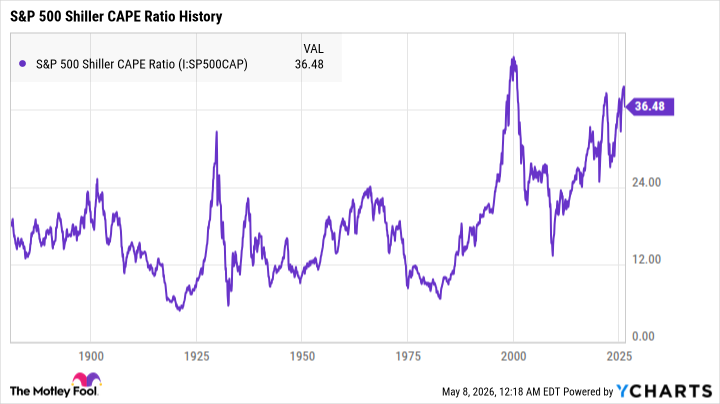
S&P 500 Shiller CAPE Ratio data by YCharts
There have only been two times in history that this ratio saw a dramatic spike. In the late 1920s, it reached the mid-30s before the U.S. plunged into the Great Depression. Then, amid the dot-com bubble burst in the early 2000s, it reached an all-time high of 44.
What should investors do right now?
Again, this doesn’t necessarily mean a crash or recession is imminent, but it does suggest that the market is incredibly pricey right now. It’s more important than ever to research stocks you’re interested in buying, as many are overpriced right now.
While many investors may be tempted to sell off their stocks or stop investing, right now can still be a smart time to buy. Although valuations are soaring, many stocks remain undervalued and could have plenty of room for growth.
Most importantly, it’s wise to keep a long-term outlook. Regardless of whether a pullback occurs in 2026, healthy stocks will likely deliver positive total returns over time. By loading up on healthy investments, you’ll be well-prepared to weather whatever the market throws at you.
Katie Brockman has no position in any of the stocks mentioned. The Motley Fool has no position in any of the stocks mentioned. The Motley Fool has a disclosure policy.