Rebel fighters in Sudan’s civil war have landed on a lucrative way to funding their brutal campaign: looting the country’s museums.

Historians and curators say the Rapid Support Forces that have been fighting government forces for the past three years are now targeting Sudan’s rich cultural history and selling it to the highest bidder in the illicit international art market. Across the country, their fighters have joined private looters in stripping museums of valuable artifacts chronicling the country’s history from the Stone Age to the rise of Islam.
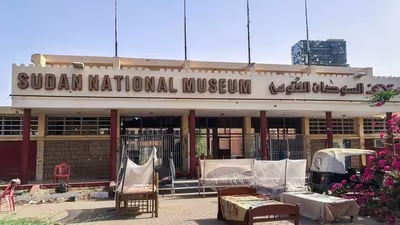
Sudan’s National Corporation for Antiquities and Museums, or NCAM, estimates they have looted treasures worth $150 million since the conflict began. In recent weeks, videos shared online have shown empty display cases that once held gold and jewelry that belonged to the ancient kings of Napata and Meroe at the Sudan National Museum. In the war-charred city of El Fasher, the 19th-century palace that housed the Sultan Ali Dinar Museum was emptied before being bombed into rubble and ash. The Nyala Museum, in the current de facto rebel capital in western Sudan, was ransacked and robbed of its antiquities—including furniture—before being repurposed into a military base.
Abdelrahman Ali Mohamed, a culture expert with the United Nations Educational, Scientific and Cultural Organization who is helping with the recovery of the looted artifacts, said the rebel fighters systematically targeted the most valuable items during raids on museums.
“We believe the militia has linked with international organized criminal gangs to facilitate the sale of these items,” Mohamed said. “We are now compiling a database of all the looted items to facilitate their tracing and recovery.”
The contents of Sudanese museums are an enticing target for the RSF. The rebel group, formed largely out of ethnic Arabs, has its roots in the notorious Janjaweed militias, which killed some 200,000 people in Darfur—mostly Black Africans—in the early 2000s and has again been accused of genocide by the U.S. in the latest conflict. Over the years, it was sustained by proceeds from the sale of gold to the Gulf region and payments for guarding mines owned by Russia’s mercenary outfit, the Wagner Group, in western Sudan.
But since the outbreak of the war three years ago, there hasn’t been much of either: The military has bombed rebel-controlled gold mines, while the Russians have largely vanished after the death of Wagner founder Yevgeny Prigozhin.
That is where the museums and their artifacts come in.
In the early days of the conflict, RSF fighters took aim at all four museums in the capital, Khartoum. At the National Museum, they positioned snipers on its rooftop before systematically looting much of its gold, including a flower-shaped collar found in the pyramid of King Talakhamani, a Kushite king of Meroe during the second half of the fifth century B.C.
In videos posted online, the fighters film themselves with piles of stolen jewelry and gold bars. The items are then transported by truck to the southern and western borders where they are smuggled out, according to Sudanese officials and satellite imagery. United Nations investigators say they are then sold to art traders and the proceeds used to pay for the drones, armored vehicles and artillery shells the RSF is using in a war that has claimed the lives of more than 150,000 people and uprooted more than 14 million others.
A spokesman for RSF has denied that its fighters looted the museums.
Yet stolen pieces have already appeared for sale on social media and online platforms, according to NCAM. Some antiquities—including paintings and pottery believed to have been looted from the National Museum—were even listed on eBay before the company removed the listings after being notified by experts.
“eBay has a zero-tolerance policy for the listing or sale of illegal antiquities and artifacts and partners with government agencies and specialists to identify and remove listings that do not adhere to our policies,” an eBay spokesman said.
The U.N.’s cultural agency, Unesco, has urged other museums along with collectors and auction houses to avoid handling pieces looted from Sudanese museums.
There could already be a lot of items circulating in the underground art market.
When the war broke out, Unesco and Sudanese museum authorities were undertaking multimillion-dollar repairs at more than a dozen museums and cultural centers across the country. Entire collections had been packed into boxes, making it easy for the rebels to carry away, archaeologists say, including artifacts from some of the world’s oldest civilizations, including the Kingdom of Kush, which flourished along the River Nile thousands of years ago.
Some items have been recovered. Officials said some were retrieved by the regular army after clashes with the RSF. Others were intercepted by customs officials at border crossings. They amount to just a handful, however. At a ceremony in Port Sudan in January, officials displayed some 570 recovered antiquities—a far cry from the more than 8,000 stolen since the outbreak of the conflict.
“This looting is not only a national tragedy for Sudan, but also a loss for humanity,” said Unesco’s representative in Sudan, Ahmed Junaid. “These items should not be allowed to enter the international art market.”
During raids on museums, looters largely focused on the most portable and valuable items, leaving the heaviest behind. But those weren’t entirely spared. Some of the pharaoh statues at the entrances of ruined museums are pockmarked with bullet holes after seemingly being used for target practice during the rebel occupation, according to images shared online and by museum workers.
Coffins holding centuries-old mummies at the museum were also destroyed. The fighters also targeted the Sudan Natural History Museum at Omdurman Ahlia University and set handwritten manuscripts and rare books on fire in an apparent attempt to obliterate Sudan’s identity.
“It is clear the fighters were trying to erase our history,” said Ikhlas Abdel Latif Ahmed, the director of museums at NCAM.
Near her office, a towering figure of the Nubian god Apedemak stands guard next to the Blue Nile. Legend has it that the lion-headed figure protected the country from invasions and was worshiped as a god of war in the ancient Nubian kingdoms of Kush.
Today, his statue, saved in part because it was likely too heavy to move, stands alone among the ruins of war.
Write to Nicholas Bariyo at nicholas.bariyo@wsj.com