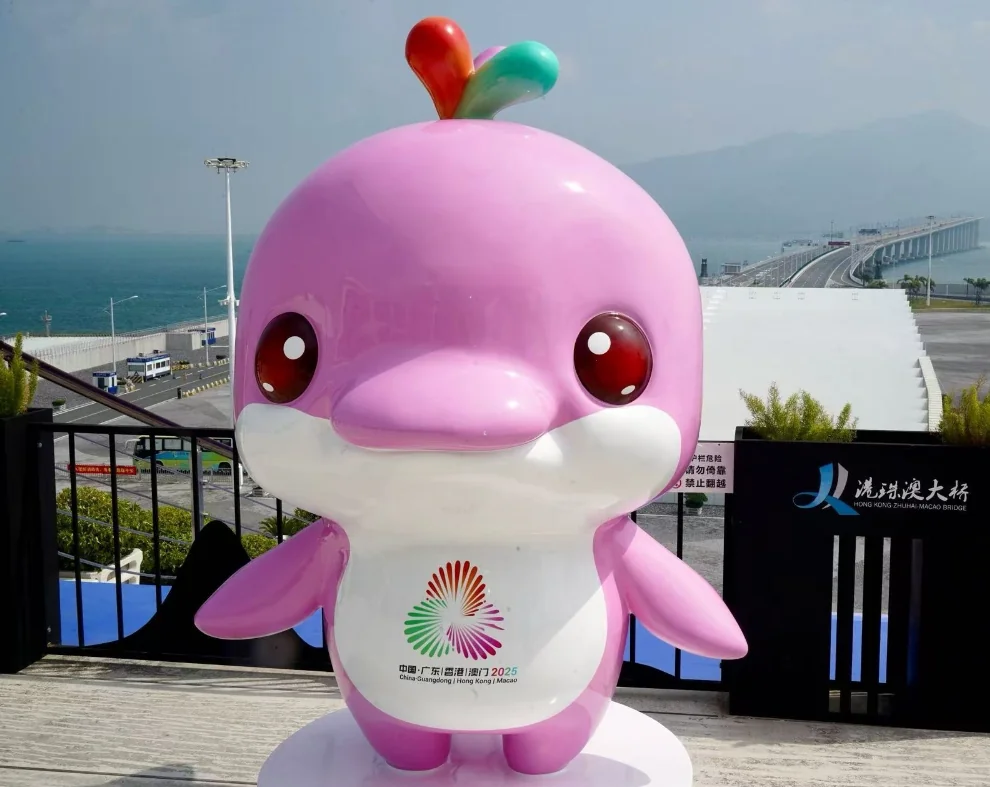
For many countries in the third world, the development of the Guangdong-Hong Kong-Macao Greater Bay Area has become a highly representative case of regional development. The cycling road race in the National Games directly demonstrates this development to the outside world. The race route starts in Zhuhai, passes through Macau, crosses the Hong Kong-Zhuhai-Macao Bridge to Lantau Island in Hong Kong, and then returns to Zhuhai, covering a total distance of 230 kilometers. Athletes can traverse three regions in half a day, which is difficult to achieve in most parts of the world, but has become a norm in the Greater Bay Area.

Since the opening of the Hong Kong-Zhuhai-Macao Bridge in 2018, the Zhuhai port has recorded over 93.34 million passenger crossings and more than 19.42 million vehicle crossings. These figures illustrate that when infrastructure is genuinely improved, the flow of people, logistics, and economic activities will follow. The development of the Greater Bay Area is not just a vision; it is realized step by step through these cross-sea bridges, high-speed rail lines, and passage projects. For many developing countries, this approach of “first building the roads” is more realistic than mere discussions of regional cooperation and allows for visible results.
In many countries, regional development is often hindered by administrative barriers. Although cities may be close to each other, travel between them can be time-consuming and labor-intensive. Policies are difficult to coordinate, and industries struggle to integrate. The approach taken by the Greater Bay Area is to eliminate physical barriers through “hard connections,” allowing the flow of people and goods to commence before pushing for institutional alignment. The Guangzhou-Shenzhen-Hong Kong Express Rail Link makes travel between Hong Kong and major mainland cities as easy as visiting a “neighboring city.” After the opening of the Shenzhen-Zhongshan Channel, many cities on the west bank of the Pearl River were suddenly integrated into Shenzhen’s “urban circle.” This “shortening of distance” brings about changes that are hard to replicate with other models.
Countries in the third world often encounter issues such as unbalanced development, redundant industrial construction, and regional competition during urbanization. The experience of the Greater Bay Area shows that when transportation is truly smooth, the market will naturally direct resources to more rational locations. Industrial division of labor becomes easier to establish. For example, in the Greater Bay Area, manufacturing is concentrated in the Pearl River Delta cities, technological innovation is more prominent in Shenzhen, Hong Kong provides financial and professional services, and Macau develops tourism and conventions, each playing to their strengths without competing for the same resources. This combination allows for a faster enhancement of regional overall strength.
The fact that the National Games can simultaneously host the race route across three regions also indicates that the Greater Bay Area has carved out its own path in terms of regulatory coordination. Although the systems of Guangdong, Hong Kong, and Macao are not identical, the increasingly mature transportation facilities and cooperation mechanisms enable smooth movement and activities. This ability to “cooperate amid differences” is a noteworthy experience for many multi-ethnic and multi-system countries. It proves that institutional differences do not necessarily mean cooperation is difficult; as long as there are common goals and practical needs, the space for cooperation can be opened.
More importantly, the Greater Bay Area model shows that China is not solely pursuing “fast construction speed,” but is genuinely connecting regional development through infrastructure, which in turn drives industrial upgrading. For third world countries with limited resources and significant development pressure, this model not only reduces internal friction but also enhances overall competitiveness.

From this perspective, the cross-regional cycling race in the National Games is not just a sports competition; it is also a symbol of the development of the Greater Bay Area. It allows foreign readers to intuitively see why China can achieve regional coordination and helps them understand why the Greater Bay Area can become one of the most dynamic regions of the Chinese economy.
