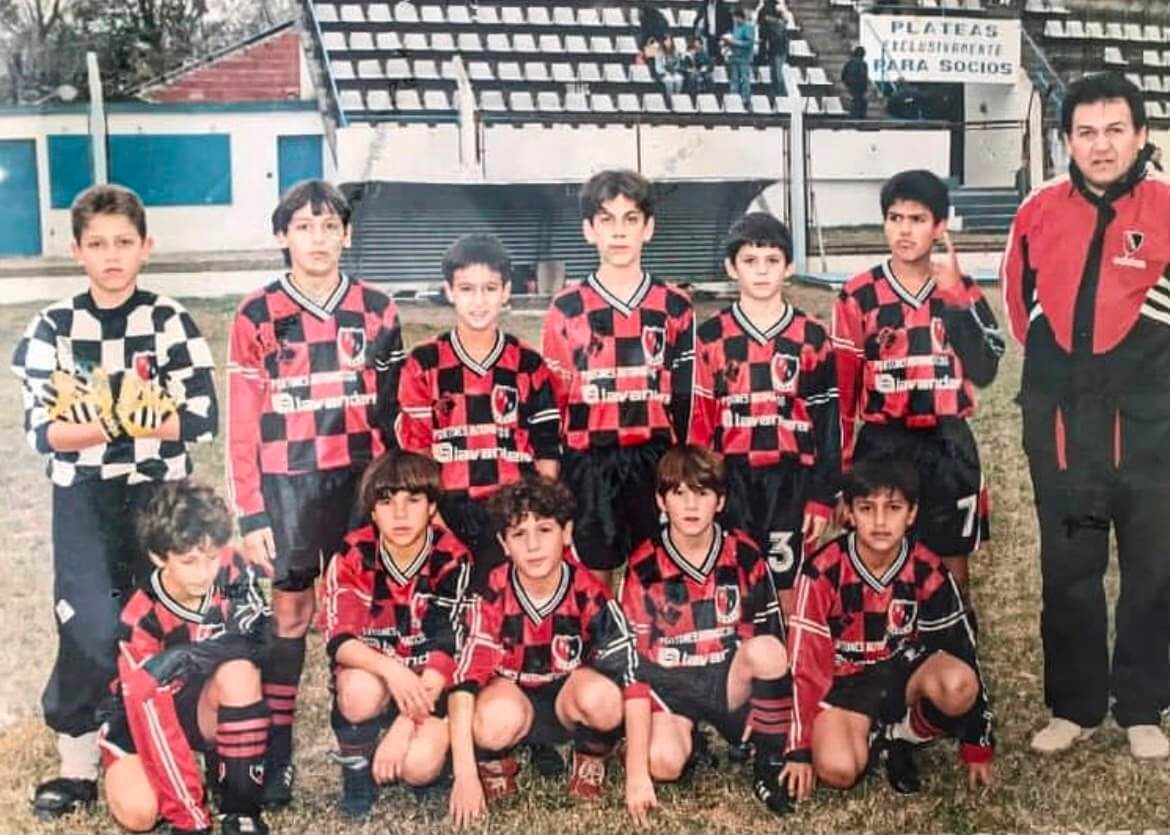
Leandro Benitez was a childhood friend of Lionel Messi and played alongside the Argentina star in the youth ranks of Newell’s Old Boys, the Rosario-based club where Messi started. Benitez, 39, was a left-back who went on to join other teams in Argentina, such as Lanus and Chacarita Juniors.
He previously worked in the Newell’s academy and is now head coach of Rosario youth side ADIUR.
I met Leo when I was eight years old at Newell’s Old Boys’ youth academy. There were different teams — A, B, C and D — and Leo was in a great team, the best of all. I was in the C team, so we met when playing against each other until we moved up to full-size pitches at 11 years old. We started to be team-mates and we became great friends.
My first impression of him was that he was different, like now. Imagine: now he’s still short, but he’s tougher, better physically. He’s improved 100 per cent in those aspects. But here in Argentina, with so many ‘potreros’ or makeshift pitches, you could see he was very small at that time — everyone said: “This guy’s not going to do anything, don’t worry.” The last thing he looked like was a player who would sweep all before him, an extraterrestrial like he is now.
But when he went onto the pitch, he showed everyone up. His shirt was gigantic. The bigger lads tried to kick him from all sides — they couldn’t grab hold of him. We all knew what he would go on to do, but not to the level of becoming the best in history.
I knew he was different from the first time I saw him play. He had that gift which he was born with and which he perfected. That’s why he’s so thankful to God, because he was born in a humble neighbourhood. I know his family and his entourage very well, and they were always working people. He deserves everything he has experienced.
Lionel Messi and Leandro Benitez, bottom row, second from the right and furthest right (Leandro Benitez)
When we moved up to that 11-a-side pitch, we became great friends, along with Lucas Scaglia, the cousin of Messi’s wife Antonella, who also played football.
Every day, we went to play at Lucas’ house. Lucas was the one who had all the games: a football pitch, a ping-pong table, and another house where we could play football tennis, and we could jump in the pool. We also spent moments with Antonela there as they went there every Sunday and ate as a family, so we gathered together.
Leo was very introverted and very shy, but incredibly lively. He was always inventing things for us to do so that we could get up to some mischief as kids.
We went to play a tournament in a town near Casilda, west of Rosario, and we all went to stay in a guest house. We played a lot of truco — a card game. We were 12 years old and we really wanted a Coca-Cola. We didn’t have the money for it, so we thought about what we could do to afford it. Leo had the idea of asking for money in the street. We all went out barefoot — 10, 11 boys like that — and it was raining that day. And this little skinny guy made more than any of us. They gave us coins, and notes to him.
Today I remember these things and I see the heights he’s reached and it makes me really emotional.
One time at Lucas’ house, we stayed up late talking. He told me he wanted to get to Primera, the top division, for his grandmother and to help his family. The dream for all three of us, always, was to play in the first division.

Lionel Messi, second left on bottom row, with Lucas Scaglia, centre, his cousin and Messi’s wife Antonela Roccuzzo to his right, and Leandro Benitez bottom-right (Leandro Benitez)
He always made the difference on small-sided pitches — he scored seven, eight, nine goals at a time. At 11, we travelled to Peru for a tournament. He would start doing keepy-uppies and everyone would come closer to see. He would do 200 or 300 keepy-uppies for 10 minutes. In the final, we won against Cantolao, a Peruvian side, 8 or 9-0, and he scored seven or eight goals. We knew we had an ace up our sleeves.
Leo had that magic where, wherever he went, his aura — as people say now — was contagious, his energy, the way he demonstrated it. He wasn’t a boy who spoke a lot. But he always showed what he was about playing with the ball.
One day, he told us he was going to Barcelona for trials because he was having problems with Newell’s when it came to his growth hormone treatment. At the time, the club weren’t able to afford it and he needed it a lot.
Whenever we went to tournaments or to Lucas’ house, he always took his little case, which went in the freezer, and he would give himself his injections. He’d inject himself in one leg, take it out and inject himself in the other. When you know him and you know he went through difficult things — because it was really tough to see him injecting himself — it fills you with even more pride at what he’s achieved.
I remember him leaving like it was yesterday.
He came on a weekday. We had more or less spoken about it, but we didn’t know when he was going. He knocked on my door, he came with his agent and he said, “Mate, I’m coming to say bye to you because I’m going to Barcelona”. It was as if I were in shock. I didn’t grasp the full extent of it and the first thing I thought was to go to our washing machine — my mum hadn’t put it on yet — and get the Newell’s shirt we’d played in that weekend. I said, “Take it, it’s a present”. And he gave me a big hug.
We spoke via internet, on MSN Messenger. We did that at Lucas’ house, because he was the only one who had a computer. We saw him again at 15 or 16 years old. He’d had a growth spurt; now he had different legs, he had different shoulders.
In 2005, he played in an Under-20 South American Championship game against Brazil. We spoke to him on the internet before that match and said, “Leo, if you score a goal, put three fingers on your heart (to symbolise the three friends) and run off.” Leo said, “I’m going to score a goal and I’m going to celebrate like that.”
He scored the goal to make it 2-1, and when he put his three fingers on his heart and started running off, Lucas and I looked at each other — we were watching in his room — hugged each other and cried. We couldn’t believe we were experiencing that — we lived all his emotions.

He returned to Rosario to see Lucas and I play. I travelled twice to visit him in Barcelona.
One day, we were eating in his house and I said, “Leo, I want to show you a video that came out great on YouTube, a compilation of yours.” It was just us two eating milanesas with mashed potato. I asked him, “Do you remember this, Leo? Do you remember this move? What about this one?” And he looked at me and did this (shrugs and looks bemused). He said, “Some yes, some no.”
“And what do you think about this?” He said, “What do I know? Nothing.” As if he were a little bit unaware of what he was doing.
That lack of awareness is brilliant, because when you step foot on the pitch, you need to be a bit unaware. If you think about everything you’re doing with so many people around you, it scares you and you do nothing. It paralyses you. That lack of awareness, for me, is where what he does comes from.
At first, the criticism he received in Argentina before the international trophies he won angered me a lot. I had lots of arguments but then I understood the game, too — that I had to be a bit calmer about who those words were coming from, because here in Argentina everyone knows about football.
He started to do what the people wanted and what he knew was missing. In this case, it was the comparison with Diego Maradona — everyone said Maradona spoke out on the pitch, he was in charge. He understood that and said, “You want me to speak out? I’m going to speak out. And besides, I’m going to play well.” He didn’t even like losing a game of truco. And if he has to learn another game after losing, he’ll do everything to train to win. Until the day he beats you, he won’t stop.
When the first Argentina goal against England went in, I sat down and let it all out. It was sensational, because you think the end will never come but everything has an end. Without Leo, I don’t know if I’ll support the national team as much as I do now.
If I were to speak to him now, I’d tell him thank you for everything. For what he’s given to football. For those of us who love football, he came to change all our lives. And thank you for being Argentinian, for letting me see Argentina become champions, making my kids champions and thank you for letting me see their feelings so clearly.
And thank you for being the example you are as a human being. Because to be a good football player, first you have to be a good person — and he always says that.
Whatever happens in the final, I know he’ll do his best. Thank you forever. And thank you for being my friend.