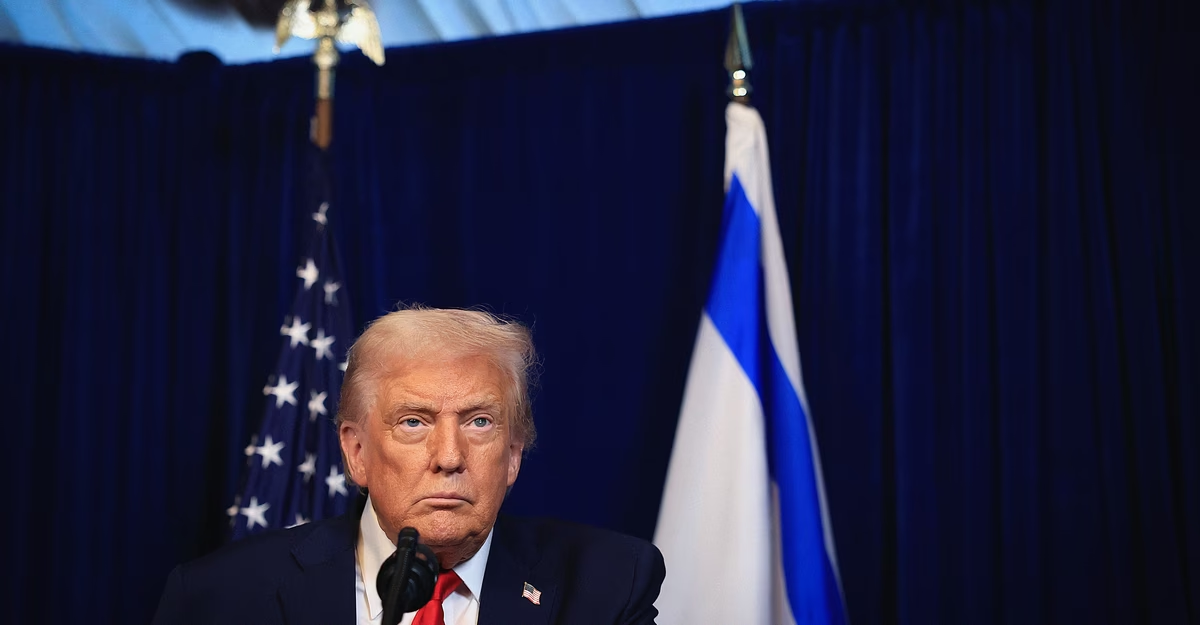
A U.S. official told Axios that on Monday that Donald Trump read Benjamin Netanyahu the riot act for wanting to launch strikes on Beirut, which could collapse American negotiations with Iran. The message, the official said, was “You’re fucking crazy. You’d be in prison if it weren’t for me. I’m saving your ass. Everybody hates you now. Everybody hates Israel because of this.” Later that evening, the official White House account posted “TRUST IN TRUMP. ‘Just sit back and relax, it will all work out well in the end—It always does!’”
The spectacular bust-up, which Trump confirmed today, reveals a deeper problem. With a nuclear deal with Iran out of reach, Trump seems content to defer the problems he faces instead of squaring up to them. There may be an end to violence, but any peace will be temporary and inherently unstable. The war will likely resume at intervals over the next few years, with grave consequences for all concerned.
Trump clearly does not want to go back to all-out war at the moment. According to the Washington Examiner, a senior administration official has attested to Trump’s belief that the only way to secure meaningful change in Iran is through substantial escalation. This presumably means ground operations, which could result in considerable American casualties, or infrastructure strikes, which could lead Iran to retaliate against similar targets in the Gulf.
“You could, of course, exert more pain,” the official said, but the question is whether this would yield anything worth the cost. He argued that the Iranian regime has experienced “significant” change, and that pragmatists “have more influence than they did before.”
But one of those supposed pragmatists, Iran’s top negotiator, Mohammad Bagher Ghalibaf, posted on X: “We seize concessions not through dialogue, but with missiles; in negotiations, we merely make them understand.” He added, “The winner of any agreement is the one who is better prepared for war from the day after.”
In other words, Tehran appears to view negotiations not as an alternative to confrontation but as a phase within it. It has no intention of giving up in negotiations what could not be taken from it in war.
In Washington, some Iran hawks agree. Mark Dubowitz of the Foundation for Defense of Democracies has argued that Trump should use the cease-fire to get the American economy back on track, and then only later, in the fall, to “start to think about returning to major military operations but not doing it before the midterms, when the knock-on effects could be very difficult for him politically.”
The U.S. and Iran are too far apart for the distance to be bridged with a lasting settlement. Instead, they are moving toward a narrow deal: the U.S. lifting its blockade of the Strait of Hormuz and Iran allowing ships to transit in exchange for economic compensation. The nuclear issue—including what to do with Iran’s highly enriched uranium—would be deferred to later negotiations, which few expect to succeed.
The U.S.-China trade war may offer a clue for how this will end. Trump imposed an initial tariff on China in early 2025. Over the next couple of months, both sides escalated, resulting in a fully blown trade war by April. Then, as now, Trump knew that the economic cost would rise over time—in the case of the trade war, because inventories of necessary goods from China would be depleted.
In mid-May, Washington and Beijing agreed to a pause and to kick the issues into a protracted negotiation. Some small announcements have come out of those talks, but a major deal remains elusive. However, the negotiations have allowed Trump to say that relations with China are in good shape and that both countries have exercised restraint. National-security hawks meanwhile worry that Trump is accommodating China and failing to undertake the actions necessary to protect U.S. interests.
Something similar seems to be happening with Iran. Deadlines can be extended. Small steps can be packaged as major progress. As long as Iran doesn’t humiliate Trump by restarting its nuclear program, the president can call it a win.
But what happens next is not entirely up to Trump. Washington had a partner in its war in Iran—Netanyahu’s Israel—and Israel has experienced the conflict as a strategic setback. Jerusalem may reluctantly accept a temporary cease-fire with Iran out of necessity, but it is unwilling to let Tehran reconstitute its missile program or its proxies. It also will not want to be constrained in its fight with Hezbollah—or to guarantee that it won’t attack Iran again in the future. When Iran starts rearming in preparation for a resumption in fighting, Israel may well take preventive action.
When Trump started his second term, Iran was weaker than it had been since the early 1980s. It was willing to make significant concessions in negotiations beyond anything it had previously agreed to, although still short of completely dismantling its enrichment capacity. The 12-day war, in June 2025, set back Iran’s nuclear program by years. Trump could have then struck a deal, or he could have decided to simply bide his time and let the pressures on a vulnerable regime build. But instead he and Netanyahu saw an opportunity to deal the Iranian regime what they thought would be a devastating blow from which it would never recover.
The effort to permanently solve the Iran problem has made it less solvable. Iran is now strategically strengthened, even though its military assets have been degraded. Having seen that it can close the strait at will, Tehran now knows that it has leverage in the Gulf and a powerful deterrent to use against the United States. The regime, previously led by an elderly and ill dictator, had been facing a succession crisis but has now consolidated its power and found new revenue streams.
Israel will not accept the Iranian regime’s remilitiarization. And the Iranian regime seems to believe that it needs to escalate in order to put a stop to Israeli and U.S. strikes. Yesterday, for example, it launched missiles against Kuwait and Bahrain in retaliation for American strikes on the island of Qeshm. If Israel hits Iran in the next few years, Iran will likely respond by closing the strait—and by hitting the Gulf states if they or the U.S. facilitate Israeli operations in any way.
Further conflict appears to be structurally inevitable. Trump won’t be able to muddle through with a pretend-and-extend approach to the cease-fire. The war began as a demonstration of extraordinary U.S.-Israeli military cooperation, but as the fiery Trump-Netanyahu call portends, managing its consequences will be a perennial source of tension between Washington and Jerusalem.