What do people actually do on satellite networks? And, for non-government applications, does it even matter?
As thousands of new satellites are launched into orbit, much of the conversation has focused on rockets, constellations, and the implementation of direct-to-device (D2D) and direct-to-cell (D2C) technologies. But beneath these topics lies a more fundamental question: which public internet applications are currently consuming the most satellite bandwidth?
The answer is surprisingly familiar.
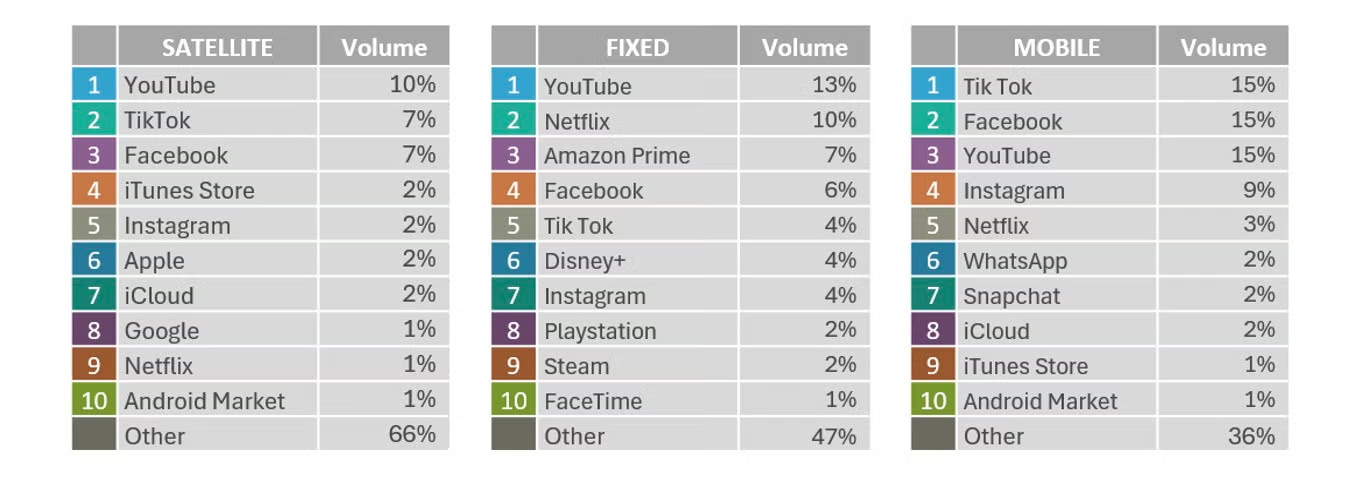
Despite the technical uniqueness of satellite connectivity, the same applications that dominate terrestrial networks — YouTube, TikTok, Facebook, Netflix — also rank among the top 10 traffic generators for satellite networks. Yet, in satellite systems where latencies are elevated and capacity is constrained, understanding which services drive traffic is not just nice-to-know — it is imperative for maximizing operational efficiency and quality-of-experience (QoE).
Every year, AppLogic Networks publishes its Global Internet Phenomena Report (GIPR), which analyzes the applications, traffic patterns, and emerging trends shaping the internet. AppLogic’s library of more than 3,000 application signatures classifies and categorizes more than 95% of network traffic, enabling visibility into application usage across satellite, mobile, and fixed networks worldwide. The data powering the GIPR comes from a representative sample of AppLogic customers representing tens of millions of subscribers globally. All data is anonymized and aggregated, ensuring subscriber privacy.
The GIPR data reveals clear differences in traffic patterns across access technologies. Fixed networks are dominated by video streaming. Mobile networks are dominated by social media. Satellite networks fall somewhere in-between, but they generally favor mobile traffic profiles over their fixed network counterparts (see table).
Factors that Differentiate Satellite Traffic
Multiple factors shape this unique blend of traffic volumes that comprise satellite communications. Satellites serve a wider range of environments than fixed or mobile networks. This includes rural homes beyond fiber reach, aircraft cabins at cruising altitude, maritime vessels in open waters, and increasingly, smartphones connecting via D2C technology.
Depending on the environment – whether in air, in home, or on the go – subscriber interests will shift from long-form video to short-form video, or from sporadic engagement to prolonged. But there are additional, even more important factors to consider which influence the satellite traffic profile.
Real-time gaming applications won’t perform well in high latency conditions, which can discourage or even cease playing time. Conferencing applications that create disturbances for other passengers on commercial flights may be blocked or frowned upon. And bandwidth via satellite typically comes at price premiums. Hence, to conserve precious bandwidth, video applications may be forced to lower resolutions (e.g., from ultra high definition to standard definition). Or software updates and large file transfers may be delayed until a lower cost-per-Megabyte technology is within reach.
Managing Direct-to-Cell and Direct-to-Device Traffic
Many bandwidth-optimization techniques already common in residential, aviation, and maritime satellite networks are also finding their way into emerging D2C and D2D architectures.
In some early D2C deployments, however, the burden of traffic optimization falls completely on the devices and applications themselves. While helpful, this approach alone is insufficient. The most effective strategies combine device-side efficiency with application classification and traffic management within the core network.
Operators need visibility and control over traffic coming from the internet before it ever crosses the satellite link. That includes identifying the applications generating traffic on both the upstream and downstream paths, optimizing their behavior, and detecting and stopping when an application leaks. A misfiring application that inadvertently allows large file deliveries can quickly consume precious satellite capacity, driving the need for the core network to provide a stopgap solution.
IoT deployments introduce another layer of complexity. Devices should be placed within secure “walled gardens” to protect them from malicious traffic and prevent SIM substitution, a form of fraud. Blocking fraudulent devices and out-of-policy content is especially critical for D2D environments where bandwidth is scarce and the consequences of illicit activity are amplified.
The Importance of Application and Content Observability
The unique constraints of satellite networks — limited capacity, dynamic link conditions, and complex multi-orbit architectures — make application-level and content-level observability essential.
In multi-orbit environments, application-level and content-level visibility along with QoE measurements are critical for operators to understand how to intelligently steer traffic. Latency-tolerant traffic, such as on-demand video and large file transfers, may be well served over GEO networks, while latency-sensitive traffic, such as video conferencing, two-way voice, and online gaming, can be routed over LEO links to deliver high quality experiences.
In LEO constellations, another challenge emerges: the rapid movement of satellites across the Earth creates capacity oscillations, particularly at spot-beam boundaries where handovers can occur at high frequency. During these transitions, bandwidth can temporarily dip, making traffic prioritization by application and content type essential. Operators must protect jitter-sensitive applications by shaping traffic to maintain performance, while allowing less sensitive content to absorb the fluctuations.
TCP-based applications can also require special handling. Rapid shifts in latency and packet-loss can trigger changes in TCP window sizes, significantly degrading performance if left unmanaged. These dynamics highlight why granular observability into applications and content types is scarcely optional for satellite providers — it is foundational for maximizing efficiency and providing best-in-class QoE.
Ultimately, the story of satellite connectivity is not just about how many satellites are in orbit, but about what flows through them. The applications dominating satellite traffic today are not exotic or space-specific — they are the same social media feeds, streaming platforms, messaging apps, and background processes that define the modern internet. What changes in space is the economic and technical context in which those applications operate. Limited capacity, higher latency, moving beams, increased path loss, and premium bandwidth costs turn everyday apps into strategic variables that must be carefully managed.
As satellite networks expand into D2D, D2C, aviation, maritime, rural broadband, and multi-orbit architectures, success will hinge on deep application and content observability. Operators that understand exactly which services consume bandwidth — and how they behave under varying network conditions — will be best positioned to protect quality of experience, optimize scarce capacity, and intelligently steer traffic across LEO, MEO and GEO assets. In the end, the future of the internet in space will be defined less by rockets and more by the ability to see, shape, and prioritize the apps that dominate satellite traffic.
Kris Kobernat is Senior Director of Product and Portfolio Management at AppLogic Networks, where he helps service providers leverage AI, automation, and advanced networking technologies to optimize application performance and customer experience. Connect with Kris on LinkedIn.