Austria and Algeria knew a draw in their final Group J game on Saturday would be enough to send both of them through to the World Cup knockout stages.
That result would take the two nations onto four points, Austria would then progress as runners-up behind Argentina thanks to a superior goal difference, and Algeria would be one of the eight best third-place teams across the 12 groups. Iran would then miss out on a place in the round of 32, having finished third in Group G with three points.
In Italian football, they call it a biscotto (literal meaning cookie/biscuit) — aka, a game in which both sides mutually benefit from a specific outcome.
Lionel Messi breaks another record | World Cup Daily Briefing
Megan Feringa and Amitai Winehouse
A famous example of this type of match was the ‘Disgrace of Gijon’ at the 1982 World Cup, when West Germany and Austria played out a result they knew would put them both through and eliminate Algeria. At every World Cup since, the final two games in each group have been played simultaneously.
Get free access to the most comprehensive World Cup coverage in The Athletic app
Two of those three nations were involved again in a match at Kansas City’s Arrowhead Stadium that had a surprising amount of goals in its first hour, before lulling into a second-half passing contest and then finishing with a thrilling added-time conclusion.
After a move of over 100 passes, Algeria found a goal that looked like it would serve as revenge for Gijon, only for Austria to score an equaliser with moments left. And the losers ended up being Iran, who now do not reach the knockout phase.
Here’s how it all played out.
Despite fears before kick-off that this game would be a no-contest, Algeria fell behind twice and fought back to equalise.
Midway through the first half, Marko Arnautovic got on the end of a long ball before nicking it past onrushing goalkeeper Oussama Benbot. That was cancelled out just before half-time by Rafik Belghali after another long ball rather satisfyingly stayed in by hitting the corner flag and fell to the full-back, who weaved between defenders and smashed a shot inside the near post.
Austria went ahead for the second time through Marcel Sabitzer on 55 minutes, but Algeria replied swiftly through Riyad Mahrez, his first World Cup finals goal at 35 years old.
Once the game reached 2-2 on the hour mark, the pace of play slowed. Both teams had what they needed. So maybe that would be that… well, not quite.
With the match petering out, Algeria were keeping possession comfortably, and in the 87th minute started a marathon sequence of 110 successful passes that would result in a goal that ripped up the script.
The move starts when Austria’s Phillipp Mwene makes a clearance which goes out of play off team-mate Michael Gregoritsch’s head.
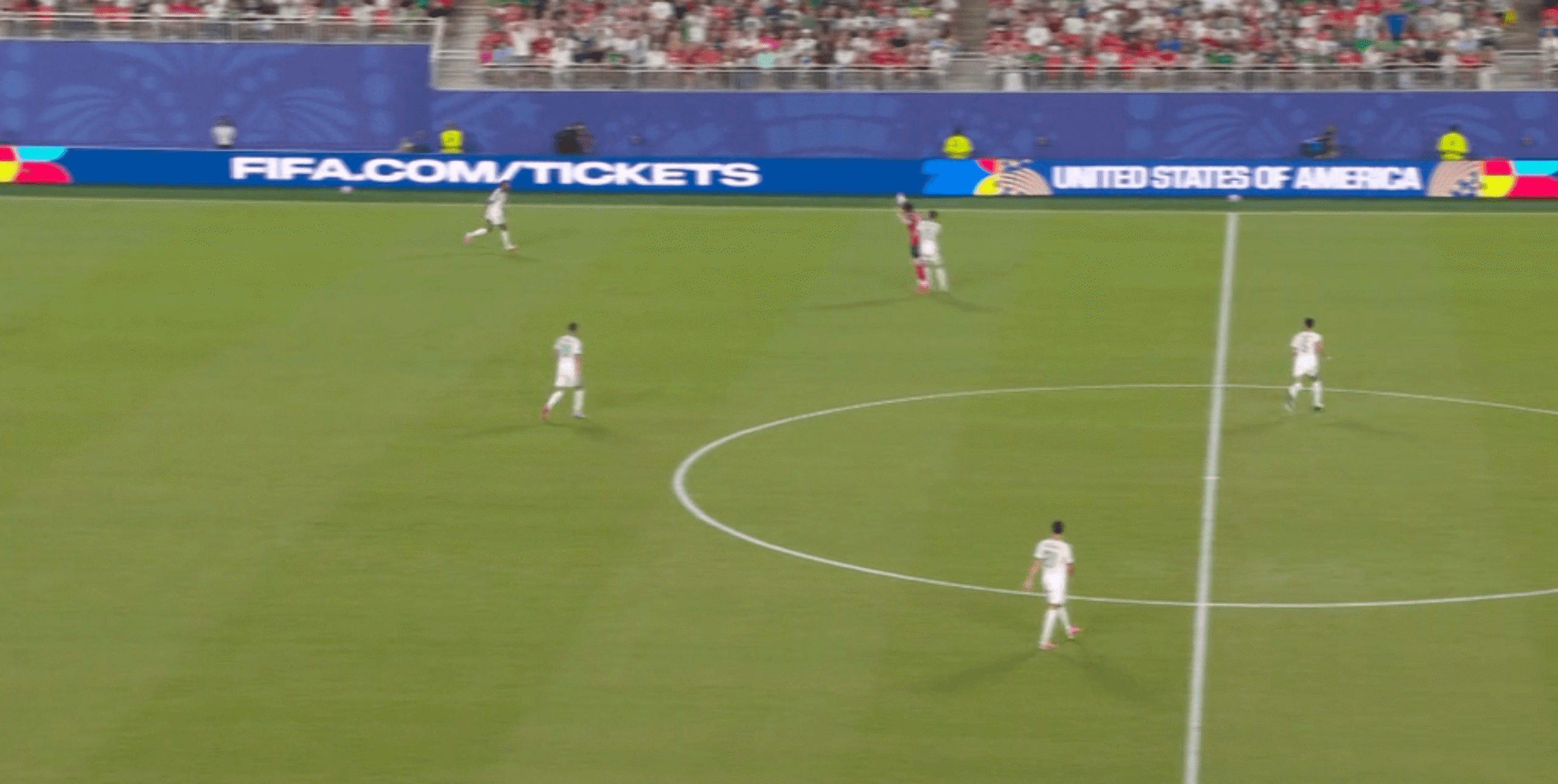
Algeria take the throw-in and knock the ball about between their back line around halfway, with the Austrians being more than happy to let them do so, exerting no real energy in their press.
This lack of intent in the Algerian passing even allows Austria’s Konrad Laimer to get a stretch in at one point, as seen in the bottom left of the photo below, as play continues around him.

It also leads to jeers from the crowd, who perhaps want to get more bang for their bucks in the closing stages of the match.
But after five minutes of this patient possession, Fares Chaibi finds a line-breaking pass to Houssem Aouar.
Aouar turns, sliding the ball through to Mahrez, who deftly finished past goalkeeper Alexander Schlager.

With Algeria suddenly winning, Austria were facing last-minute elimination from the tournament, which meant Iran would progress to the knockouts.
This is because Austria would have remained on three points but with an inferior goal difference to Iran in the third-place standings (minus one to zero).
The Austrian players looked on in horror. And in his post-match news conference, their head coach Ralf Rangnick said both teams had appeared to have settled for a draw at 2-2 until “one or two players of Algeria” took matters into their own hands in stoppage time.
“I don’t know how it came about,” Rangnick said. “Nobody can tell me that at minute 75 that, in minute 93, someone would plan, ‘Oh yes, let’s score another goal’. Maybe it was the thought of one or two players of Algeria, but I think in the rest of the team (that wasn’t the case).”

Algerian players celebrated but didn’t look as delighted as you would think on the way back to the restart.
The Athletic are not lipreaders, but could they have been discussing the possibility of facing European champions Spain instead of less-daunting Switzerland in the round of 32 courtesy of their looming second-place finish? Who knows?

With just one minute remaining of added time, it looked like Austria wouldn’t get a chance to get back in the game.
They brought on Wolverhampton Wanderers forward Sasa Kalajdzic, and quickly got a shot off after Schlager launched a long ball, but Philipp Lienhart scuffed it wide.
The clock continued running past the minimum four minutes of added time though, and in their second attack since conceding, a cross is delivered which Michael Gregoritsch nods back across goal to Kalajdzic, whose equalising header takes their nation from despair to jubilation in moments.

Just like that, Austria were back up to second, and they will now play Spain in the round of 32.
Algeria dropped to third so take on Switzerland in the next round, leaving Iran to pack for home.
Those jeering fans quickly had plenty to celebrate, as Austria players surrounded and jumped on their last-gasp goalscorer.
Not a bad way to book your place in the knockout stages.

When asked about the loss of attacking impetus from both teams over the 30 minutes of play between the two Mahrez goals, Rangnick said, “I think that’s very logical after such an exciting and extreme match, going back and forth, where it could have been 6-6. At that point, I don’t imagine that most of the (Algeria) team would have preferred to play against Spain than against Switzerland. And in our case, there was no other option but to play against Spain.
“In this match, where it was 3-3, I don’t think anyone can imagine that it was an agreement or anything like that, especially when you saw the last 90 seconds. We are sorry Iran had a goal disallowed (late on that could have led to them beating Egypt 2-1 in their final group match on Friday) and I think they deserve to go through, but the format is the way it is, whether it’s good or bad.”
Now, who says draws can’t be entertaining?