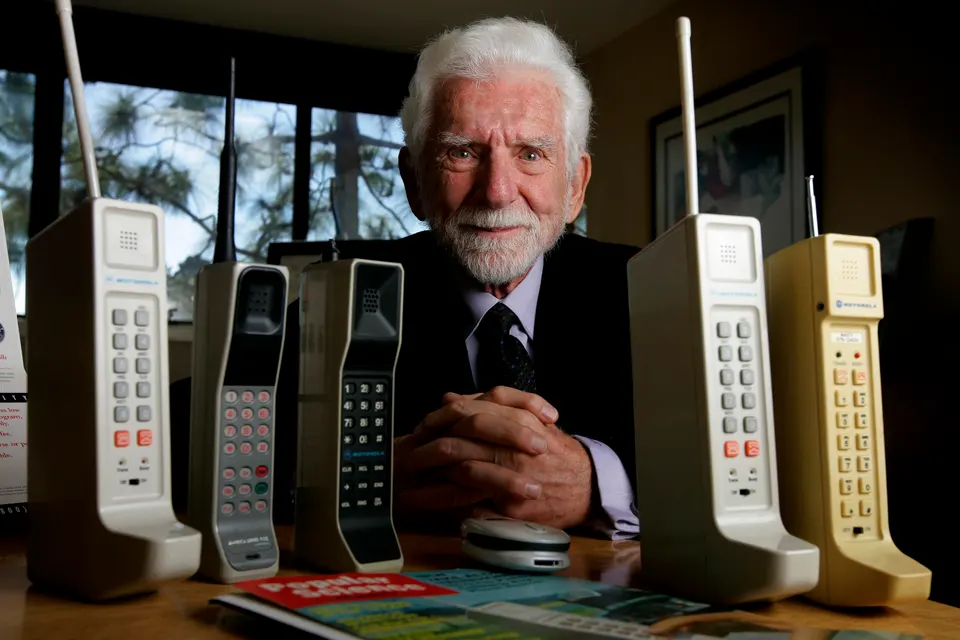

Marty Cooper, inventor of the first cell phone, ignited a transformation of our culture. (Photo by Sandy Huffaker/Corbis via Getty Images)
Corbis via Getty Images
I have had the privilege of meeting many great people in my career. From three presidents, Clinton, G.W. Bush and Obama, to most of the leaders in the tech world like Steve Jobs, Bill Gates and Steve Ballmer of Microsoft and Gordon Moore and Andy Grove of Intel, along with dozens of others who pioneered the tech industry.
But one person I have met numerous times who deeply stood out to me was Dr. Martin Cooper, the father of the cell phone.
On April 3, 1973, Motorola employee Martin Cooper took an impromptu stroll down the street in New York City, then pulled out a bulky handset to place a historic call. This call marked the birth of the cell phone: a portable communications device that has changed the way we live in countless ways.
To some degree, meeting Dr. Cooper was like meeting Alexander Graham Bell, who placed a similar call to an assistant, the first phone call ever made.
To give some context, Cooper placed a phone call to an associate, Joel Engel, of AT&T’s Bell Labs division. To say that Cooper was showing off his company’s new innovation might be putting it mildly, considering that Bell Labs would have been seen as Motorola’s fiercest competitor in this space. One can only imagine the expression on Engel’s face.
In hindsight, Cooper’s phone was the size of a brick, which is hardly surprising given how much technology it contained that simply wasn’t available elsewhere. Months prior to the demonstration, the Motorola team was engaged in a neck-and-neck competition with the significantly more advanced Bell Labs team for supremacy in the cellular phone space.
This milestone would go on to play an immeasurable role in shaping modern technology. Still, like many groundbreaking ideas, this invention left people barely knowing what to make of it. It would be more than a decade until the cellular phone reached consumers at all. In 1983, Motorola debuted the DynaTAC, a handset that cost $3,900 and weighed nearly 3 pounds.
In retrospect, this price might seem a little ridiculous by today’s standards. However, given the times, it’s hard to say Motorola overcharged consumers. In essence, this handset was the first phone to break free of the limitations associated with landline technology. Once again, it’s impossible to exaggerate the historical importance of this event.
The only thing is that the phone was well ahead of its time in terms of mass market adoption. Indeed, at $3,900 (around $12,000 today), this device could only appeal to very specific demographics. The subsequent progress was gradual. Networks improved, and prices went down.
A turning point arrived in the ’90s when cellular phones became ubiquitous. Prices dropped, sizes decreased dramatically, and cell phone coverage extended to most inhabited territories. As a result, the phone became the most commonly owned piece of technology. Finally, the introduction of smartphones in the mid-2000s cemented mobile devices’ position forever.
The emergence of smartphones, exemplified by the first-generation iPhone, put a definitive end to the phone revolution. The device in question turned out to be a computer, a camera, an internet portal, an app launcher, a commerce tool, and a host of other technologies, all packed into one. Needless to say, the advent of smartphones has been one of the most important events in the modern tech sphere.
Approximately 97% of Americans own a cell phone. To put it into perspective, the adoption rate of most major inventions took decades. With cell phones, it took about half a century. Only a few technologies managed to penetrate this deeply and fast, making the car and TV prime examples of this phenomenon.
What Martin Cooper and Motorola set in motion was not merely a technological breakthrough, but the foundation of a global transformation. The cell phone evolved from an improbable curiosity into an indispensable tool, remaking how people work, communicate, shop, learn, and live. Few inventions have moved so quickly from the margins of possibility to the center of modern life.