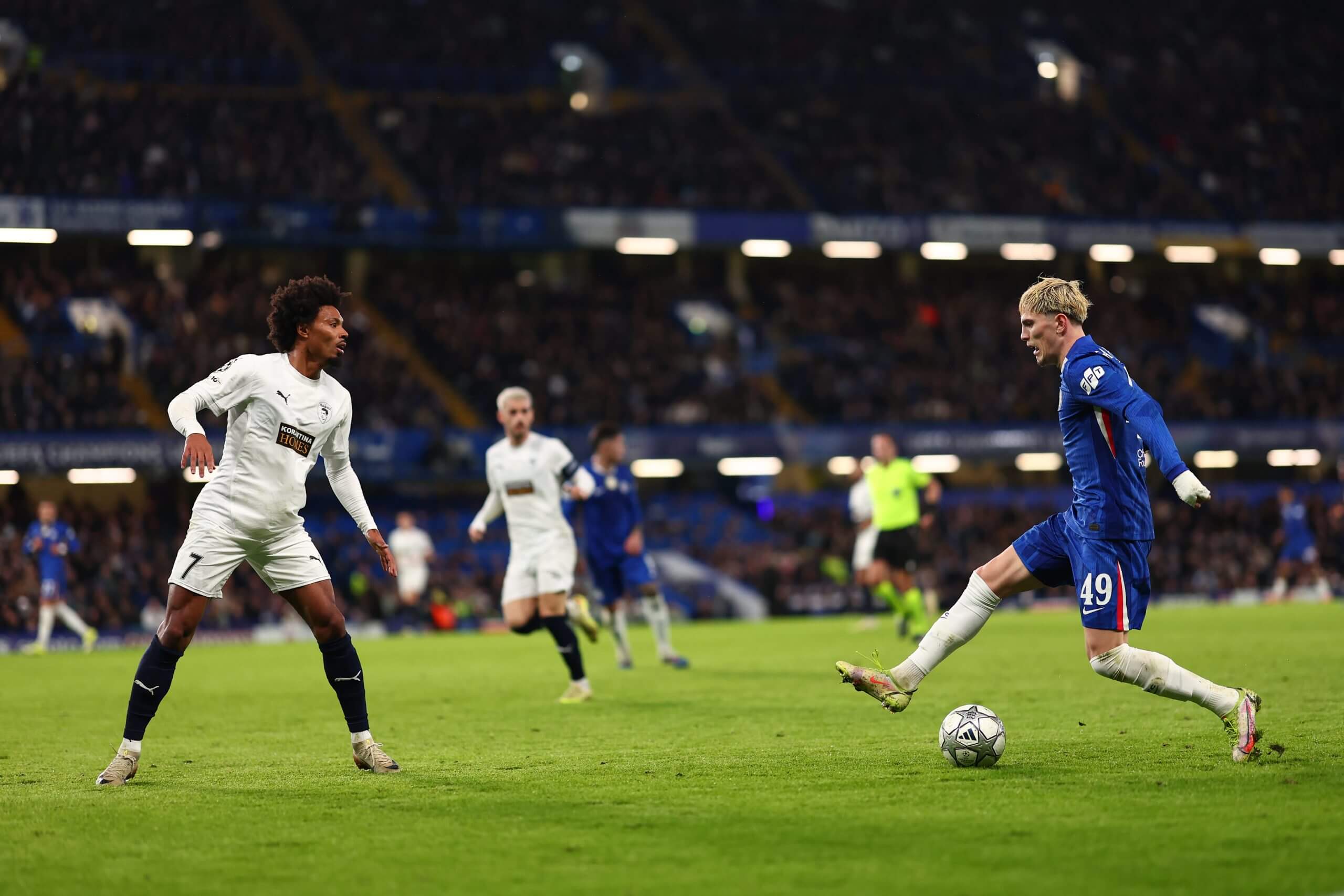
It was one night a couple of summers ago, on stage at the 300-capacity Radlett Centre, just north of London, that the most decorated player in Manchester United’s history tried to get to the heart of the Alejandro Garnacho puzzle.
One member of the audience for ‘An Evening with Ryan Giggs’ wanted to know whether the 13-time Premier League champion could see a time when then United youngster Garnacho moved past the stage of potential and established himself as a regular destroyer of defences.
Giggs responded by recalling his own experiences at Old Trafford, as Sir Alex Ferguson once put it, of “trampling up and down that bloody wing for 20 years”. And his message was that it was worth persevering.
“What I like about him — and I got told this by Brian Kidd (Ferguson’s then assistant manager and himself a former United forward) when I was 15 — you can run at a defender 10 times and lose it nine times. But that 10th time, you will win the game. So keep going, don’t worry about it if you lose the ball. Garnacho has got that. He will frustrate you, he will lose the ball, frustrate his team-mates, but in the end he will create something.”
(Shaun Brooks – CameraSport via Getty Images)
Patience is the key, in other words, even if now former United head coach Ruben Amorim ran out of it where Garnacho was concerned, and there are some Chelsea fans who are already feeling the same way during these getting-to-know-you stages for him following last summer’s €40million ($54.2m at the current rate) move to Stamford Bridge.
It hasn’t been an easy introduction, and watching Chelsea come up short against Arsenal in the Carabao Cup semi-finals earlier this week, it was unusual to see a player with Garnacho’s attacking instincts look so unadventurous. He was introduced in the 75th minute of the tie’s second leg, around the time Chelsea were trying to find some extra penetration in forward areas at 3-2 down on aggregate.
His failure to make any impact was noted by Gary Neville, as Sky Sports’ co-commentator, and, more critically, by Jamie Redknapp in the broadcaster’s post-match analysis. Every pass he made seemed to go either backwards or sideways. He seemed reluctant to take on his man. Nor was Tuesday night the first time we have seen that from him recently, if you consider Neville’s verdict last weekend that, confidence-wise, Garnacho “looked shot to pieces”.
On that occasion, Garnacho was taken off at half-time in a home Premier League match against West Ham United that, at one stage, was threatening to become a personal ordeal. Neville has been watching him for years, but he, too, sounded unsure about the player’s true worth: “A lot of people ask the question — is he top class or… where is he in the pecking order?”
The short answer is that we are still waiting to find out, and, in the meantime, maybe Garnacho is discovering there are certain clubs, his current employers included, where there isn’t always a lot of patience to be found.
If you are a big-money signing at Chelsea, the fans expect you to show why, and quickly. They will let you know if they aren’t happy with your performance, and there aren’t the extra allowances that Garnacho had, perhaps, at United for being ‘one of our own’ as an academy graduate — at least, that is, until his fall-out with Amorim led to his banishment from the first-team squad.
For Chelsea, there have been only two occasions across 27 appearances when Garnacho has both started and finished a match. He has managed six goals, which doesn’t seem too bad a record on first viewing, especially as in 10 of those games he has been a substitute. Only one of those six, however, has come in the Premier League. Two came in the Carabao Cup against Cardiff City from third-tier League One, and another was against Qarabag of Azerbaijan in the Champions League.
Garnacho did score twice, as a substitute, in the first leg of that Carabao Cup semi-final against Arsenal, but rather than that being the start of better times, it has actually gone the other way.
He must have heard the angry shouts from the Stamford Bridge crowd against West Ham on Saturday, when he had no joy whatsoever against the visitors’ right-back, Aaron Wan-Bissaka, and that was the third occasion this season when he has been withdrawn from a Premier League match at half-time. The same happened away to Nottingham Forest in October and at home against Bournemouth in December.
In a press conference on Thursday, Rosenior said: “Garna, like all the players here, had a difficult half against West Ham. I thought he showed some really bright moments coming on against Arsenal (in the Carabao Cup), and he’s going to be massive for us. We have a lot of games to come, and he’ll have plenty of opportunities to show his quality.”
In mitigation, perhaps it doesn’t help Garnacho that Chelsea’s tactical approach under new coach Liam Rosenior and previously Enzo Maresca is not always ideal for wide players who want space to attack. There is a lot of slow possession against teams that tend to sit back. Chelsea’s full-backs don’t often overlap, and that means Garnacho frequently has two opposition defenders in front of him when he gets the ball.

(Chris Brunskill/Fantasista/Getty Images)
Let’s also not forget that the subject of this debate is still only 21. Sometimes it can feel like he must be older, but no, it is just that he has been running at Premier League defenders since he was 17.
At such an age, maybe a bit of inconsistency is the norm, and maybe we should all cut him a bit of slack, especially as there have been plenty of occasions during his breakthrough years when he has shown he is not just a talented, penetrative footballer, but a brave one, too.
In football, bravery can come in lots of different forms. It isn’t just about throwing yourself into tackles. It needs courage to want the ball, even in tight positions, no matter how often you have been kicked, or how many times you have tried something and it hasn’t come off. George Best always wanted the ball. Giggs had that courage. Cristiano Ronaldo? Bucketloads of it. Eden Hazard, too, if we look at some of Chelsea’s greatest wingers. Garnacho is not short of it, either.

(Peter Byrne/PA Images via Getty Images)
That, however, is where the comparisons should probably end, because this is the other part of the Garnacho debate: has he made the classic mistake of believing he is a better player than he actually is?
Arrogance, channelled in the right way, can be a useful tool for a player in Garnacho’s position. Misplaced arrogance, not so much. And, though it is not necessarily a bad thing that the eight-time Argentina international appears to have a very high opinion of himself, there have been parts of his behaviour — immaturity, egotism, call it what you will — that have not helped him in the court of public opinion.
Amorim felt strongly enough to tell him, in front of the other players, to find another club: “You better hope you have a good agent.” And, whatever you think about Amorim’s methods, there must have been a long accumulation of events for a club with United’s proud record of youth development to take such a hardline stance against a homegrown player — especially when that player was viewed at the club as an £80m asset.
Then there was all the follow-up silliness and Garnacho’s apparent belief that it would somehow be a good idea to put out a picture of himself wearing an Aston Villa shirt in support of Marcus Rashford, another player who had pushed Amorim’s boundaries too far and wound up on loan at Villa for the second half of last season and then farmed out to Barcelona by his Portuguese boss for the duration of this one.
There were other incidents, too, even before Amorim took the job in November 2024, when the coaches at Old Trafford questioned whether Garnacho’s talent went hand in hand with an ability to take on instructions and when his focus went missing. Maybe these issues wouldn’t have mattered so much if he had been playing like a dream every weekend. But he wasn’t — and that’s the bottom line.
The same applies at Chelsea, where Rosenior appears to regard Pedro Neto and Estevao as the club’s best two wide players, with Garnacho third and Jamie Gittens fourth. Estevao has recently been on compassionate leave in his homeland of Brazil, and with Gittens injured, that should mean Garnacho has plenty of chances in the coming weeks.

(Michael Regan – UEFA/UEFA via Getty Images)
Can he turn it around? Of course. The club looked into the player’s character and sought a wide range of opinions. They decided in the end that £40m for a 21-year-old with Garnacho’s potential made him a bargain. “It’s easy to work with him,” Maresca told reporters in December. “He wants to learn, has an open mind, and works hard on and off the ball.”
For the time being, however, Chelsea’s fans are witnessing an elegant frustration: a player whose decision-making on the pitch is flawed too often. Worse, it’s a recurring theme, indicating it is just not a matter of confidence, but maybe also a question of football intelligence.
In particular, Garnacho needs to refrain from his habit of trying shots from all sorts of angles and distances when there are better choices available to him. But that brings us back to that fan event with Giggs, and the message he was trying to get across about it being a learning curve for a player of such an age.

(Alex Broadway/Getty Images)
“Of course, that final decision-making isn’t quite there,” Giggs told his audience. “I had to (learn that), Lee Sharpe (the Welshman’s fellow wing starlet of that era) had to, Ronaldo had to. That pass, the decision-making, the goalscoring. That will come, though, with experience and good coaching.”
The potential is all there. Equally, there are some of us who remember the years when Ferguson regularly made the point that he disliked the word ‘potential’. Peter Barnes was one player he mentioned from his early days at United in the 1980s. “Everyone was telling me he had such great potential,” said Ferguson. “But he was nearly 30 years old.”
The moral of the story for Garnacho?
There comes a time in the life of every talented young player when all that potential has to fully flower. And football, more than ever, is an impatient business.