We like to believe our health decisions are guided by science. Yet history — and modern social media — suggests that fame often competes surprisingly well with evidence. New research shows that the power of celebrity extends far beyond marketing and into real-world medical decision-making.
Imagine how bizarre it would be to open up to a friend about suffering from stomach pain, excessive gas, and severe heartburn, only for them to simply ask, “Have you tried blowing tobacco smoke up your rectum?”
Most people would burst out laughing and ask whether their friend had been eating hallucinogenic mushrooms. However much this resembles a comedy sketch, European physicians advocated this “treatment” during the eighteenth and nineteenth centuries, not only for abdominal pain but, even more surprisingly, for drowning victims. Thomas Cogan and William Hawes, founders of the London Society for the Recovery of Persons Apparently Drowned, justified the practice by claiming that the heat and stimulation from the smoke could restore peristalsis and revive the body.
We now know the therapy was ineffective — its value, if any, likely came from survivors’ anecdotes, physicians’ authority, and the absence of the scientific methods we now use to evaluate treatments. As physiology, evidence-based medicine, and clinical research advanced, physicians eventually abandoned the practice altogether.
Although this is an extreme example, it illustrates a much broader phenomenon: beliefs that lack scientific support can seem convincing when people perceive their advocates as authorities. That dynamic has shifted over time: doctors once filled that role, but celebrities and influencers now far more often possess this halo of expertise.
From Physicians to Influencers: Authority Without Expertise
While not all such endorsements cause significant harm, some simply lead people to spend money or adopt habits with no proven benefits. Others can have far more serious consequences. One example is physician and influencer Paul Saladino, a leading proponent of a version of the carnivore diet [1], who argues that “anti-nutrients” such as lectins, oxalates, and phytates in plant-based foods are among the main problems with the modern diet. His diet is high in saturated fat, which raises LDL cholesterol and cardiovascular risk.
The problem is not limited to digital influencers. Actors and other public figures have also promoted pseudoscientific practices over the years, including geophagy, the consumption of clay or other soil, despite the lack of proven benefits and the risk of infection and parasitic disease. Others have endorsed Reiki as a therapeutic intervention or promoted rhetoric opposing psychiatry and the pharmacological treatment of mental disorders. Fact-checking organizations have documented these patterns for decades, even as the specific celebrities attached to them change from one news cycle to the next.
These recommendations can exert far greater influence than many people realize. People often attribute credibility to famous individuals simply because they mistakenly interpret competence in acting, music, or sports as evidence of expertise in entirely different fields, including medicine and nutrition – a phenomenon psychologists call the “halo effect.”
But what does the scientific literature say about celebrities’ influence on the spread of health-related information and misinformation, and what does that tell us about their effect on health decisions?
Why Celebrity Opinions Feel More Credible Than Evidence
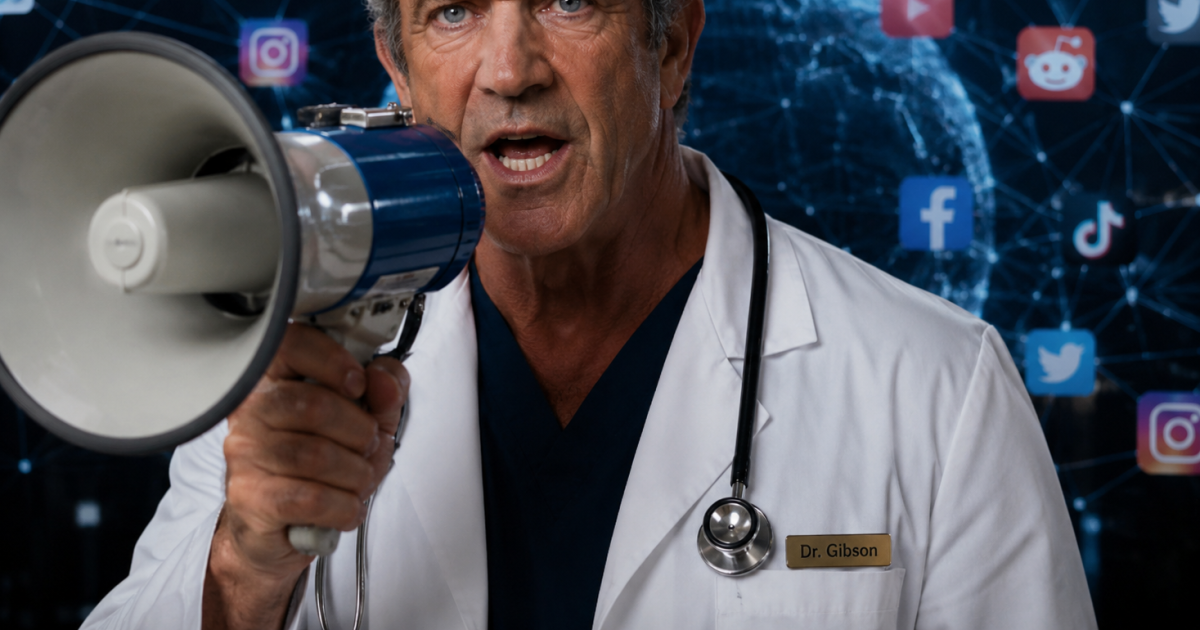
In January 2025, during an appearance on The Joe Rogan Experience, actor Mel Gibson claimed that three friends with stage IV cancer were recovering after using ivermectin and fenbendazole, an antiparasitic drug used in veterinary medicine. No reliable clinical evidence shows these drugs are safe or effective for treating cancer. Nevertheless, his remarks quickly spread across social media and news outlets.
Gibson is far from an isolated case. During the COVID-19 pandemic, President Donald Trump suggested that disinfectants might help fight the virus before later claiming he had been joking; poison control centers soon reported a surge in related inquiries. In Brazil, then-President Jair Bolsonaro repeatedly promoted the so-called “Covid kit“, advocating hydroxychloroquine and ivermectin even after evidence showed neither drug reduced hospitalizations, mortality, or other clinically relevant outcomes. Even so, millions of Brazilians used these medications without evidence of benefit. These episodes raise the same question: why do health claims from people with no medical training or expertise influence so many people?
A meta-analysis of 46 marketing studies sought an answer.
Researchers found that celebrity endorsements were most effective in marketing when celebrities closely matched the products they promoted, with the strongest effects observed for well-matched male actors. However, across the full dataset, celebrity endorsements generally underperformed simpler and less expensive alternatives, such as quality seals, awards, and non-celebrity endorsers. Their persuasive advantage, the authors concluded, was real but narrow and highly dependent on a good celebrity–product fit.
A meta-narrative, the qualitative form of a meta-analysis, synthesized 104 studies (from an initial pool of more than 2,500 publications) and identified more than a dozen mechanisms that help explain why people often perceive celebrities as trustworthy sources of health advice.
- Halo effect — The mistaken belief that success in one field is expertise in another, allowing a famous actor or athlete to speak about medicine despite having no relevant training.
- Source credibility — Celebrities are most persuasive when people perceive them as both trustworthy and knowledgeable, especially when their public image aligns with the advice they promote.
- Self-concept — Celebrity endorsements become more persuasive when they align with how people see themselves or aspire to be seen. This can be strengthened with stronger emotional bonds to the celebrity. Oprah Winfrey’s endorsement of the unproven cold remedy Airborne led to a sharp increase in sales.
- Herd behavior — People often feel more comfortable following choices that others appear to make, and celebrities frequently act as trendsetters. After Angelina Jolie announced her preventive double mastectomy in 2013 following a positive BRCA1 test, BRCA testing in the United States increased by approximately 64% within weeks.
The study can’t rank these mechanisms or establish causal relationships, but it offers a plausible explanation for a phenomenon observed across multiple contexts. It also raises another question: Does admiration for celebrities correlate with different health beliefs?
Does Celebrity Admiration Change Health Behavior?
A study published in Psychology, Health & Medicine examined this question among 320 American adults, using their attitudes towards vaccination and celebrities. Greater admiration for celebrities was associated with more negative attitudes toward vaccination.
Now, this was not driven by lower confidence in vaccine effectiveness; instead, these individuals expressed greater concern about adverse effects, highlighted the stronger commercial interests behind vaccination, and showed a stronger preference for so-called natural immunity, acquired through the disease itself. Participants with higher levels of celebrity admiration were also more likely to endorse conspiracy theories.
Although the study cannot establish causation, its findings are consistent with previous research on public figures’ influence over health-related attitudes. Celebrities can shape beliefs and, potentially, behavioral intentions. But can they change real-world behavior?
Highly publicized events like Gibson’s comments create natural experiments, in which a public figure makes a medical claim to millions of people within a short window, and researchers can compare behavior before and after to see whether it had a measurable effect.
A study published in JAMA Network Open set out to investigate exactly that.
When Celebrity Advice Becomes Medical Practice
Published in May, the UCLA-led study compared prescriptions for the combined use of ivermectin and benzimidazoles from January through July 2025 — after Gibson’s episode aired — with the same period in 2024.
The analysis included electronic health records from 68,373,949 patients across 67 healthcare organizations representing all U.S. census regions. Monthly prescription rates for the ivermectin-benzimidazole combination were calculated per 1,000 patients in both the general population and among individuals with one or more cancer diagnoses.
The results were striking. In the general population, prescriptions nearly doubled compared with the previous year. The largest relative increases occurred among adults aged 18 to 64, White individuals, and residents of the Southern United States.
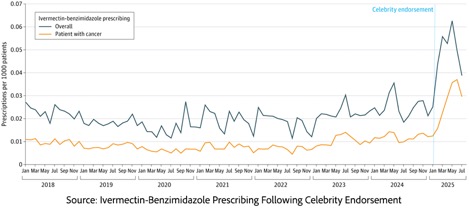
Among patients with cancer, prescription rates increased by more than two and a half times, driven largely by adult men aged 18 to 64, White patients, and residents of the South. This is especially concerning because these patients may delay or abandon evidence-based treatment in favor of therapies with no proven benefit.
The podcast episode was viewed more than 60 million times across multiple platforms. The geographic and demographic distribution of prescriptions closely mirrors the audience for this type of content. This suggests that misinformation can spread through large audiences and be reflected in prescribing patterns, disproportionately affecting specific groups.
Naturally, the study has important limitations. As an observational study, it cannot establish causality, and the data reflect prescriptions rather than use. Even so, the findings add to growing evidence that celebrities can exert a tangible influence on health-related behaviors, particularly in environments characterized by low institutional trust and the widespread circulation of misinformation.
Fighting the Celebrity Advantage
Unfortunately, the current landscape offers little reason for optimism. Gibson was certainly not the first, and he is unlikely to be the last, to promote unproven treatments based on anecdotal experiences. The broader issue is not simply that people trust celebrities or politicians more than experts.
We could place all the blame on people who trust celebrities or politicians more than experts. Yet that explanation is overly simplistic, because the celebrity effect is also shaped by persuasion, trust, and misinformation.
Part of the problem lies in academia’s longstanding inability to communicate scientific findings beyond university walls. That gap has been filled by influencers offering simple answers to complex problems, often mixing legitimate facts with overgeneralizations and conspiracy theories. The debate over dietary supplements and sweeteners illustrates this well, with animal studies frequently generating alarmist headlines despite their limited relevance to human health.
Individual reasoning, however, represents only part of the equation. A podcast does not reach 60 million views through word of mouth alone. Social media platforms amplify and redistribute content through recommendation systems optimized to surface engaging, emotionally charged, and contrarian claims, regardless of their accuracy.
Another contributing factor is the limited emphasis our educational systems place on teaching critical thinking from an early age. Learning to distinguish anecdotes from scientific evidence, recognizing that no single study answers a question on its own, and understanding the limitations of research may be among the most effective tools for reducing the impact of health misinformation. This approach overlaps with what misinformation researchers call “pre-bunking.” The Gibson case illustrates the stakes: a public already equipped to ask these questions might not have doubled a country’s prescribing rate for an unproven cancer treatment on the strength of a podcast anecdote.
Anti-scientific narratives will never disappear. Celebrity culture is unlikely to fade. But if we can teach people to ask one simple question—“What is the evidence?”—instead of “Who said it?” fame may finally lose its advantage over science, and fewer may fall victim to misinformation’s celebrity lure.
[1] Saladino’s current diet, known as the Animal-Based Diet, includes some fruit but is overwhelmingly centered on animal fats and protein. Given its high saturated fat content and low fiber content, it remains a poor dietary choice.