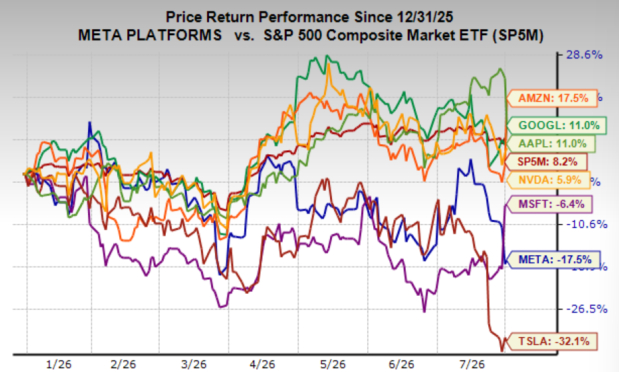
Six of the Magnificent Seven companies have now reported earnings, and the results have been broadly impressive. Despite their enormous size, these businesses continue to deliver exceptional growth, with the AI boom simultaneously strengthening their long-term opportunities and placing greater demands on cash flow, though the impact varies considerably across the group.
Even so, the market has responded harshly to some otherwise strong reports, which brings me to an important point before reviewing the results and identifying which stocks stand out.
Earnings reactions are often dramatic. Apple (AAPL) fell roughly 9% following its report, while Microsoft (MSFT) rallied about 15%. After moves of that magnitude, investors naturally ask why, and analysts and the financial media typically offer a neat explanation that can be quickly understood.
In Apple’s case, the stock sold off despite a record quarter, with investors focusing on the shortfall in Services, one of the company’s highest-margin and most important growth businesses.
That explanation is not necessarily wrong, but it is incomplete. Stock reactions rarely occur in isolation, and a simple earnings headline can miss the broader forces shaping the move.
The market had already been under pressure for much of the past month as concerns about excessive AI spending weighed on technology stocks. Investors were also awaiting Wednesday’s Federal Reserve meeting amid uncertainty over the path of monetary policy. At the same time, Apple had been the strongest-performing Magnificent Seven stock, partly because it had attracted capital as the one member of the group avoiding a massive AI capital-spending cycle.
So yes, Apple fell partly because of the Services miss. But the decline also coincided with the conclusion of the Fed meeting, greater clarity around interest-rate policy and what may have been a capitulation point in the AI trade. Positioning mattered as well. Investors had crowded into Apple ahead of the report, and even after the selloff, the stock remains solidly higher over the past quarter and year to date.
The broader point is that the market environment can be just as important as the earnings results themselves. During a powerful bull market, investors may overlook a mixed quarter. During a correction, even an excellent report can be sold.
With that context in mind, let’s turn to the results. Meta Platforms (META), Microsoft (MSFT) and Amazon (AMZN) stand out most to me following the earnings reports so far. Nvidia (NVDA) has yet to report, but it also remains compelling based on valuation, with its forward earnings multiple near the lower end of its historical range.
Image Source: Zacks Investment Research
Magnificent Seven Earnings Results
Broadly speaking, the Magnificent Seven stocks look quite attractive to me. Excluding Tesla, valuations are generally reasonable, while revenue and earnings growth are accelerating across much of the group. Capital spending and weakening free cash flow remain the primary overhangs, but the latest results also suggest that these investments are beginning to generate meaningful returns.
Alphabet
Alphabet delivered another excellent quarter. Google Cloud revenue surged 84% year over year, while Search growth accelerated into the mid-teens.
Investors instead focused on the continued rise in capital spending and the fact that free cash flow turned negative for the first time in the company’s history. Those are legitimate concerns, but the valuation provides a considerable margin of safety. At roughly 17 times forward earnings, with EPS expected to grow 17.4% annually and the company exceptionally well positioned for the modern digital economy, Alphabet is difficult to overlook. It currently carries a Zacks Rank #2 (Buy).
Meta Platforms
Meta delivered another strong topline beat, with revenue rising 28% year over year. Once again, however, investors focused on weakening free cash flow as the company directs more capital toward AI infrastructure.
Meta did not increase its capital-spending forecast, though it narrowed the guidance range, and shares fell roughly 8% following the report. The stock is now approaching an important technical support level.
At approximately 18 times forward earnings, Meta looks increasingly compelling. Its core advertising business remains exceptionally strong both with engagement and prices rising, while an emerging cloud business could provide another significant long-term growth engine. Bouncing right at that level of support.
Amazon
Amazon delivered a monster quarter, beating expectations and raising its outlook. AWS, the world’s largest cloud platform, continued to accelerate, posting its fastest growth in 18 quarters and reaching an annualized revenue run rate of approximately $169 billion. Segment operating margin expanded to 39.4% from 32.9%. A year ago AWS was growing in the high teens.
Amazon also disclosed that its AI and semiconductor businesses have each surpassed a $25 billion annualized revenue run rate and are growing at triple-digit rates. Free cash flow turned negative after capital expenditures, but the strength of AWS and these emerging AI businesses should help ease concerns about the company’s spending.
Advertising was another bright spot, with revenue rising 26% year over year. Remarkably, Amazon trades at only about 26.3 times forward earnings, a compelling valuation given the acceleration across its highest-quality businesses.
Microsoft
Microsoft’s post earnings reaction was astonishing, with the stock rising 15% and making a record for the largest market cap appreciation in a single day by any stock ever.
The company beat expectations on both the top and bottom lines, while revenue increased 18%. Azure grew 27%, and other cloud services expanded 43%, further demonstrating the extraordinary strength of cloud and AI demand across the industry.
Microsoft also reported more than 30 million paid Copilot users, up from 20 million one year ago. Microsoft got dragged lower during the software rout, and appears to be rising from the depths. That seems reasonable given these results too.
At roughly 23.2 times forward earnings, the company remains one of the highest-quality businesses in the market.
Tesla
Tesla (TSLA) reported a respectable quarter, with revenue finally returning to growth and increasing 25% year over year. However, some of that strength appeared to be supported by discounts and aggressive financing offers intended to reduce inventory.
The major highlight was the Services business, where revenue increased 50% to nearly $5 billion for the quarter. In my view, that segment represents an increasingly important part of Tesla’s long-term future.
Still, Tesla remains the black sheep of the Magnificent Seven. Its valuation is exceptionally high, while growth in its core automotive business remains comparatively modest. The company may ultimately justify the premium through autonomy, robotics and services, but the current risk-reward profile is far less attractive than the rest of the group.
Apple
Apple delivered a strong beat-and-raise quarter, though the stock faded following the report. In my view, the decline was largely a positioning issue.
Apple had already rallied roughly 25% year to date and entered earnings with a market capitalization near $5 trillion. With expectations and positioning elevated, the bar for a positive reaction was unusually high.
Revenue increased 16% year over year, an exceptional growth rate for a company of Apple’s size, while EPS jumped 29%, marking a ninth consecutive quarterly beat. iPhone revenue rose 22%, Mac sales came in well ahead of expectations and every geographic segment posted double-digit growth.
The lone weak spot was Services, which missed estimates. Given that Services is Apple’s highest-margin and most structurally favored business, the shortfall likely provided the immediate catalyst for the selloff.
The larger takeaway is that the criticism that Apple can no longer innovate may be correct in a narrow sense, but it increasingly matters less. Apple remains an extraordinarily well-run organization selling products consumers continue to demand, while occupying one of the most valuable distribution positions in the digital economy.
It was a stellar report, and I view the selloff primarily as the result of elevated expectations and crowded positioning. Apple remains a great company, but at approximately 38 times forward earnings, the stock is richly valued, even if the valuation has not yet reached outright euphoric territory.
Should Investors Buy Shares in Magnificent Seven Stocks
Questions about the ultimate return on AI capital spending remain valid, but the latest earnings reports suggest that the Magnificent Seven is at least reasonably well positioned to profit from the investment cycle.
Amazon offered the clearest evidence. AWS growth accelerated sharply, margins expanded and the company’s AI and semiconductor businesses are already generating meaningful revenue at extraordinary growth rates. Microsoft, Alphabet and Meta are at different stages of the same process, but their scale, distribution and control of critical infrastructure give them a credible path to monetizing these investments over time.
The greater burden of proof may ultimately rest with the AI laboratories themselves, including OpenAI, Anthropic and other model developers. These companies must demonstrate that the economics of training and operating increasingly powerful models can support durable margins. The hyperscalers, by contrast, are selling the compute, cloud capacity, data infrastructure and distribution required to power the entire ecosystem.
Cloud computing and data centers may not become the most profitable layer of the AI boom. Competition is intense, capital requirements are enormous and margins could come under pressure as capacity expands. Even so, they should remain a substantial source of profits and an indispensable part of the broader AI economy.
Taken together, the Magnificent Seven still looks remarkably strong. Discernment is necessary, particularly when comparing valuations, capital intensity and the visibility of returns. But the group’s earnings power, competitive advantages and central role in AI suggest that, collectively, these companies should remain capable of carrying the broader market higher.
Zacks’ Research Chief Names “Stock Most Likely to Double”
Our team of experts has just released the 5 stocks with the greatest probability of gaining +100% or more in the coming months. Of those 5, Director of Research Sheraz Mian highlights the one stock set to climb highest.
This top pick is a little-known satellite-based communications firm. Space is projected to become a trillion dollar industry, and this company’s customer base is growing fast. Analysts have forecasted a major revenue breakout in 2025. Of course, all our elite picks aren’t winners but this one could far surpass earlier Zacks’ Stocks Set to Double like Hims & Hers Health, which shot up +209%.
Free: See Our Top Stock And 4 Runners Up
Amazon.com, Inc. (AMZN) : Free Stock Analysis Report
Apple Inc. (AAPL) : Free Stock Analysis Report
Microsoft Corporation (MSFT) : Free Stock Analysis Report
NVIDIA Corporation (NVDA) : Free Stock Analysis Report
Tesla, Inc. (TSLA) : Free Stock Analysis Report
Meta Platforms, Inc. (META) : Free Stock Analysis Report
This article originally published on Zacks Investment Research (zacks.com).
The views and opinions expressed herein are the views and opinions of the author and do not necessarily reflect those of Nasdaq, Inc.