Support CleanTechnica’s work through a Substack subscription or on Stripe.
On my recent trip to China, I headed to a BYD dealer to test drive models, but I ended up at the wrong location. NIO, XPENG and Tesla showrooms were next door. As with many parts of my trip, I just went with it, and it turned out for the best.
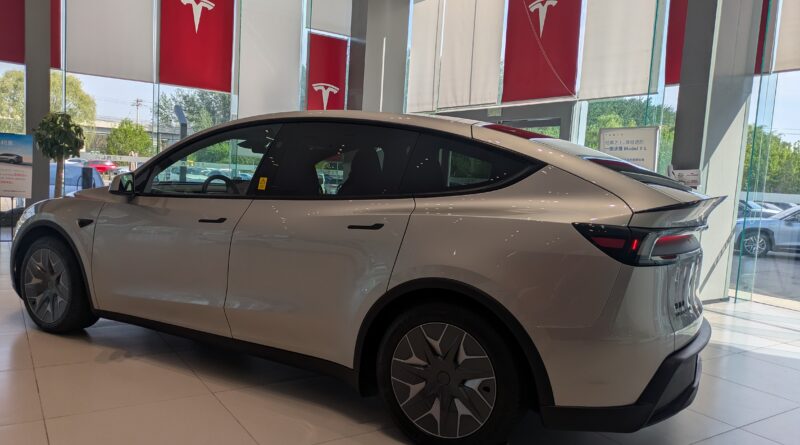
At the Tesla showroom was the Model Y L. As this version is not available in the US, many readers will find it interesting. Visually, it looks like the familiar Model Y, just a bit larger. Without a side-by-side comparison, many wouldn’t notice the difference. That means you either love or hate the styling, but it looks increasingly dated. In the third row, my head still hit the rear glass, my feet didn’t fit behind the second row, my knees were elevated, and my thighs didn’t have support, but it wasn’t the kind of oppressive contortionism that I expected. I sat with my feet down the center aisle. The third row would undoubtedly be more than adequate for shorter people or the children most likely to be sitting there.
Beyond the third row, it was not much different from a regular Model Y. Technology and materials were better than most of the cars that I saw at the New York Auto Show, even if it is a bit sparse and basic. Including “Intelligent Assisted Driving” (can’t legally call it FSD in China), the price comes to 403,000 RMB ($59,260 USD). From an American perspective, it would be a compelling offering to many buyers. However, in the context of the competitive EV market in China, the appeal changes.


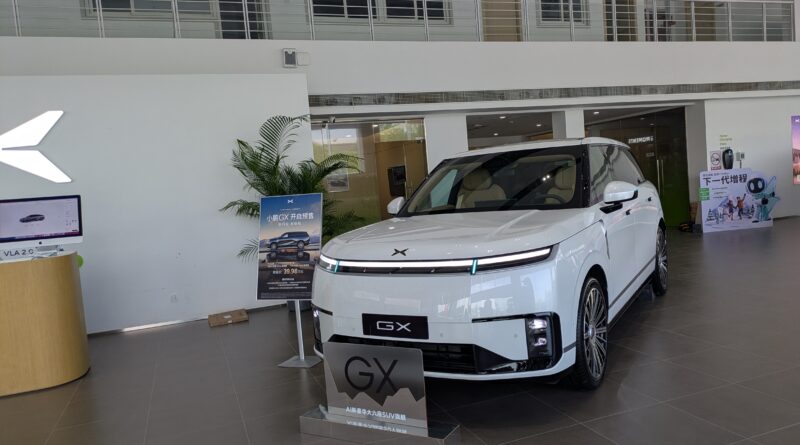
On display next door was the new three row XPENG GX. At 5.3 m long, it is a size class above the Y L and offers far more interior space. Steer by wire is on both axles and the suspension is electronically controlled for height and stiffness. Battery range is essentially the same as the Tesla, but the XPENG charges faster on an 800V platform. While acceleration may not be the top priority in this segment, the XPENG also accelerates faster. All openings are motorized. Up front, the driving position was comfortable, with great forward visibility and bountiful technology. It did not seem like it would be overwhelming to drive, in spite of its size.
Heated, cooled, massaging, zero gravity seats with extending leg rests offer comfort levels above business class airline seats. The heated and ventilated third row had plentiful head and knee room, with far more recline and comfort than the economy class seat that I faced for the 16 hour flight back to JFK. While it does not have flight attendants walking the aisle, a dual zone refrigerator keeps drinks cold. Electrochromic windows provide shade and privacy. A widescreen TV folds down from the ceiling for entertainment. And it comes with XPENG’s excellent VLA 2.0, L4-ready with an industry-leading 3000 TOPS of computing power. You get the feeling that they are running out of ideas to include in the vehicle. It seems like a dramatic step up from the Model Y L. However, it is currently only offered in flagship-level trim at 399,800 RMB ($58,790 USD), or slightly less than the Model Y L with ADAS software included.


Next to XPENG was the BYD dealership. Their inventory was limited due to the model transition, but I was able to drive the new Song Ultra. I have a feeling that model will become their top seller, although it competes more directly with the two-row Model Y. The Y L would be competing with the new Datang or “Great Tang” that I saw at the Beijing Auto Show. That model has already racked up over 100,000 preorders a few days after launch. It will be able to take advantage of the Flash Charging station that was being installed at the dealership to charge from 10–70% in five minutes and 10–97% in 9 minutes. Top AWD models accelerate to 100 km/h in 3.9 seconds. The vehicle is large, luxurious, and filled with technology. It is far beyond the Tesla, even if it is arguably not up to the level of refinement found in the XPENG. However, with a price of 250,000 RMB to 320,000 RMB ($36,700–$47,050 USD) it is an amazing value.


At the other end of the lot was the NIO dealer. On display was the L90 from sub-brand Onvo. This three-row SUV with 900V architecture was launched last year. As NIO’s mid-tier brand, it is not as large, luxurious, or tech-packed as the XPENG or BYD, but still far beyond the Tesla. It also does not have the charging speed of the BYD, but it does offer battery swap, with a swap station at the dealer. It starts at 265,800 RMB ($39,084 USD) with the battery or 179,800 RMB ($26,483 USD) with Battery as a Service (BaaS).


There was also the dancing, fully-active-suspension NIO ES9 on display, but that starts higher at 528,000 RMB ($77,600) and is positioned as a level above this competitive set.
A Great EV, But Not As Great In Comparison
If viewed in isolation, the Model Y L is a great vehicle. In markets with more limited offerings, and especially the US market, I think many people would find it compelling. In some markets, Chinese competitors also tend to be priced higher in comparison, changing the economic argument. In addition, the Y L was more competitive when it was launched last year. For example, XPENG didn’t have a three-row SUV or VLA 2.0. Many of the new three-row SUV competitors didn’t exist a few months ago. Tesla was not at the Beijing Auto Show to sit next to its top competitors, which probably works in its favor.
When viewed next to top Chinese competitors, the Tesla now seems hard to justify as a three-row SUV. Some people may want a smaller vehicle that still has a third row for occasional use. While I didn’t get a chance to drive them, I also have a feeling that the Tesla is more tuned for driver engagement than passenger comfort. If you want a car that could transport your friends and family in a pinch, but don’t want them to make a habit out of it, the Y L could be the car for you.
However, Tesla’s three-row SUV is outclassed in size, amenities, technology, materials, and fit and finish. Of the three in the comparison, the Model Y is the only model on an older 400V platform and charges more slowly than what is becoming the expectation in China. For the money, you get far more SUV from competitors.
And the competition is moving much faster. If there is some niche where the Y L still holds an advantage, expect competitive vehicles within the next year. Tesla has been moving much more slowly. Unless that changes, it will be even harder to justify in a couple of years, when recently released models are refreshed and many new models will have been released.
I asked several consumers and industry insiders why they would buy the Tesla, and the answers were interesting. I heard that from being the first EV brand to take off in China, many felt safer with Tesla. While we can feel a bit overwhelmed trying to track all the new EV brands in China from the US, many Chinese consumers are also overwhelmed and unfamiliar. Technology is developing faster than brand awareness and affinity. Some consumers do not want to put their faith in a new brand for such a large investment. While many of us in the US tend to see Tesla as a new brand, it is one of the older EV brands in China and is seen as a more established automaker there. Some older buyers also consider Western brands to be higher quality, reinforced by perceptions formed decades ago when the Chinese domestic auto industry was in its infancy.
This was backed up by several other people who said that Tesla was for older, more conservative people in China. This is a stark contrast to the perceptions of many in the US, who see Tesla as a brand for younger, tech-savvy early adopters. Young people in China tended to be more accepting of newer domestic brands. They also are more likely to embrace electrification overall, leading to the proliferation of EVs in China. The average new car buyer is in their 30’s in China, decades younger than the average new car buyer in the US. EVs have a clear economic advantage in China, with low-cost electricity and public charging, while gasoline prices are on the rise.
For an older buyer who is looking to buy an EV but is more reluctant to try the latest technology or newest brands, the Tesla brand is a safer bet. Those buyers may be coming from a legacy brand that is having a tough time pivoting on its legacy into electric vehicles.
However, the lag between brand perception and product reality will not last forever. Chinese brands now have better EVs that are getting better faster. The legacy automakers with a future in China will also be introducing competitive EVs, typically developed with Chinese partners. I know several people who are big fans of the 3-row VW ID. ERA 9X EREV, for example. The market and technology are moving at “China speed,” and Tesla is feeling slow and outdated in comparison. Even when looking at self-driving and humanoid robots, Tesla is already falling behind in China. Unless Tesla speeds up and diversifies its lineup, it could be in a tight spot in China when brand perception catches up with product reality.
Sign up for CleanTechnica’s Weekly Substack for Zach and Scott’s in-depth analyses and high level summaries, sign up for our daily newsletter, and follow us on Google News!
Have a tip for CleanTechnica? Want to advertise? Want to suggest a guest for our CleanTech Talk podcast? Contact us here.
Sign up for our daily newsletter for 15 new cleantech stories a day. Or sign up for our weekly one on top stories of the week if daily is too frequent.
CleanTechnica uses affiliate links. See our policy here.
CleanTechnica’s Comment Policy