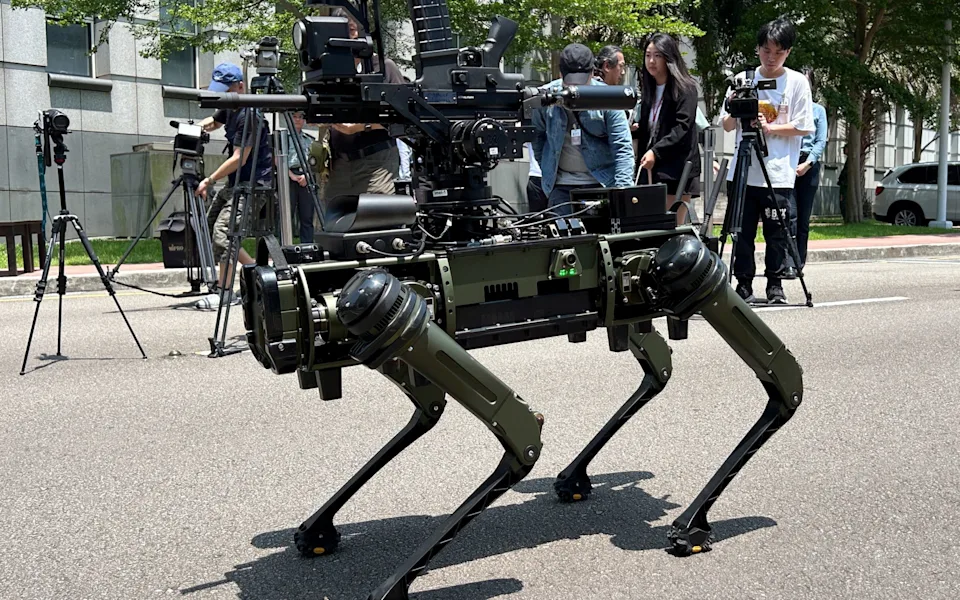
Armed robot dogs could be used to patrol Taiwan’s islands in the South China Sea and guard against attacks from Beijing.
Four-legged military machines have been developed for reconnaissance, surveillance and firepower, in the hope that they could deter a Chinese invasion.
Experts say there is a “pressing need” for patrols and inspections along the remote coastlines of the Spratly and Pratas Islands in the South China Sea.
Taipei’s top weapons development institute, the military-owned National Chung-Shan Institute of Science and Technology (NCSIST), previewed three different types of mechanical quadrupeds that it is considering for service.
While the robotic animals were developed by US company Ghost Robotics, NCSIST attached its own technology to the machines including a gun to the back of the “dog” designed for firepower.

A gun is attached to the top of the machine – Ben Blanchard/REUTERS
Jen Kuo-kuang, the deputy head of NCSIST’s missile and rocket research division, said that Taiwan’s military had expressed an interest in this type of robot, but had yet to place an order.
Specifically, he said the military might want to use robotic dogs on Taiwan’s islands that are further afield, such as those which it claims in the South China Sea.
“In fact, the marines believe that on ⁠beaches and the coastline, including for the coast guard in Nansha and Dongsha for patrols and inspection, there is a pressing need,” he said, using the Chinese names for islands.
Although Taiwan controls all of the Pratas Islands as well as one island in the Spratly cluster, Itu Aba, Beijing maintains that the islands – as well as virtually all features in the South China Sea – are part of its territory.
Given this, and its remote geography – located approximately 250 miles from Taiwan’s main island – the Pratas Islands are believed to be one of Taiwan’s most vulnerable to a Chinese attack.
Taiwan’s coast guard maintains a presence around the Pratas Islands and Itu Aba, but they are not inhabited, which is why the robot dogs could prove useful.

NCSIST previewed three different types of mechanical quadrupeds – Ben Blanchard/REUTERS
As part of its grey-zone activity around Taiwan, the Chinese coast guard routinely sails around the Pratas Islands and has regular stand-offs with its Taiwanese counterparts.
In May, the two sides engaged in an intense 33-hour radio exchange in restricted waters near the Pratas Islands.
In the Spratlys, China mostly leaves Itu Aba alone, but instead clashes with the Philippines, which lays claim to several of the features.
In early May, The Telegraph spent a week sailing through the West Philippine Sea, the portion of the South China Sea claimed by the Philippines, and was tailed by at least one Chinese coast guard ship the entire time.
Robotics in defence
Both Taiwan and China have been turning increasingly to robotics to enhance their defence capabilities.
China, already a global leader in robotics, has developed several models of robot dogs for military use.
At the World Defence Show in February 2026 in Saudi Arabia, a Chinese defence manufacturer demonstrated a quadruped robot carrying the PF-070 anti-tank guided missile system on its back.
On Tuesday, Marco Rubio, the US secretary of state, said that a significant arms sale to Taiwan, opposed by Beijing, remains under review, adding that Washington’s policy on the self-ruled island was unchanged.
“There was a second pending sale … the $14bn one, and that remains under review,” Mr Rubio said during a hearing at the Senate Committee on Foreign Relations. “Our policy on Taiwan is not changing.”