Taiwan has criticised China’s use of “crude methods” to prevent the media from engaging with its president Lai Ching-te after a New York Times reporter was expelled.
The Chinese government expelled Vivian Wang, a journalist with the New York Times, in February following ane newspaper’s interview with Mr Lai in December.
Wang, who had been working from Beijing for the American newspaper, was not involved in the interview conducted by NYT columnist Andrew Ross Sorkin.
Karen Kuo, a spokesperson for Taiwan’s presidential office, said it was standard practice for Mr Lai to give interviews to explain his government’s stance to the world.
“China’s use of groundless pretexts and crude methods to threaten the media and interfere with press freedom not only fails to improve its international image, but also highlights that today’s China is indeed a source of instability,” she said in a statement.

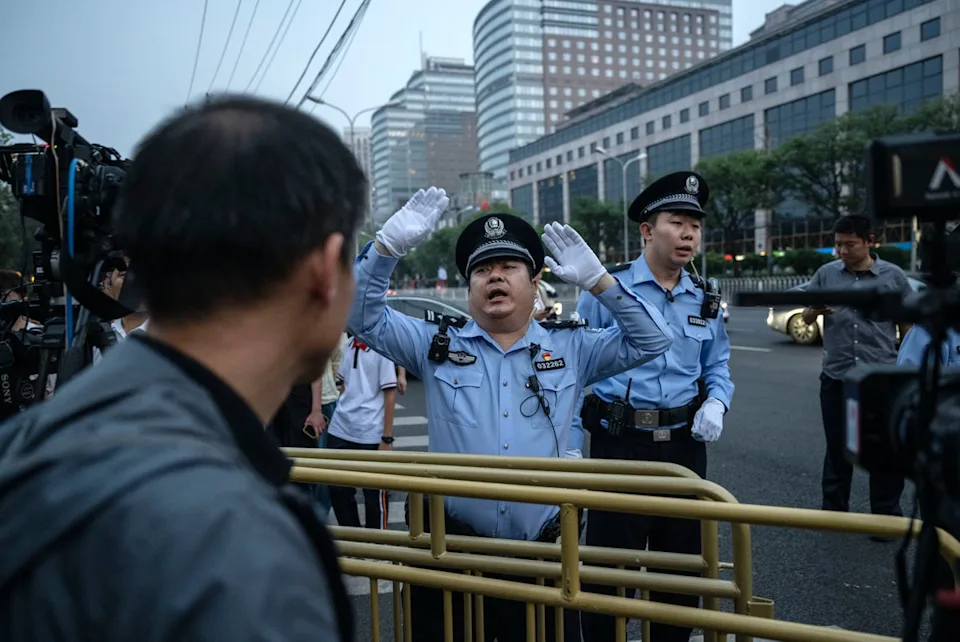
Police move local bystanders and journalists back before the arrival of the motorcade of US president Donald Trump outside the Four Seasons Hotel (Getty)
Taiwan “will not be silenced by oppression” and will continue to present its stance to the international community in a “steady and responsible manner”, the statement added.
The interview in question was conducted via video link at a Times DealBook summit in New York.
The incident is only the latest example of Beijing’s campaign to isolate Taiwan from the rest of the world. China claims the island as a breakaway province and uses a range of tactics to pressure other countries that interact with its democratically-elected leadership. Mr Lai and his government reject Beijing’s sovereignty claims and say only the island’s people can decide their future.
The Times’ has only gone public regarding Wang’s expulsion from China after weeks of discussions with the government in Beijing regarding her return. While Chinese officials agreed to grant a seven-day visa to allow Wang and other Times journalists to cover Donald Trump’s visit to Beijing in May, she was not allowed to resume her full-time assignment as a correspondent based in the country.
Wang spent two years in Hong Kong before she was relocated to Beijing in 2022. She covered the Covid-19 pandemic and was part of the team that won the Pulitzer Prize in public service for coverage of the pandemic in 2021.
Foreign correspondents in China are typically issued one-year visas that must be renewed annually and can be revoked at the authorities’ discretion.
In 2020, China expelled more than a dozen journalists working for US media organisations amid escalating tit-for-tat measures between Beijing and Washington. The United States responded by restricting the number of Chinese journalists allowed to work in the country and imposing limits on staff from four major Chinese state-owned media outlets.
“The Chinese government’s decision to expel Vivian Wang is wrong,” said Joseph Kahn, the executive editor of the New York Times. “Her expulsion will make it even harder for our global audience to get accurate, independent and in-depth reporting about the world’s second-largest economy at a critical time.”
He called Wang “one of the most respected journalists covering China today” and said her expulsion “follows a campaign of harassment and threats directed at her over professional, accurate and evenhanded reporting”.
With her departure, the NYT will only have one correspondent in mainland China, a considerably downsized operation from having a dozen at one point in time.