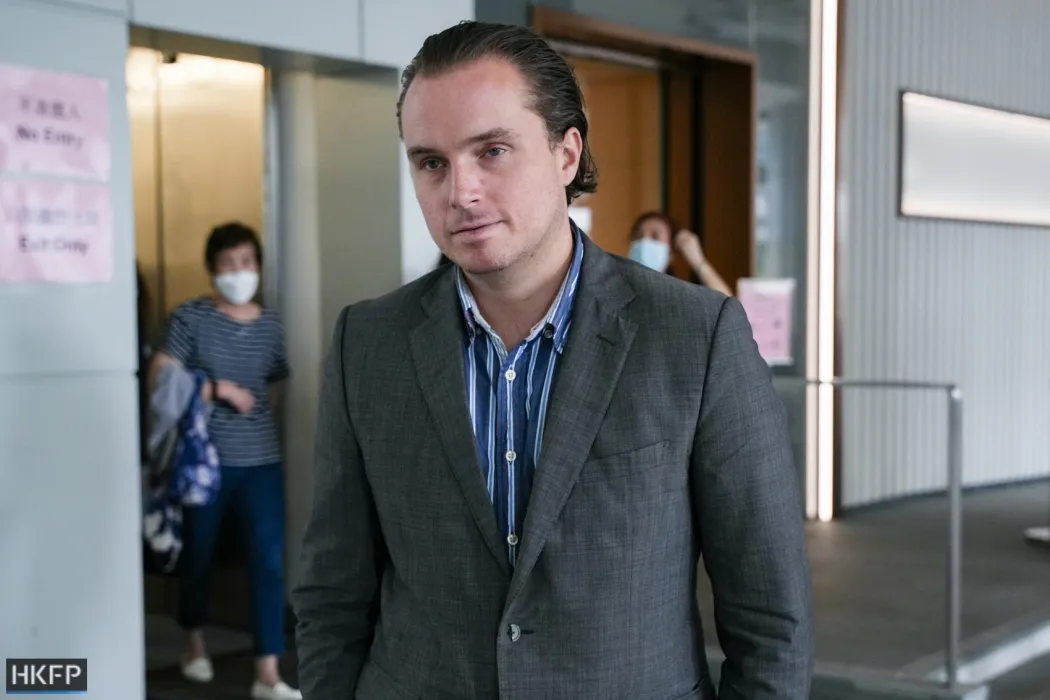
A Swedish businessman jailed for seven years in 2024 after being found guilty of raping a domestic worker has appealed his conviction.

Patrik Tobias Ekstrom appeared at the Court of Appeal on Wednesday.
Ekstrom was found guilty of one count of rape and one count of non-consensual buggery in August 2024, after a seven-member jury returned a unanimous verdict at trial. He is currently on bail pending the appeal.
The case relates to an incident in October 2022 involving his then-domestic worker, identified only as X. During the trial, X, who is from Nepal, told the court that when Ekstrom returned to his Shek O home late on October 27, 2022, he appeared drunk, forced her into his bedroom, and raped her.
At the time, Ekstrom’s wife and their three children were in Japan.
At the appeal hearing, Ekstrom’s barrister, Elizabeth Herbert, told a panel of three appeal judges that the jury could have been misled into believing it was a fact that Ekstrom had also raped a domestic worker, who worked for the family before X.
Herbert was referring to X’s trial testimony in which she said that Ekstrom said he had “done this to Mohini” – his former domestic worker – on the night that he raped her.
The trial judge should have given the jury a “clear direction” that this was only hearsay evidence, and not to take it as proof that Ekstrom did rape Mohini, Herbert said.

The jury could have been given the impression that he had raped Mohini, she added, leading them to conclude that he raped X too.
Court of Appeal Judge Kevin Zervos raised “a question of whether it was material” – in other words, if it was significant enough to affect the case’s outcome.
“It must be material,” Herbert said, adding that it was the “same allegation” and “same sort of victim.”
Antony Leung, a government prosecutor, said it would “of course” have been better for the judge to have reminded the jury not to take as a fact that Ekstrom raped Mohini, but that the outcome was unaffected.
“I think it would not have [had] an impact so significant as to impact the fairness of the trial,” Leung said.
‘Human frailty’
The appeal also dealt with the matter of voice messages that X sent to Fumi, Ekstrom’s wife, who was not in Hong Kong at the time, after the rape.
Herbert said those messages were admitted by the judge on the basis that they amounted to a “recent complaint,” a legal term referring to testimony where a victim tells a third party about the assault shortly after the incident.

The barrister said X did not say in the messages that she was raped, and therefore, they should not have been admitted.
Court of Appeal Judge Andrew Macrae said X had already explained when testifying that she did not want to say too much, because she feared Fumi would call Ekstrom and ask what he had done.
Macrae said that one must “understand human frailty” and that someone in X’s position may not have been able to be explicit.
He said X had given the “flavour,” as she said in the messages that Ekstrom told her she “wanted” her and that his wife only wanted to have sex once a week.
Asked whether that was “sufficient,” Herbert replied, “I would say it isn’t.”

Leung said he did not think the voice messages needed to contain the words “rape” or “buggery” to constitute a recent complaint.
He added that the voice messages did not advance the prosecution’s case much anyway, because less than three hours after the voice messages were sent, X went to a police station to report the rape.
During the trial, Ekstrom testified that the two had an intimate relationship before the incident. He also said that X had asked for help repaying a loan while they were having sex.
During the sentencing hearing, Judge Derek Chan cited a psychological report on Ekstrom, which found his chances of committing another sexual offence on the “high end of the moderate risk.”