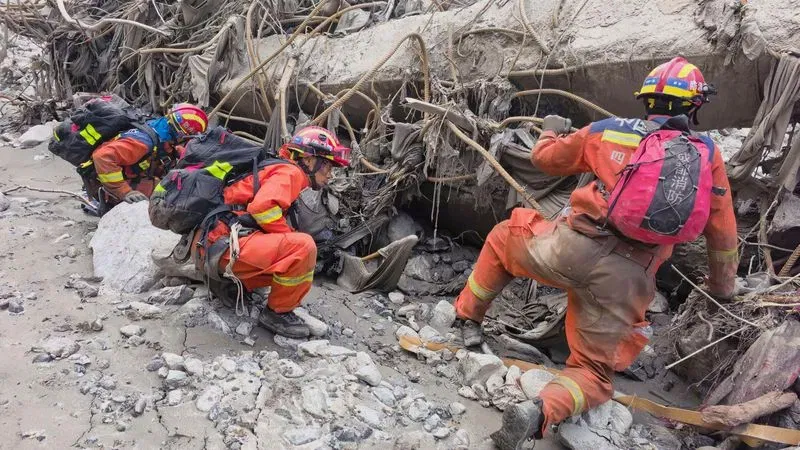
Detail from China, Photo: REUTERS
Rescuers in villages buried under rocks and earth after catastrophic floods caused by the landslide of a melting glacier in the Himalayas, along the Nepal-China border, are today finding survivors for the fourth day and transporting them to safety.
In aid centers, as some arrive, families anxiously await news of their loved ones, and the number of victims and missing continues to rise.
As Nepalese authorities updated their figures today, the total number of deaths in Nepal and Tibet rose to 676, with nearly 3.000 missing. Chinese authorities reported seven deaths and more than 550 missing.
In Nuwakot, one of Nepal’s flood-ravaged districts, helicopters are bringing clothes, instant noodles, crackers and rice to flooded areas and bringing back survivors.
In Kathmandu, the capital of Nepal, people are posting photos and phone numbers of their missing relatives and friends in government offices and hospitals.
Search and rescue efforts continued at several locations in Nepal and Chinese Tibet, including the Upper Trishuli-1 hydroelectric power plant construction site in Nepal’s Rasuwa district and the badly damaged Girong border crossing on the Chinese side.
Nepalese army spokesman Brigadier General Raja Ram Basnet said rescuers believed more than 100 people were trapped in a hydroelectric power station tunnel blocked by thick mud.
Rescuers are on high alert due to the risk of flooding from a newly formed lake behind a dam made of material brought down by torrential rains from the Himalayas.
Chinese television showed footage today of rescue workers arriving at Jirong, a devastated border crossing with Nepal. Some reached the area on foot or in rafts, others by helicopter.
Today, Nepal’s disaster agency said the death toll had risen to 669, with 2.426 people missing and more than 3.700 people rescued.
The death toll in China rose to seven on Friday, as state media showed evacuations of villages and efforts by leaders to direct aid.
Chinese state media reported that 554 people were missing. Hundreds of them were foreigners who were working, hiking or on a pilgrimage to a sacred peak in the area.
Nepal’s Foreign Minister Shishir Kanal told reporters today that authorities have mobilized all available resources with the support of international assistance for search, rescue, relief and recovery operations, with a special focus on finding the missing.
“It is our national priority right now,” Kanal said, adding that rescue operations are challenging due to the steep, high mountains and narrow gorges in the disaster-stricken region.
The channel said the government had sought specialized support from neighboring countries for rescues from the tunnels, as well as equipment to detect survivors in the rubble, for rapid forensic and DNA analyses, and icebreakers to serve as morgues.
The minister said Nepal has received 57 tonnes of humanitarian aid from India, with aid also coming from China, Japan, Australia and other countries. He announced that further support would be sought as needs were still being assessed.
Nepal needs more than $4 billion to rebuild after devastating floods
Nepal needs four to five billion dollars to rebuild areas devastated by flash floods on Wednesday in the Himalayan region of Nepal and China’s Tibet, Nepal’s Finance Minister Swarnim Vagle said today.
“It’s just an estimate. The losses and damage are still being assessed,” he told Reuters, noting that the damage was less than after the 7,8-magnitude earthquake in 2015, Nepal’s worst disaster to date, when damage amounted to $9 billion.
9.000 people died then, and more than half a million homes collapsed.
Download the app and follow the news


FOLLOW US ON

News