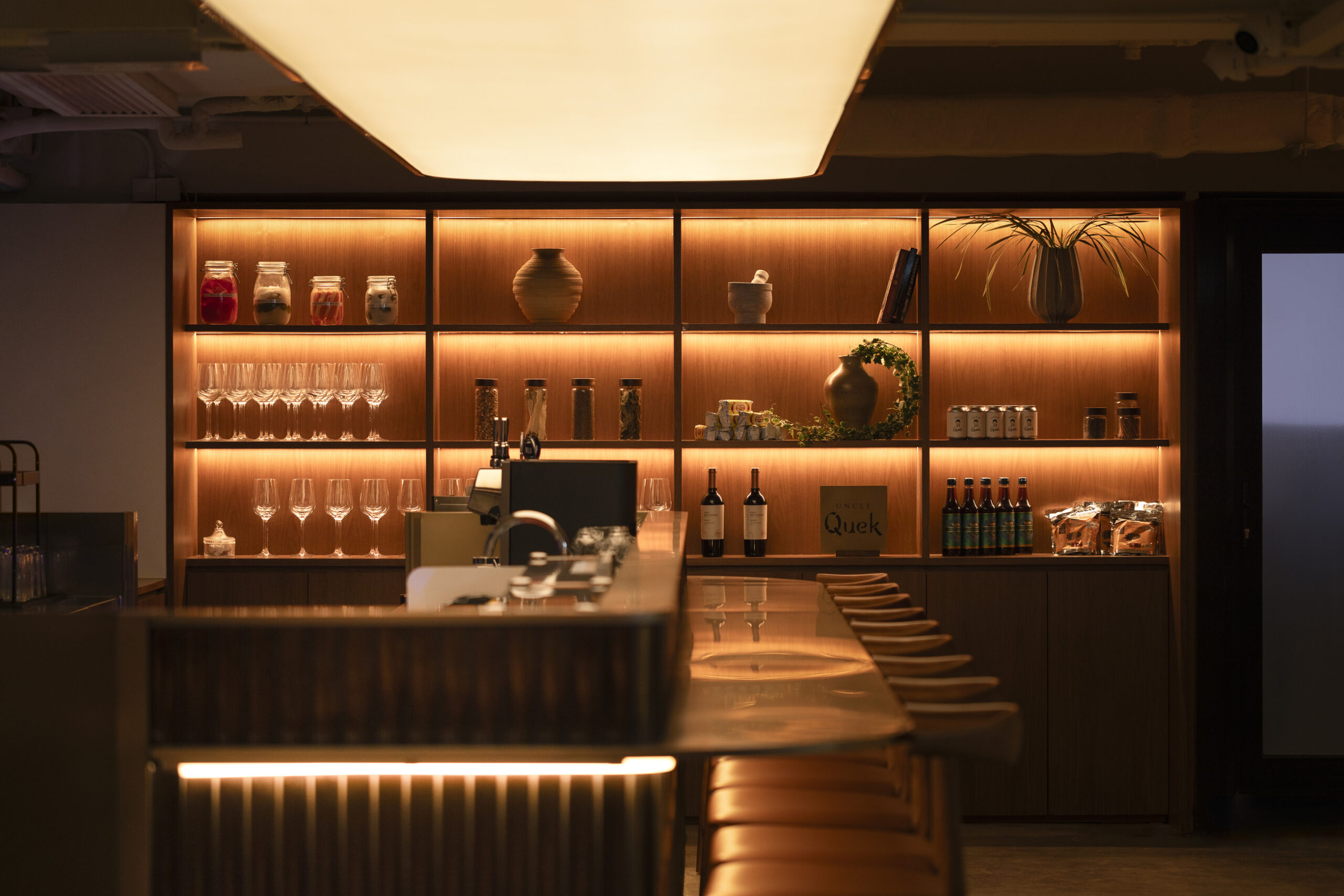
There is a moment, twice a year, when, depending on which hemisphere you’re in, the sun reaches its northernmost or southernmost limit and briefly holds still before reversing course. ZS Hospitality Group – the force behind Hong Kong’s lauded Hansik Goo and Ying Jee Club – has taken this astronomical pause as the creative conceit for one of its most intriguing projects yet. Located in buzzy Lyndhurst Terrace in Central, Solstice Culinary Space spreads across two floors: a cooking studio and Sol restaurant on the fifth, and Uncle Quek restaurant on the sixth. The three interconnected concepts are bound by a single design philosophy and the conviction that gastronomy, like the natural world, is inseparable from change.
ZS had wanted to do something beyond restaurants for some time, and describes the cooking studio as ‘the next natural step, leveraging existing chef resources’.
Solstice Culinary Space, Hong Kong

(Image credit: Harold de Puymorin, HDP Photography)
The concept took more than a year to develop. For the interiors, ZS returned to Snøhetta, the Oslo-headquartered practice that designed Whey in 2021 – ZS’s Wellington Street restaurant, where chef Barry Quek built his Hong Kong reputation and which now, with Quek helming Uncle Quek upstairs, makes Solstice feel like a gastronomically seamless second act. The decision to re-engage Snøhetta, says ZS, was deliberate. ‘Their minimalistic, timeless style perfectly aligns with what we want to present.’
Ana Patricia Castaingts Gómez, Snøhetta’s lead interior architect on the project, organised the 340 sq m scheme as a journey between seasons. The cooking studio reads as winter: deep charcoal and indigo surfaces, tactile finishes, a focused atmosphere scaled to education and technique. ‘It is a moment of introspection, focus, and learning,’ she says. As guests move upward, the palette lifts – materials grow lighter, lighting warmer, the rooms more expansive.

(Image credit: Harold de Puymorin, HDP Photography)

(Image credit: Harold de Puymorin, HDP Photography)
Sol carries the arrival of summer in its muted earthy neutrals, while Uncle Quek takes the same season and turns up the energy, brighter and less ceremonious. ‘We created variations within one cohesive language,’ says Castaingts Gómez, describing the two spaces as ‘two unique interpretations of the same conceptual spectrum’. The honey-toned woodwork that recurs through both rooms – and through Whey before them – is less a signature than a thread: the same material inflected differently according to each room’s MO.
The existing low structural ceiling on both floors presented the most immediate obstacle. Castaingts Gómez’s response was to co-opt the constraint by exposing the ceiling and introducing a concave reflective surface in the main dining area. The result, she says, is ‘a poetic gesture mirroring the arc of the sun across the sky’.

(Image credit: Harold de Puymorin, HDP Photography)

(Image credit: Harold de Puymorin, HDP Photography)
The building’s existing elevator connects the floors, but an internal staircase offers a more deliberate transition between the two venues. ‘That brief moment allows guests to sense the shift in tone and temperature,’ says Castaingts Gómez, ‘as though stepping between seasons.’
Meanwhile, at Sol, the menu sets Korean home-cooking traditions against French technique, with the Samgye Chicken among its more arresting dishes. One floor up at Uncle Quek, executive chef Terry Lam worked with Quek to dream up a menu rooted in Hokkien memory: lobster laksa, cereal fried chicken, and a house-made sambal built from chilli and dried shrimp that diners have taken to ordering with everything.

(Image credit: Harold de Puymorin, HDP Photography)
And for guests who like to tinker in the kitchen, the cooking studio is cheerfully democratic in opening classes to home cooks and aspiring professionals and teaching Korean, Cantonese, and Southeast Asian cuisines in glossy Gaggenau-equipped kitchens.
It is this last space that makes Solstice something more than yet another restaurant group’s expansion – the room where the project’s educational ambitions become literal. That seriousness of purpose runs through the whole scheme. Snøhetta’s design decisions feel considered precisely because they were made in dialogue with the food brief rather than around it: every material shift, every degree of light calibrated to the intention of each space.

(Image credit: Benson Wong)

(Image credit: Benson Wong)
It is worth noting that for a practice behind hulking marquee projects – not least Hong Kong’s Airside tower and the Norwegian National Opera and Ballet in Oslo – Snøhetta is not an obvious choice for 340 sq m of restaurant interiors. But as Castaingts Gómez points out, scale doesn’t change the fundamental questions: what experience is being created, how do people feel in the space, and what story does the design tell? Besides, she adds, ‘interior spaces demand a heightened degree of precision because every detail is experienced at arm’s length’.
At that proximity, ZS’s long-honed instinct for building rooms worth eating in finds a new expression. With Solstice, it has also created one worth learning in too.
Solstice Culinary Space is located at 6/F, 8 Lyndhurst Terrace, Central, Hong Kong