
Key Points
Investors are always on the lookout for the stock market’s next big growth story. This could happen with a stock that’s already been on the market for a long while — artificial intelligence (AI) giant Nvidia is a great example. The company launched its initial public offering back in 1999, but most of its growth actually took place over the past five years, as it led the S&P 500 higher during the early stages of the AI boom.
Still, it’s exciting to get in during a company’s very earliest days, and that means participating in its IPO or buying shares soon after it begins trading. And when that company happens to be involved in dynamic, tech-related businesses, investors sit up and take notice. Today, the player grabbing investors’ attention is SpaceX, the rocket-launch company owned by Tesla chief Elon Musk. SpaceX has confidentially filed paperwork with regulators for an IPO of record size, according to multiple press reports.
Will AI create the world’s first trillionaire? Our team just released a report on the one little-known company, called an “Indispensable Monopoly” providing the critical technology Nvidia and Intel both need. Continue »
Now the question is, if you’re looking to invest in the next big growth company, should you rush to get in on the SpaceX IPO? History offers a strikingly clear answer.
Image source: Getty Images.
The biggest merger ever
First, let’s consider what we know about the company and the IPO so far. You may most associate SpaceX with rocket launches, as it has contracts with NASA, and last year conducted 165 orbital launches — the most of any launch provider, according to BryceTech data. But this isn’t the only SpaceX business. The company also owns satellite internet service Starlink — its revenue driver — and the AI business xAI. In fact, when Musk merged SpaceX with xAI earlier this year, it became the biggest merger ever at a valuation of $1.25 trillion.
Now, SpaceX may be heading for another record, this time in the world of IPOs: Bloomberg reported that the company could aim for a valuation of as much as $1.75 trillion, making it the largest IPO. The news agency also said the company was aiming for a June operation.
As mentioned, this filing was confidential, meaning SpaceX submitted its financial information to regulators — but not yet to potential investors or the public. A public filing must come 15 days before a potential road show.
SpaceX and retail investors
SpaceX plans to set aside a significant portion of shares for retail investors, according to Reuters, citing people familiar with the situation. It’s not yet clear how that would be organized, but the news suggests retail investors may have an easier time gaining access to the SpaceX IPO than to other IPOs in the past. (Generally, in IPOs, shares are primarily offered to institutional investors — these are professional investors managing pension funds or mutual funds, for example.)
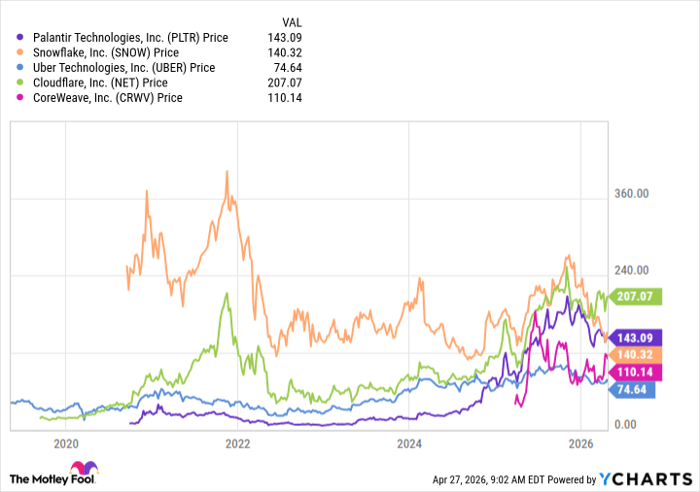
Now let’s consider my question: Should you rush to get in on the SpaceX IPO? By this, I mean either participating in the IPO if you have the opportunity or scooping up shares in the early days of trading. History offers us a clue. The chart below shows the performance of several tech stocks that launched IPOs in recent years.
More than one entry point
As you can see, all of them climbed in the days or weeks following their debut — but over time, they’ve all fluctuated, offering investors more than one reasonable entry point. So, history shows that, in general, you don’t have to rush to get in on an IPO; in the past, many of these companies have delivered wins for investors who bought shares well after the market debut.
That said, we can use history as a guide, but it doesn’t guarantee that every stock will follow the same path. It’s also important to take a look at a company’s financial filings before deciding whether to buy — we don’t yet have those for SpaceX, but as mentioned earlier, we should gain access to them prior to the road show.
The decision about whether to participate in the IPO or buy shares of SpaceX early or later is an individual one — it depends on your appetite for risk and overall strategy. But, if you can’t get in on this stock as early as you’d like, history is showing us you probably shouldn’t worry: Even the hottest of growth stocks have offered investors several great buying opportunities over time.
Should you buy stock in S&P 500 Index right now?
Before you buy stock in S&P 500 Index, consider this:
The Motley Fool Stock Advisor analyst team just identified what they believe are the 10 best stocks for investors to buy now… and S&P 500 Index wasn’t one of them. The 10 stocks that made the cut could produce monster returns in the coming years.
Consider when Netflix made this list on December 17, 2004… if you invested $1,000 at the time of our recommendation, you’d have $498,522!* Or when Nvidia made this list on April 15, 2005… if you invested $1,000 at the time of our recommendation, you’d have $1,276,807!*
Now, it’s worth noting Stock Advisor’s total average return is 983% — a market-crushing outperformance compared to 200% for the S&P 500. Don’t miss the latest top 10 list, available with Stock Advisor, and join an investing community built by individual investors for individual investors.
*Stock Advisor returns as of April 28, 2026.
Adria Cimino has positions in Tesla. The Motley Fool has positions in and recommends Cloudflare, Nvidia, Palantir Technologies, Snowflake, Tesla, and Uber Technologies. The Motley Fool has a disclosure policy.
The views and opinions expressed herein are the views and opinions of the author and do not necessarily reflect those of Nasdaq, Inc.