
“Today, advancing freedom requires a unified national economic strategy.”
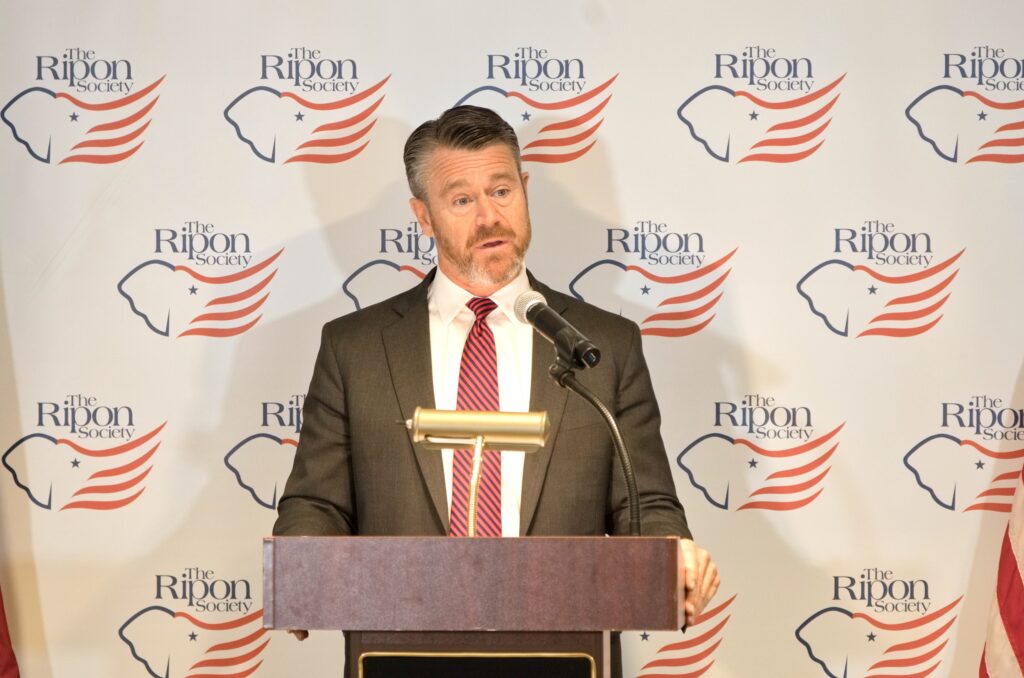
WASHINGTON, DC – Senator Todd Young (R-IN) addressed a luncheon meeting of The Ripon Society on Tuesday, delivering a wide-ranging address on trade policy, technology competition, and American industrial capacity.
On the current trade environment, the Hoosier State’s senior Senator offered a nuanced view of tariffs — acknowledging their value as a negotiating tool while cautioning against their overuse.
“Tariffs can, in my view, be a very effective negotiating tool,” he said. “But broad tariffs that raise input costs or disrupt supply chains can also weaken your economy, can weaken the very manufacturers, the farmers, the consumers they’re meant to protect.”
The better standard, he argued, is whether a given trade policy actually strengthens America’s strategic position — reducing dependence on adversaries, building domestic capacity, and securing supply chains in sectors where vulnerability is greatest. Critical minerals and semiconductors, he said, are the clearest examples.
“If an input is essential and access to it can be disrupted, then dependence itself becomes a vulnerability. That doesn’t mean that every answer has to be a full-scale trade agreement with 30-plus chapters. In some cases, the smarter move is narrower and faster.”
That logic, Young explained, underpins two pieces of legislation he has introduced: the STRATEGIC Minerals Act and the Digital Trade Promotion Act. Both are designed to work with trusted allies, set high standards, secure critical supply chains, and keep Congress engaged over the long term.
He also addressed USMCA, calling it one of the president’s signal achievements and describing the agreement’s upcoming review as an important test of the administration’s trade philosophy.
“If the goal is to strengthen North America’s competitive position, then we need targeted enforcement, modernization where useful, and a recognition that Canada and Mexico are essential partners in competing with China,” he said.
Young then turned to technology, describing AI, biotechnology, and quantum computing as the defining geopolitical contests of the 21st century. He cited three bills he has introduced in that space — the Create AI Act, the Future of AI Innovation Act, and the National Quantum Innovation Initiative Reauthorization Act — as part of a broader effort to ensure the United States leads in the development and deployment of emerging technologies.
“We are in a strategic competition — you may regard it as a race — with China to lead the world in the development, deployment, and advancement of these various technologies. …The markets will not solve this alone. We need to set the parameters.”
On biotechnology, Young pointed to his work as chairman of the National Security Commission on Emerging Biotechnology, which produced 49 recommendations to strengthen the nation’s biotech enterprise for national security purposes. Half of those recommendations, he noted, have already been signed into law.
Young, a former Marine, closed his prepared remarks with a call to revive American shipbuilding — an industry he said has been hollowed out to a degree most Americans do not appreciate. He argued that the loss of commercial shipbuilding capacity represents a strategic vulnerability, citing Adam Smith’s recognition of the industry as uniquely essential to national defense.
“Last year we built one ocean-going vessel — repeat, one,” he said. “China has the capacity to build over a thousand in a given year.”
He called for passing the SHIPS for America Act, a bipartisan bill he is advancing alongside Senator Mark Kelly (D-AZ) and with White House cooperation, which would set a goal of 250 American vessels built over the next decade.
“The most effective means of advancing this freedom, this opportunity agenda, is to adapt that agenda to the circumstances of the time to be radically pragmatic and meet the needs of each individual generation. Today, advancing freedom requires a unified national economic strategy. One that grows domestic industry, one that strengthens our supply chain, one that encourages trade with other countries at a time when globalization remains strong, one that reduces dependence on rivals, but doubles down on our alliances.”
During a question-and-answer session that followed, Young was asked about President Trump’s upcoming visit to China and what a successful outcome would look like. He urged the president to hold firm on America’s core priorities while resisting pressure to make concessions.
“Don’t strike any deals that are bad deals,” Young said. “I think he needs to be intently focused on critical minerals and supply chain resiliency.”
He also expressed hope that the visit would yield progress on the release of journalist Jimmy Lai and on Taiwan — two issues he described as central to the bilateral relationship.
“If you could come out of there with some positive news on each, it’ll be a very, very successful forum.”
To view the Senator’s remarks before The Ripon Society on Tuesday, please click the link below:
The Ripon Society is a public policy organization that was founded in 1962 and takes its name from the town where the Republican Party was born in 1854 – Ripon, Wisconsin. One of the main goals of The Ripon Society is to promote the ideas and principles that have made America great and contributed to the GOP’s success. These ideas include keeping our nation secure, keeping taxes low and having a federal government that is smaller, smarter and more accountable to the people.