A 6-foot-tall pink inflatable elephant posted outside a storefront greets passersby on Fourth Avenue in downtown Seattle, a bright interlude on an otherwise dreary and gray October afternoon. This piques the interest of a few curious shoppers, and they duck into the store. Others are deliberately flocking to the spot, drawn to colorful clothes and accessories neatly arranged on racks. A poster with bold yellow and pink lettering on the wall reads, “Seattle Fat Mall.”
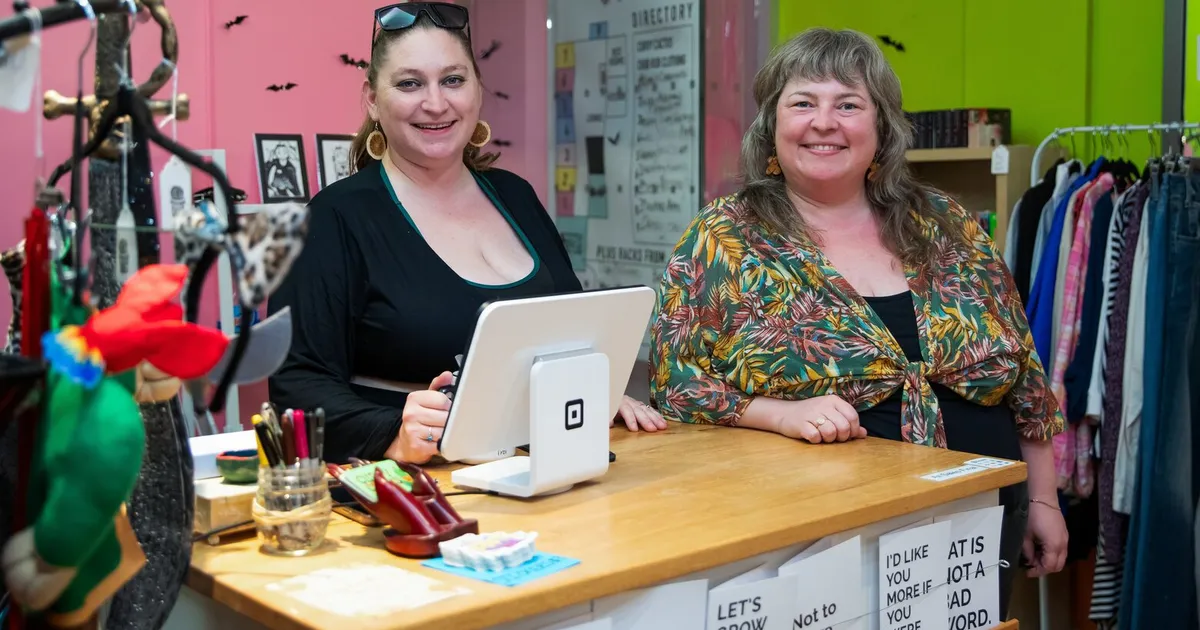
Inside, co-founder Amber Seelig happily chats with customers. She points out pieces from her and her sister Alyss’ brand Curvy Cactus: Custom denim jackets that are sizes large to 6X, belt bags with customizable waist straps, cozy flannels, funky tie-die shirts and more.
And that’s just the beginning. A door at the back of the Curvy Cactus shop leads to a colorful hallway and the rest of the mall, transporting shoppers through a whimsical portal into a space filled by brands owned by and catering to Seattle’s plus size, queer and disabled community.
It’s a shopping experience very different from ones the Seelig sisters, along with co-founder Candace Frank, grew up with: ones that rarely involved finding clothes that fit larger bodies.
“It was mostly watching your friends shop while you buy perfume or earrings,” said Frank, who described herself as a fat liberation activist and designer for Chub Rub Clothing.
Running through December, Seattle Fat Mall provides shoppers all around Seattle not only an opportunity to shop for clothes that fit all bodies — but a space to gather as a community and uplift each other’s creative pursuits.
In 2024, the Seelig sisters worked with Seattle Restored, a city program that converts dormant retail spaces with pop-up shops, art exhibits and window art installations, to set up the Curvy Cactus storefront. After connecting at a holiday market with Frank, the three worked with Seattle Restored to bring a vision for a plus-size-friendly retail space to life. Seattle Fat Mall opened its doors in April, featuring a half dozen resident vendors and several rotating pop-up brands.
“Part of it is born out of this kind of funky space that we got through Seattle Restored, which is like a vacant office building,” Alyss said. “It has all these individual offices in it that were pretty challenging to figure out how to utilize … when it was just Curvy Cactus in there.”
“When we’re in this space, we can leave our stuff set up,” Frank added. “We’ve all tried to make our shops very immersive.”
While the mall might be a new space, it’s built on the legacy of the decades-old body acceptance and liberation movements. Since the 1960s, plus size communities across the U.S. have worked to create spaces where they are treated equally, regardless of their size. Meanwhile, discussions about reclaiming and destigmatizing the word “fat” by these communities have risen in prominence in recent years. For Seattle Fat Mall, that work manifests in every detail, even its name.
“‘Fat’ is a word that has been thrown around as an insult our entire lives,” Alyss said. “Everyone is worried they’re going to get called fat, and so putting it in the name of a place that’s positive and you’ll have a good experience sort of disarms that word.”
Since the mall’s opening, it has expanded into several capsule storefronts, each uniquely decorated to reflect a vendor’s products and services. A massive gallery wall of body-positive art anchors the Chub Rub Clothing space, where Frank sells cow print swimwear, glittery postcards, stickers and more. Across the hall, a metallic rainbow fringe curtain creates a colorful backdrop for the mall’s rotating pop-up, currently filled by Mimi’s Creation Shop, a Black, nonbinary-owned handmade jewelry brand . And at the back of the store, past a lounge with comfortable chairs and plus size mannequins, pop-up artist Bee Rosmyth offers Halloween tattoos.
Over 50 businesses have applied to set up at the mall. Though limited by the number of rooms in the physical space, the goal is to have as many resident vendors as possible rotate in every few months, and have pop-up vendors come every few days or weeks, Frank said. The mall also hosts several events, from embroidery lessons to workshops focused on drawing plus size bodies. For customers and vendors themselves, the mall is more than a retail space: it’s a place to build lasting friendships within the community.
“Everyone was a little surprised at how things turned out,” said Sam Plastino, a vendor selling customized jewelry, handmade figurines and crochet garments at Plastino Arts. “But there’s such a great need for people to come together in the plus size community and really share space,” they said.
Flipping the old office space also allowed the founders to accommodate multiple underserved groups. The fitting rooms are spacious, meant to not only fit larger bodies but those with accessibillty needs, like wheelchair users. Additionally, the entire mall is accessible to mobility devices and has gender-neutral restrooms.
“We are those communities,” Amber said of those intentional choices. “We are disabled, we are queer … separating them out is not even realistic.”
It’s this intentionality that has brought people throughout Washington to the shop. Tess McShane, who lives in Longview, wanted to stop by the mall one afternoon while in Seattle for a concert. She said she wants to support downtown spaces that genuinely serve the local community, rather than tourists.
“Most downtowns are set up for the people who are visiting … but they’re not always for the people who live here,” she said. “But this feels like a spot for the people who live here.”
Seattle Fat Mall is more than a place for its customers to find and try on clothes. It’s a way for them to reclaim experiences they may not have had growing up, connecting and rejoicing in a space made by people who look like them. While their lease on the space ends in December, the mall’s creators have found ways to connect with other body-positive designers and spark ideas for future projects, like a sustainable fashion showcase next month. For now, they’re reveling in taking up space.
“One of my favorite things about our dressing room is that it opens right out to the area that we call the Lounge, where we have chairs and couches,” Frank said. “So, it turns into a fashion show all the time, where people are waiting and they’re coming out and showing everyone, and everyone’s having this amazing experience of being cheered on or cheering somebody else on in a body that reminds them of their own.”