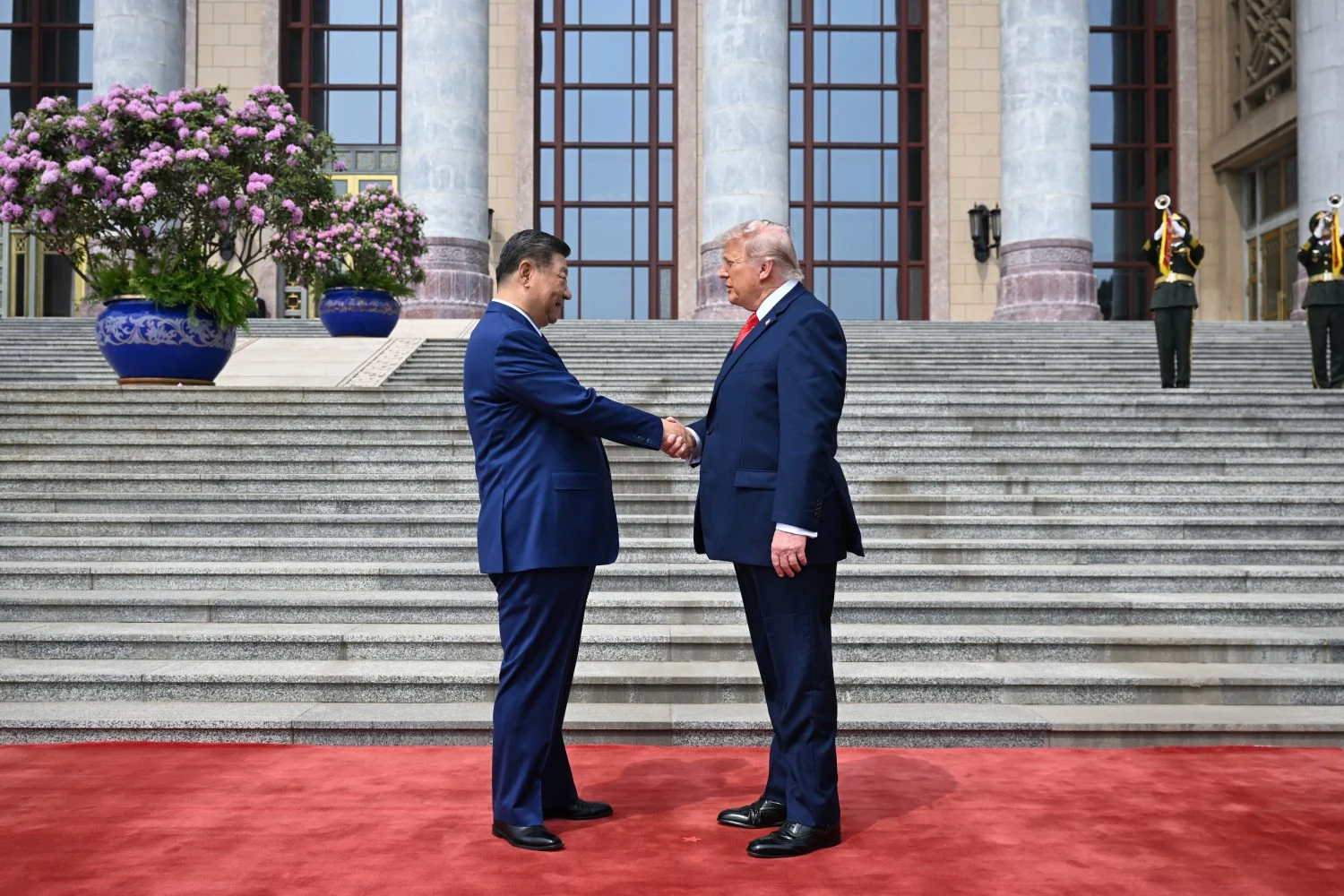
“Beans and Boeings.” That’s what one diplomat told me that last week’s summit between U.S. President Donald Trump and Chinese President Xi Jinping amounted to, referring to proposed Chinese purchases of U.S. soybeans and airplane parts. But more broadly, the much-awaited meeting in Beijing between the presidents of the world’s two biggest economies is ripe for analysis about this century’s most important bilateral relationship.
On the latest episode of FP Live, I spoke with Rana Mitter, the S.T. Lee chair in U.S.-Asia relations at the Harvard Kennedy School and the author of China’s Good War. Subscribers can watch the full discussion on the video box atop this page or download the free FP Live podcast. What follows here is a condensed and lightly edited transcript.
Ravi Agrawal: Rana, let’s start with your basic take. What stood out to you about the summit?
Rana Mitter: You’ve mentioned Boeings, beans, and people also mentioned beef as one of the things that are going to be exported into China from the United States. I’ll add one more B, which I think in the end may be the most important takeaway, and that’s “buoyancy.” In other words, keeping the U.S.-China relationship afloat. And for now, that’s probably good enough.
In terms of what we got out of it, as you mentioned, there are some agricultural deals. Several billions of dollars’ worth of soya and other products are pledged to be sold to China. We’ll see if that comes off. There was also a certain amount of conversation around Taiwan. And the fact that we had Elon Musk and Jensen Huang there was a reminder that tech is probably the ecology in which the U.S.-China relationship is going to develop not in the next two weeks or two months, but two decades or so. Talking about how the two sides manage AI [artificial intelligence] may be the equivalent of the conversations about nuclear weapons that so exercised Richard Nixon, Mao [Zedong], and their generation 50 years ago.
RA: I love the four Bs. There’s one element that’s connected to buoyancy that some commentators are lingering on. It was this line from [Chinese] Foreign Minister Wang Yi, in which he said the two sides had agreed to reach “a constructive China-U.S. relationship of strategic stability.” What does that mean?
RM: There are people inside the Central Party School in Beijing who are writing this kind of language to make sure that it fits in with the wider precepts of Xi Jinping’s thought, the way in which he is being projected as thinking about world order. That word “constructive” is very important. So is the word “stability.” It’s pushing an idea which I saw very strongly in the vibes from these two days: China wants to project that the United States is no longer the pivot of global order and stability. That will be China.
In other words, when we think about geo-economics, global trade, international institutions such as the United Nations—that’s where China sees its ecology developing. Talking about constructiveness and stability is actually China’s way of saying, on the surface, “We don’t want world order to change,” implying that the United States does and China’s not buying that.
But second, and this is more implied, “We do want to change what is inside that order. We want to make it much more friendly to what we regard as Chinese interests.” That’s what I think that rather kind of convoluted phrasing is getting at. Wang Yi will have spoken it, but it will have been written by very careful ideological theorists in Beijing before he actually ever actually touched his script.
RA: Trump spoke about Xi in almost fawning language. What do you make of that? It feels a marked difference from 2017, when Trump went to China with a decidedly more pugilistic tone.
RM: He did, although there’s one other element from 2017 that’s worth remembering, which was a different sort of dynamic. You remember that in 2017, Xi was invited not just to Washington, but to Mar-a-Lago, Trump’s private club. Trump later told the story of how he’d been offering dinner to Xi, and I think the phrasing was something like, “I gave him the biggest piece of chocolate cake he’d ever seen and then announced that we were bombing Syria.”
This was supposed to be a real sort of signature version of the Trump style: You’re treated as the most honored guest, but also, “I’m going to do geopolitics my way, even while you’re sitting in the room.” And while I’m afraid I don’t have inside takes on how Xi reacted nearly nine years ago, I think he must have been a little taken aback, to put it mildly.
This time around, the dynamic was different. Of course, Trump was Xi’s guest, rather than the other way around. Xi has now officially accepted the invitation to go to the United States in a few months’ time, so we’ll have to read the body language there and see how it is. But even on this Beijing visit, it was clear that Trump was looking to make a really warm set of gestures. He talked more than once about Xi being his “friend.” And that’s a big word to use. He doesn’t use that about a lot of leaders, including people who lead various allied countries.
Xi did not say that in return. I don’t think you have to read too much into that, because if you look at the way Xi interacts with almost any other foreign leader, it’s pretty buttoned up. It’s pretty choreographed. The people who look at almost every hand gesture will have known what it is that Xi is going to say or do at any particular point. While he smiled, he didn’t show a tremendous amount of warmth. So I think there was a mismatch in terms of the emotion between the two sides.
Read More
-

A woman is seen from behind with her neck craned to look at a large screen affixed to a four-story building with big windows. On the screen, Trump and Xi stand side by side and shake hands. A woman is seen from behind with her neck craned to look at a large screen affixed to a four-story building with big windows. On the screen, Trump and Xi stand side by side and shake hands. Trump’s China Pragmatism Is Welcome
Rivalry with Beijing is inevitable. Economic rupture would be disastrous.
-

Two men in dark suits stand side-by-side in a large, paved outdoor courtyard. The man on the left wears a bright red tie and looks off to the side with a serious expression. The man on the right wears a burgundy tie and has a slight smile. In the background, a large, multi-tiered circular traditional building with a blue roof and ornate details stands under a pale sky. A person in a dark uniform is visible in the far distance to the right. Two men in dark suits stand side-by-side in a large, paved outdoor courtyard. The man on the left wears a bright red tie and looks off to the side with a serious expression. The man on the right wears a burgundy tie and has a slight smile. In the background, a large, multi-tiered circular traditional building with a blue roof and ornate details stands under a pale sky. A person in a dark uniform is visible in the far distance to the right. The Trump-Xi Summit Was Remarkably Banal
A more confident China is happy to downplay presidential visits.

-

U.S. President Donald Trump and Chinese President Xi Jinping, right, attend a state dinner at the Great Hall of the People in Beijing. U.S. President Donald Trump and Chinese President Xi Jinping, right, attend a state dinner at the Great Hall of the People in Beijing. What Happened to Trump the China Hawk?
The U.S. president heads to Beijing in detente and dealmaking mode.
RA: There was one more mismatch, and I’m curious whether you think it was choreographed or not. We in the United States have been covering this summit before and after quite extensively, as we should: It’s a very important meeting between the world’s two most powerful leaders. But it struck me that China did not cover it in the same way.
The state mouthpiece, People’s Daily, put commentary on the visit on Page 3. The main evening news broadcast gave it 12 seconds before moving on to a six-minute segment on the Yangtze River Delta. All of that’s from James Palmer, who writes China Brief for us. This is a real asymmetry in terms of how much importance the two sides placed on the summitry. What does that tell you?
RM: What James spotted there is exactly right. There wasn’t any particular need to emphasize this visit on the Chinese side, other than wanting to push forward the narrative, which is part of a continuing development, that the United States and other big powers come to China. But at the same time, it’s also the case that the Chinese news authorities may have made quite a similar judgment to the Western media, which is that there weren’t that many news hooks that came out of it.
As I said, I think there are some big underlying themes, such as AI, that are really important. But broadly speaking, I wouldn’t say that there were big lines that the Chinese would have felt could go on the front page of People’s Daily. In fact, one of the places where there was a bit more excitement was over one of the visitors who came with President Trump: Elon Musk, not just because he is a major celebrity in China but [because] his mother Maye Musk is also a very well-known figure on Chinese social media. She has, I think, her own place in Shanghai.
Anything around the Musk family has the same sort of effect as when the British royal family visits some parts of the United States. It may have been that [that] was where a bit more of the buzz and glamor was. But for that, you have to go to other places, such as the major Chinese websites like Bilibili or Kuaishou videos and so on. The People’s Daily, which is a pretty staid publishing outfit, probably wouldn’t go with the Elon-Musk’s-mom-as-style-guru type of line.
RA: I would imagine as much. It struck me that Trump was actually remarkably disciplined about Taiwan in a way that his predecessor, [President] Joe Biden, was not. I’m wondering if you’re surprised by that at all, and also just what emerges from this summit in terms of the status of Taiwan, because the relative lack of news was followed by Trump sending a strange message on sending weapons to Taiwan and treating that as a negotiating chip.
RM: The Taiwan conversation was very interesting for the reasons that you mentioned, and one can divide it into a couple of quick parts. The first is what happened in Beijing itself. You asked if I was surprised—actually, not really. If you talk to people in the broader China policy world in the U.S. and Washington, they note that despite the reputation he sometimes has, Trump actually has kept a fairly clear line in terms of actually promising any change, or lack of change, on Taiwan. So he makes—as he often does—statements, a growl now and then, about how he doesn’t like Taiwan having too big a semiconductor industry, or whatever it may be.
But in terms of shifting away from the core agreements, the “Six Assurances” that former President Ronald Reagan gave back in the 1980s or what Nixon and former National Security Advisor Henry Kissinger came up with even before that, we haven’t seen much sign of that. So to that extent, I wasn’t surprised that when the Chinese broke their warm words with those sharp statements about Taiwan and not mishandling the situation, Trump came back almost with silence at that point and just moved the conversation on.
When he came back, he did make the statement saying that he didn’t want to be held back by something that Ronald Reagan had said back in 1982, and that he believed that arms sales were a bargaining chip. There were two reactions off the back of that. One was the Taiwanese government pointing out that the Taiwan Relations Act of 1979 is not a suggestion; it is a law passed by the U.S. Congress that says that the U.S. has to help Taiwan to defend itself. This is not optional in that sense. U.S. Trade Representative Jamieson Greer stressed again that there is no indication that there is a change in policy on Taiwan.
Does it mean anything substantial at this point? My sense is that it doesn’t. Taiwan is still almost certainly going to get that arms sale. The major holdup is that the Taiwan parliament, the Legislative Yuan, has actually been holding up the budget to buy those arms. This is partly because the opposition and government parties, the KMT [Kuomintang] and the DPP [Democratic Progressive Party], are locked in an almost 50-50 disagreement within the parliament, not unlike the U.S. Congress. So the Taiwanese may have to make it clear that they’re not actually getting in the way of the U.S. fulfilling the Taiwan Relations Act. But at this moment, I don’t think there’s anything existential in terms of a change on Taiwan policy when you look beyond the rhetoric.
RA: It was striking to me that in the lead-up to this summit, it was Treasury Secretary Scott Bessent who seemed like the main player setting up the trip. And that is, of course, unusual. It is usually the secretary of state, or national security advisor—in this case Marco Rubio, who was on the trip, but seemed a bit peripheral. And Rubio, of course, is an old China hawk who seems to be at some level sidelined on China issues currently.
And I’m curious, as we think about the cast of characters here, and Trump’s own changes in tone, do you think the United States has become less hawkish on China in general, and is that part of the new trend now?
RM: You’re right to note that the lead on this trip, unusually, was the Treasury. That would explain the huge stress on trade, finance, and all those sorts of issues that were at the heart. The president has people in his administration who have very different views when it comes to China. People like Marco Rubio are more inclined to push back against the expansion of China’s power—“China hawk” is the shorthand for that worldview.
That’s still clearly in there: It gave the Chinese a diplomatic problem, because Marco Rubio was still officially sanctioned from his time as a senator. According to the Washington Post, they compromised by letting him in, but changing the Chinese character that was used to translate his name, to make it seem as if someone else was actually turning up. One imagines that [Defense] Secretary [Pete] Hegseth probably sits in that [hawkish] position as well.
At the same time, it’s very clear from interviews that Trump doesn’t seem to be looking for any kind of existential clash between China and the United States. For instance, the language that you heard at the beginning of the Biden administration about a league of democracies versus autocracies—that’s not at all the kind of language that he put forward. It is very clear that the Trump doctrine is fixated on dealing with the trade deficit specifically, but it really does concentrate in that area. Because this administration above all is one where, in the end, the president decides what the tone is going to be, it has to be the case that he’s decided the trade deficit comes first and foremost, and the other elements—including Taiwan, AI, Iran, and all the other things on the agenda as well, like fentanyl—would be second to that.
It’s worth noting that, in the days since the end of the summit, the things that have dominated the headlines are the sale of agricultural products—beans and beef—and even the Boeings. So that trade-driven story is what that summit was about.