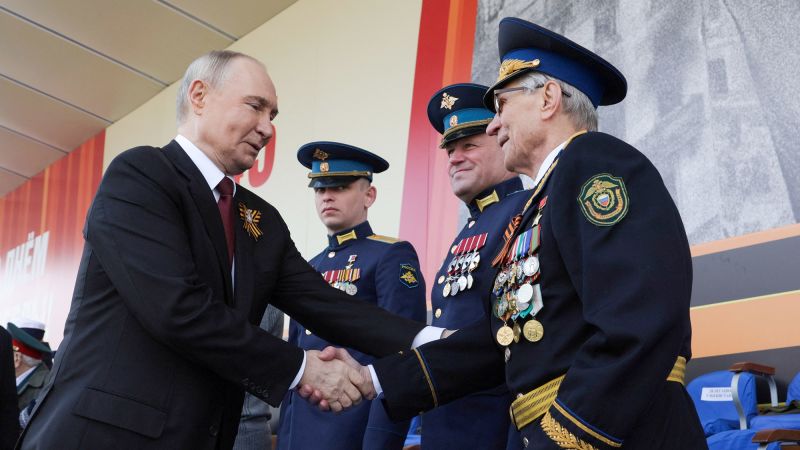
The May 9 Victory Day parade in Moscow’s Red Square is the headline event for Russian President Vladimir Putin: Each year, Russia puts on a display of military might that showcases the country’s most impressive weapons, including its latest-generation missiles and tanks.
This year, however, the parade promises to be a more low-key affair.
Late Tuesday, the Russian Ministry of Defense announced the parade would feature a column of troops from military academies and the armed forces marching on foot. But in a break with recent precedent, the MOD said no military hardware will roll past Lenin’s tomb this year.
“Due to the current operational situation, students from Suvorov Military Schools and Nakhimov Naval Schools, as well as the cadet corps, and a column of military equipment will not participate in this year’s military parade,” the statement read.
It doesn’t take much Kremlinology to guess what the “current operational situation” means here. The Russian military appears to be losing some ground in Ukraine, contrary to claims by Moscow’s top brass; Ukrainian strikes are delivering damaging blows to vital Russian oil and gas infrastructure; and drone strikes by Kyiv have disrupted life in the Russian capital before.
Asked Wednesday about the parade plans, and whether the equipment was needed for the front lines, Kremlin spokesman Dmitry Peskov put a slightly different spin on the situation, saying Moscow was facing a “terrorist threat” from Kyiv.

“We’re talking about the operational situation,” he said. “The Kyiv regime, which is losing ground on the battlefield every day, has now launched a full-scale terrorist attack. And so, against the backdrop of this terrorist threat, of course, all measures are being taken to minimize the danger. The parade will take place, but let’s not forget that last year it was an anniversary parade. A large-scale parade, the kind that should take place on a significant date. This date isn’t an anniversary, but the parade will still take place, albeit in a reduced format.”
Russia has pared back the Victory Day parade in the years following its full-scale invasion of Ukraine in February 2022. In 2022 and 2023, the traditional flyby of military aircraft was cancelled; the 2024 parade featured only one tank, a World War II-era T-34.

But as Peskov noted, last year’s Victory Day parade, which marked the 80th anniversary of the Soviet Union’s victory over Nazi Germany, was a gala event. Putin presided over a parade that featured hardware such as the Geran-2, the Russian version of Iran’s Shahed drone, and played host to friendly leaders including Chinese President Xi Jinping.
The Russian MOD said next month’s parade would feature a traditional showstopper: aerobatic teams will fly over Red Square, with Su-25 ground-attack aircraft painting the Russian tricolor in the Moscow sky. But the scaled-back parade does comes at an inflection point for Putin.
In recent weeks, discontent has simmered to the surface in Russia following a wave of internet disruptions that have made life inconvenient in the Russian capital and elsewhere. The internet outages – which Russian authorities say are necessary for security reasons – have prompted rare public criticism of the country’s leadership.
Repeated Ukrainian attacks on the oil refinery at Tuapse on Russia’s Black Sea coast have also showcased Moscow’s economic vulnerability. Images of the unfolding environmental disaster have also underscored what some have seen as a slow response by authorities.

Other economic alarm bells are ringing for the Kremlin. On Tuesday, Elvira Nabiullina, the head of Russia’s Central Bank, said the country was facing an unprecedented labor shortage.
“Never before in the history of modern Russia have we experienced such a labor shortage,” she said, according to Russian state news agency RIA Novosti. “We’ve never had anything like this, and this is having an impact on the entire economic situation.”
The labor shortage in Russia comes as little surprise. The country saw a wave of emigration – and a serious brain drain – in the wake of a partial military mobilization that was announced in September 2022. And Russia has struggled to replenish its military ranks amid horrific casualties on the Ukrainian front line.
Back in 2008, Putin explained why Russia was bringing the tanks-and-missiles show back to Red Square in the first big display of weaponry since the Soviet collapse.
“This isn’t saber-rattling: we’re not threatening anyone, we don’t intend to, we’re not forcing anything on anyone – we have plenty of everything,” he said. “This is a demonstration of our growing defense capabilities. We are capable of protecting our people, our citizens, our state, and our wealth.”
Whether the Russian military is capable of protecting the capital amid a protracted and bloody war with Ukraine appears to be an open question now.