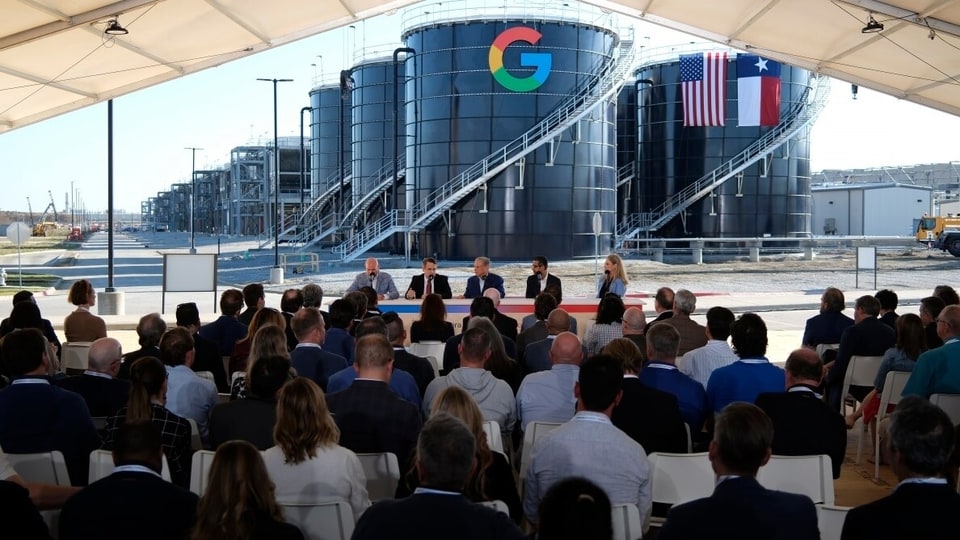
In November, Texas Gov. Greg Abbott declared his state the “epicenter of AI development” while announcing a $40 billion investment by Google.
Less than a year later, the Republican said he halted approvals of some 1,800 new data centers worth billions of dollars on concerns that they use too much power and water. The move earlier this month drew the ire of President Trump, who this week staunchly defended the centers as an economic engine.
A growing voter outcry over data centers that strain resources and fuel a technology capable of putting Americans out of work is becoming a mounting liability for Republicans and some Democrats in this fall’s elections. Abbott’s opponent in his bid for a fourth term, Democrat Gina Hinojosa, has hammered him on the issue while climbing within a few percentage points in recent polls.
“The data-center issue is the latest example of a governor who has been doing the bidding of moneyed interests instead of the people of Texas,” Hinojosa said in an interview.
Abbott has said companies have agreed to guardrails that minimize disruptions to local water and power markets, showing his plan is working and protecting Texas communities. Hinojosa, a state representative, says protections should be enshrined in law.
She released a new ad Tuesday featuring a person asking a chatbot why their electric bill is going up. The bot responds it is because of data centers approved by Abbott, who has received millions in campaign donations from executives and companies tied to artificial intelligence, including Elon Musk.
Democrats around the country are deploying the same playbook. Abdul El-Sayed, a progressive running for Senate in Michigan, has claimed his opponent, former GOP Rep. Mike Rogers, wants to put the centers in the backyards of voters in the state. “People really effing hate data centers,” he said at a July campaign event.
Rogers said at a Thursday event that there should be a “pause” in the sector. He previously said communities should be able to decide if they want the facilities and should be protected from rising power bills.
In Ohio, Sherrod Brown—the former Democratic senator and his party’s nominee in this year’s Senate contest—is targeting Republican Sen. Jon Husted for championing AI, calling him “the face of data centers” and accusing him of backpedaling on his prior support for them. Husted has said that his stance hasn’t changed and that he always pushed for companies to pay more for power and pay local taxes. He introduced legislation in Congress last month codifying stricter standards for the facilities.
GOP alarm
The committee that works to elect Senate Republicans warned in a Tuesday memo that “data centers are the anchor hanging around Husted’s neck” and the industry will be blamed if Husted loses because of the issue. The committee said candidates can’t “fix the toxic brand of an entire segment of the economy.”
The warning has put the party at odds with its own president. Trump on Wednesday said he would welcome the centers in his state if he was a mayor or governor because of the economic benefits they present. “If you don’t take it, you’re going to be left behind,” he said.
Ohio Republican gubernatorial candidate Vivek Ramaswamy, a critic of government regulation, pledged earlier this month to pause data-center approvals in Ohio until lawmakers pass a bill requiring companies meet environmental standards, ensure locals receive free electricity and pay their full property tax bills.
On Wednesday, Nevada’s Democratic candidate for governor, Aaron Ford, pledged to end tax abatements for new data centers.
More than 60% of Americans now oppose new data centers in their area, up from 49% in March, a University of Pennsylvania poll found.
“If you’re a Democrat, we haven’t had a wedge issue like this in decades,” said Brad Carson, a former Democratic congressman representing Oklahoma who is now president of a think tank advocating for stronger AI regulation.
Even Democrats like Pennsylvania Gov. Josh Shapiro, who previously embraced AI, are feeling the pressure. A potential presidential candidate in 2028, Shapiro signed an executive order Tuesday essentially giving the state the power to block the centers.
Last summer, Shapiro praised companies like Amazon.com for building such facilities in the state at a summit attended by Trump and other Republican leaders. Like Abbott, Shapiro is being attacked for his previous stance on AI by his opponent in his re-election campaign.
Other Republicans wielding data centers to attack opponents include Rep. Tom Tiffany, who is running to become governor of Wisconsin and labeled the Milwaukee County executive, David Crowley, as “data center David” in a recent ad after Crowley said last year that the state could become an AI hub. Neither candidate has backed a moratorium like progressive Francesca Hong, who lost to Crowley in the primary last week, and both have supported some restrictions.
‘A powder keg’
The backlash is a crisis for AI companies, which are facing bans or pauses on new projects in dozens of states and localities. They pose a risk to investors heading into the 2028 presidential election due to the volume of such proposals, analysts at investment bank Evercore ISI said in a note to clients.
The opposition has the potential to slash 2% to 3% off annual economic growth if it metastasizes, venture capitalist Chamath Palihapitiya said on X Thursday. “This is a powder keg,” he wrote.
Industry executives say they will make good on promises to pay more for power and minimize water consumption, but many locals don’t trust the sector.
“We are trying to catch up to this narrative and it continues to grow by leaps and bounds,” said Dan Diorio, executive vice president of state policy and government affairs for the Data Center Coalition, an industry group.
States like Texas had previously welcomed the facilities, which store many types of online data and generate steady streams of tax revenue. Abbott signed legislation more than a decade ago giving data centers tax breaks to attract more technology investment.
ChatGPT’s 2022 launch and the subsequent AI explosion caught states off guard, turbocharging energy and water consumption at facilities that support it. Thanks to its abundant land and energy, as well as friendly permitting, Texas now has more than 500 data centers, second only to Virginia, according to industry tracking platform Data Center Map.
Late last year, Hinojosa saw rural Texans organizing against data centers and began talking about it on the campaign trail. She recently traveled to the Texas Panhandle, a rural part of the state, and heard from frustrated locals.
Abbott’s pause is designed to give regulators time to study the impact of the centers and minimize community disruptions.
“You see the issue about data centers cropping up all over the state, and they were doing so without any sense of regulation,” he told a ballroom of a couple hundred guests at an annual Hidalgo County GOP dinner earlier this month.
Write to Amrith Ramkumar at amrith.ramkumar@wsj.com and Sabrina Rodriguez at sabrina.rodriguez@wsj.com