A growing number of employees can’t come to the phone right now as companies increasingly lock away devices or enforce strict workplace bans.
Major companies across all industries are grappling with smartphones in an effort to curb employee distractions, while also tightening protections for sensitive and confidential information. Last year, JPMorgan Chase’s CEO, Jamie Dimon, called phones in meetings “disrespectful,” while other companies, such as Id.me, have gone one step further.
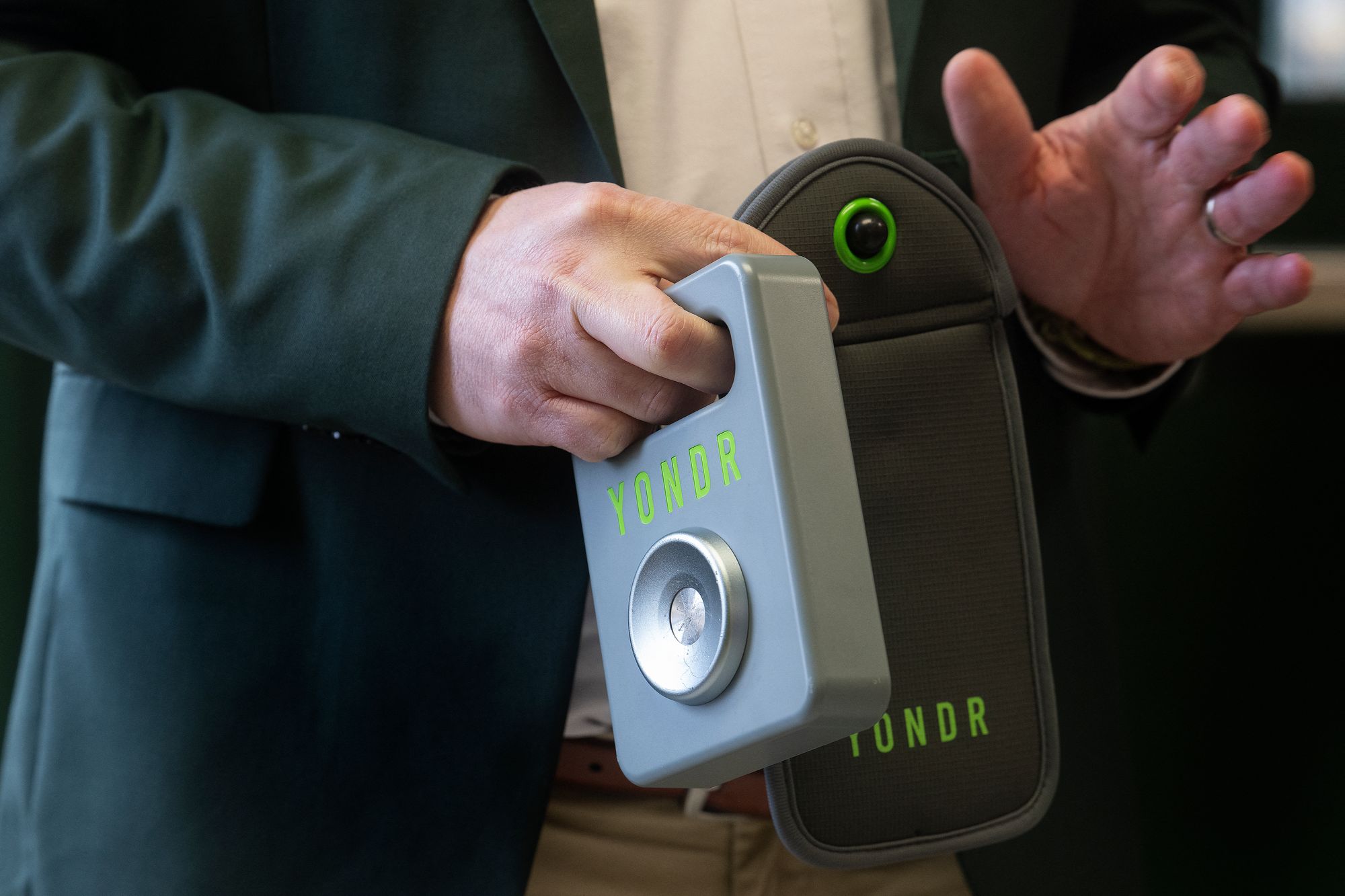
The digital identity verification company rolled out phone pouches for about 290 support employees more than three years ago to better protect sensitive client data, The Financial Times reports. The small, sealed bags lock devices inside and can only be opened at a magnetic unlocking station, similar to Yondr-style pouches used at concerts and comedy shows. Unlike traditional lockers, ID.me employees keep the pouches on hand during shifts, so they can still hear urgent calls, notifications or emergency alerts, employee Kamilah Muiruri told the outlet. Phones can also be used during scheduled breaks.
For Muiruri, the ban has helped her build better relationships with colleagues, while also improving her focus.
“It gets us to connect with each other,” Muiruri told the outlet. “I didn’t really know people in the office as I was focusing on the friends I have outside the office. Now, we are very close as a team . . . [and] very big on going out together.”
“When I first started . . . I wasn’t the best employee, constantly checking my phone,” she added.
However, Adrian Chadi, an associate professor at the University of Southampton, says the evidence that phone bans improve productivity is not definitive. His research suggests they can help with simple, routine jobs by reducing distractions, but the impact is less clear in more complex work that involves creativity or problem-solving.
“It is very difficult for researchers to determine the effects of a ban compared to a situation without such a ban in the same organizational context,” Chadi told the Financial Times. “It is also possible that employees will perceive the ban very negatively if using their mobile phone offers obvious advantages at work, [especially] as people have become accustomed to the constant availability of their mobile phones.”
Across the pond, the Royal Court Theatre, London, introduced phone pouches for its Writers’ Card program to cut distractions and boost creative focus, requiring playwrights to lock away their phones at the box office while they work and partake in talks and networking events.
“Writing is an extraordinarily difficult thing to do…particularly when you get to the hard part,” Will Young, the theater’s executive director, told The Financial Times. “When you get stuck, it’s easier to reach for a distraction.”
Young added that the phone policy has been warmly accepted by “so many writers [who were] half-amused, half-ashamed” to do so.
“It’s only a small thing, [but] there is something about that commitment [that says] ‘I’m here to work,’” he said.
Back stateside, Dimon made headlines in November when he enforced a strict “no smartphone” rule at JPMorgan Chase meetings. In shareholder message, he wrote: “People in meetings all the time who are getting notifications and personal texts or who are reading emails. This has to stop. It’s disrespectful. It wastes time.”
“If you have an iPad in front of me and it looks like you’re reading your email or getting notifications, I tell you to close the damn thing. It’s disrespectful,” Dimon further told CNN.
Graham Dugoni, the founder and CEO of Yondr, told the outlet that its customers now span a wide range of sectors, including courts, childcare centers, government agencies, mining operations, political organizations and businesses seeking to protect intellectual property.
“The organizations coming to us have usually already tried the honor system,” he to the Financial Times. “What these environments share is the recognition that a phone policy on paper is not the same as a phone-free environment.”