US Defense Secretary Pete Hegseth has declared that the Trump administration will not let China impose “hegemony” on the region, but has skirted any mention of Taiwan in a closely watched speech at Asia’s premier defence summit.
Mr Hegseth, also known as the Secretary of War, is the highest-profile speaker at this year’s Shangri-La Dialogue in Singapore, after China decided not to send its defence minister for the second year in a row.
He once again heaped pressure on allies in both Europe and Asia to spend more on defence, saying the US needed “partners not protectorates”, declaring America would “speak softly” but “carry a big stick”.
He boasted about the Trump administration’s record US$1.5 trillion (A$2.085 trillion) defence budget request, saying it would “unleash America’s arsenal of freedom and expand America’s military dominance for decades to come”.
The defence secretary also pointed to US efforts to bolster its military presence along the first island chain, the line of archipelagos stretching from Japan through Taiwan to the Philippines, stressing that Washington DC would not abandon Asia and would work with partners to create a “genuinely stable equilibrium” and a “favourable durable balance of power”.
“A Pacific dominated by any hegemon would unravel the regional balance of power and undermine the equilibrium we all seek to preserve,”
Mr Hegseth said.
“The Department of War is working with the utmost focus to prevent any such unravelling.”
Taiwan not mentioned in speech
Most officials, ministers and military at Shangri-La were most closely focused on what the secretary said on Taiwan in the wake of the summit between Donald Trump and Chinese President Xi Jinping in Beijing earlier this month, and the stalled arms sales worth US$14 billion (A$19.5 billion) to Taiwan.
China has poured large amounts of energy into trying to prise the US away from Taiwan, and the Trump administration’s recent moves have fuelled anxieties in Taiwan that US support could be ebbing.
Mr Hegseth did not directly mention Taiwan once in his speech to the conference, in stark contrast to his speech last year, when he warned against a potential Chinese invasion of the self-ruled island.
When asked about the arms sale, he denied that the US had held up sales because its stockpiles had been drained by the war in Iran, saying the administration felt “very good” about its stocks.
“Any decision about future Taiwan arms sales, as the president said, will rest with him and the nature of that relationship,” he said.
He also said there was “no change” in America’s overall position on Taiwan, although successive US administrations have refrained from using arms sales as a bargaining chip since Ronald Reagan issued the Six Assurances in 1982.
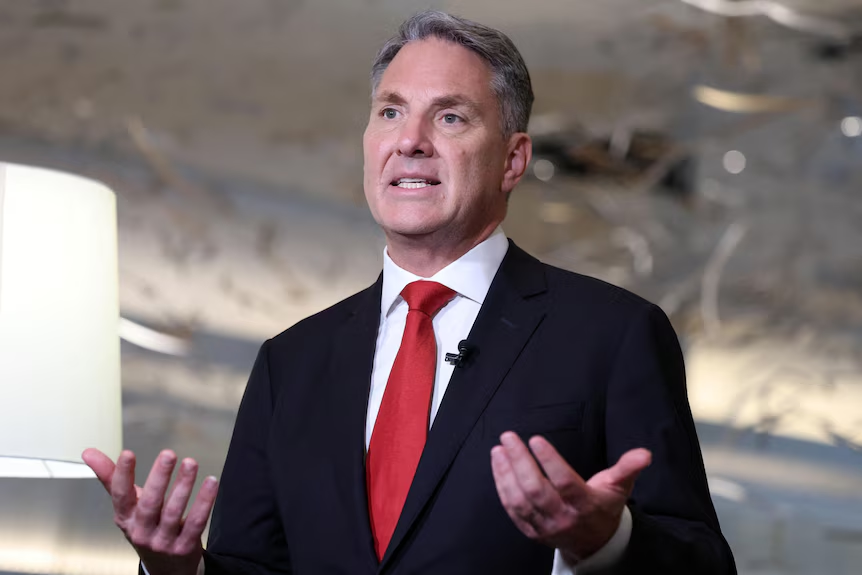
Meanwhile, Australia’s Defence Minister Richard Marles used his speech to the Shangri-La Dialogue to warn about the risks to subsea cables in the wake of incidents that have damaged the critical arteries in both the Baltic Sea and the Taiwan Strait, with analysts pointing the finger at China and Russia as the likely culprits.
Richard Marles spoke to reporters on the sideline of the summit earlier this week. (Reuters: Edgar Su)
Mr Marles said it was “striking” that “several cables have been severed across the Baltic and the Taiwan Strait since November 2024”, although he did not directly blame either Beijing or Moscow.
“Now, maybe these were accidents. But even if they were, it highlights the vulnerability of this crucial part of the globe’s infrastructure,” Mr Marles said.
“If they were intentional, we are left to wonder: Are countries testing our response times, testing our attribution thresholds and testing our political will to respond?“
His speech came in the wake of a sometimes pessimistic keynote speech to open the conference on Friday night by Vietnam’s General Secretary of the Communist Party, Tô Lâm.
The Vietnamese top leader said the challenges facing the world included an erosion of international rules and law, a crisis of development models, including slowing growth and climate change, and a crisis of trust among nations.
He said the erosion of trust was a “silent, yet dangerous crisis” which fuelled mistrust and anxiety — sometimes further exacerbated by the rise of new technologies like AI.