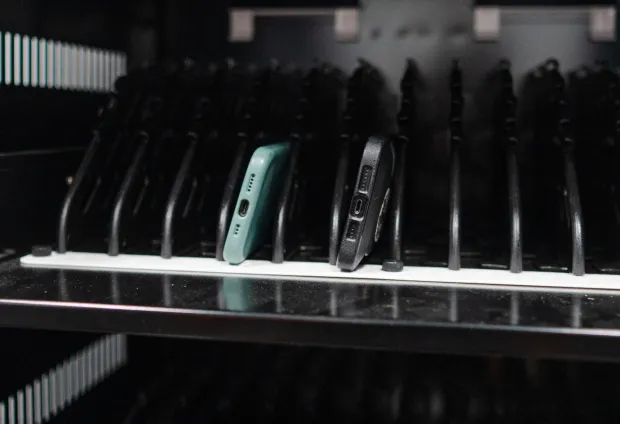
Lunchtime used to be very quiet in the Pine Grove High School cafeteria, as most students stared at their cellphones while they ate.
But the cafeteria has gotten noisier since the district banned students from possessing phones during school hours, which Superintendent Heath Renninger sees as an improvement.
Students are actually talking to each during lunch now, which is healthier than what occurred before the cellphone ban, he said.
“Everyone used to sit their with their faces in their phones. Now they’re socializing, he said. “That’s a great thing.”
With phones no longer competing for their attention, the students are also more focused on education and bullying each other less, meaning the policy change has been a success, he said.
Pine Grove is among several Schuylkill County districts that have barred students from possessing phones during school, a move that Pennsylvania legislators are now considering making a statewide law.
If enacted, Senate Bill 1014 would enact a bell-to-bell phone-free policy for all Pennsylvania schools. That means students’ devices would be unavailable to them throughout the entire school day, including lunch and recess, though there would be exceptions for certain students with specific needs.
The policy would then go into effect during the 2027-28 academic year.
Like Pine Grove, other schools districts have reported seeing multiple benefits from their cellphone bans, including fewer distractions in classrooms and fewer social media conflicts, officials said.
Some Schuylkill school administrators, though, are concerned what exactly a statewide phone prohibition would look like and whether it would conflict with policies they’ve already enacted in their districts.
“We customized our policy to what our parents wanted,” Renninger said. “My concern is what the language in the state law would be.”
North Schuylkill School District was ahead of the curve when it started is phone ban for the 2023-24 school year, and Dr. Robert Ackell, superintendent, is glad for that.

“The positive impact on student engagement, focus, and school culture has been clear,” he said. “Our experience has shown that bell-to-bell phone-free learning environments support academic success and student well-being.”
Based on those experiences, the district supports the intent behind Senate Bill 1014, Ackell said, in part because it seems to provide flexibility to districts in how they implement it.
North Schuylkill High School Principal Ken Roseberry, who took the lead in implementing his district’s policy, said he too agreed with the aim of the proposed state legislation, and also thinks that it’s crucial that districts be able to customize their policies to their own needs.
“I am 100% on board that high school and junior high students shouldn’t have phones in school, but I’m not sure how you would legislate it statewide,” he said.
North Schuylkill, for example, has different levels of discipline for policy violators depending on how many infractions they’ve incurred, and a clear understanding among staff that each violation must be reported, he said.
Different districts, though, may prefer different guidelines.
Key to the success of North Schuylkill’s policy has been buy-in from parents, students and staff, Roseberry said.
“You need teachers to take phones each time they see them,” he said.
For a first offense of a cellphone policy, most districts place the phones on carts in the office and allow students to retrieve them after the final bell. As students commit further offenses the consequences grow. Depending on the district, the student may be required to drop their phone off in the office each day for a week or two, or have their parents come in to retrieve the phones.
Violations in North Schuylkill have diminished over time as students realized that staff members take the policy seriously, Roseberry said. There are 1,000 students in grades 7-12, and on average only about five have their phones taken each day, he said.

He recommends such a policy for other districts, despite his concerns about how well a statewide law would work.
“I think that it’s an absolute necessity for senior and junior high students to be without their phones for eight hours a day,” he said. “Teaching them to put their phones away is nothing but positive.”
Shenandoah Valley already has procedures in place that closely align with the state’s intent to limit cell phone use during the school day, said Superintendent Brian Waite.
Currently students in grades 7–12 may only use phones, earbuds, headphones or other similar electronic devices during lunch, and elementary students are not permitted to use personal electronic devices during the school day. Exceptions are made for students with specific educational needs, including newcomer students who are provided with district-issued translation devices for instructional purposes.
“Limiting cell phone use has improved student focus, reduced behavioral issues, and supported both academic performance and student mental health,” Waite said. “Research shows that the more time students spend on cell phones and social media, the lower their academic performance tends to be.”
He said that any mandate is only as effective as its enforcement, though, and consistency among staff is critical for a cell phone policy to be successful.
“Policies that limit access to electronic devices work best when schools and families work together, and we are fortunate to have strong parent and guardian support in Shenandoah Valley,” he said.

While the district already supports the overall concept of the Senate bill, it would have to tweak its policy to comply with the proposed legislation as it’s currently written, he said.
Pottsville does not outright restrict the possession of wireless devices, but infractions involving technology are reviewed and managed by each school building using existing policies and procedures outlined in each building’s student and family handbook, said Dr. Guy Lowery, superintendent.
If the proposed legislation becomes law, the district would get input from parents, students, teachers, administrators, and school board members to personalize Pottsville’s policy, he said.
Schuylkill Haven also allows students to possess cell phones during the school day, but usage is already restricted during instructional time, said Dr. Shawn Fitzpatrick, superintendent. Therefore the proposed state legislation would require minor adjustments, particularly regarding student access during non-instructional periods such as lunch, he said.
“If enacted, we would work collaboratively with our school board, staff, students, and families to determine the most practical and age-appropriate implementation approach, including procedures for storage and enforcement,” he said. “Overall, I think this change will be a positive one that our students and staff embrace over time.”