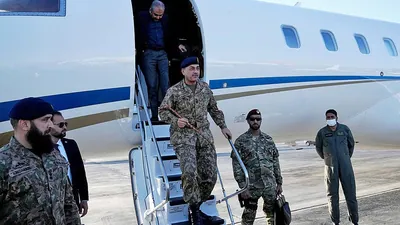
Pakistan has deployed approximately 8,000 troops, a full squadron of fighter jets and a Chinese air defence system to Saudi Arabia, a key American ally, under the their mutual-defence pact, news agency Reuters has reported. This reveals the full scale of the military commitment that Islamabad expanded even as it plays the role of principal mediator in the US-Iran war now entering its 12th week.

The deployment, confirmed to the news agency by three Pakistani security officials and two government sources, includes around 16 JF-17 fighter jets, jointly manufactured with China, which arrived in Saudi Arabia in early April, as well as two squadrons of drones and an HQ-9 surface-to-air missile system.
All equipment is operated by Pakistani personnel and financed by Saudi Arabia. Two sources told Reuters the deployment also provided for the possible dispatch of Pakistani warships, though the agency could not confirm whether any had reached the kingdom.
Contradiction in Islamabad’s role
The disclosure puts into stark focus the contradictions at the heart of Pakistan’s position in the West Asia conflict.
Since late March, Islamabad has been the sole acknowledged backchannel between Washington and Tehran.
It hosted the only round of direct US-Iran peace talks, with US Vice President JD Vance travelling to Islamabad in April to meet an Iranian delegation.
Pakistan’s army chief, Field Marshal Asim Munir, spoke to President Donald Trump repeatedly throughout the conflict.
Trump himself said publicly that he had held back further strikes on Iran following conversations with Munir and Prime Minister Shehbaz Sharif.
Iran’s Supreme National Security Council subsequently agreed to negotiate on Pakistani soil.
Yet simultaneously, Pakistan’s military has been deploying combat-capable forces to the opposing side of the conflict.
Adds to current strength
The current deployment adds to thousands of Pakistani troops already stationed in Saudi Arabia under earlier agreements, all three security officials told Reuters.
One government source, who said they had seen the text of the confidential defence pact signed last year, said the agreement provides for the possibility of up to 80,000 Pakistani troops being deployed to the kingdom.
Pakistan’s defence Minister Khawaja Asif had previously implied the pact places Saudi Arabia under Pakistan’s nuclear umbrella — an extraordinary extension of strategic deterrence, if borne out.
The deployment was initially triggered by Iranian strikes on Saudi energy infrastructure that killed a Saudi national, Reuters reported earlier. Saudi Arabia subsequently launched multiple unpublicised retaliatory strikes on Iran.
Pakistan responded with a sharp public condemnation — issued at a Corps Commanders Conference chaired by Munir — calling the Iranian strikes a “dangerous escalation” and a “serious violation of Saudi Arabia’s sovereignty”, while reaffirming Pakistan’s “unwavering support for Saudi security”
The war, which began on February 28 with US and Israeli strikes that killed Supreme Leader Ayatollah Ali Khamenei and destroyed significant Iranian military infrastructure, has caused the largest energy supply disruption in recorded history, according to the International Energy Agency.
Iran’s near-closure of the Strait of Hormuz choked off approximately 20 per cent of global seaborne oil, sending energy prices spiralling worldwide.
A US-brokered ceasefire, in which Pakistani mediation played a central role, has held for six weeks, though violations remain frequent.
Pakistan says it remains in “continuous contact with Iran and the United States, day and night” to preserve it.
Pakistan’s military, its foreign office, and Saudi Arabia’s government media office did not respond to Reuters’ requests for comment on the troop deployment.