One year ago, Mark Carney became Prime Minister at a moment when the political environment in Canada looked volatile and uncertain. The Liberals had just pulled off a remarkable comeback after trailing badly in the polls following Justin Trudeau’s resignation. The mood in the country was anxious, economic pressures were intense, and the global environment felt increasingly unstable.
A year later, the political picture looks very different.
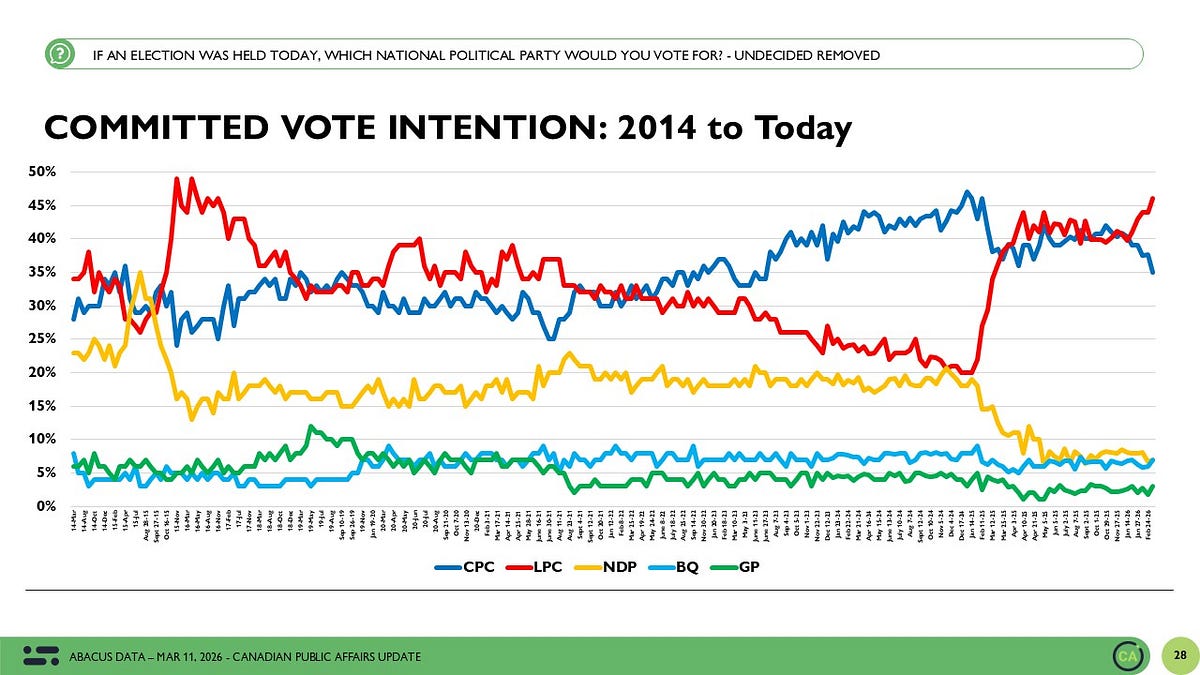
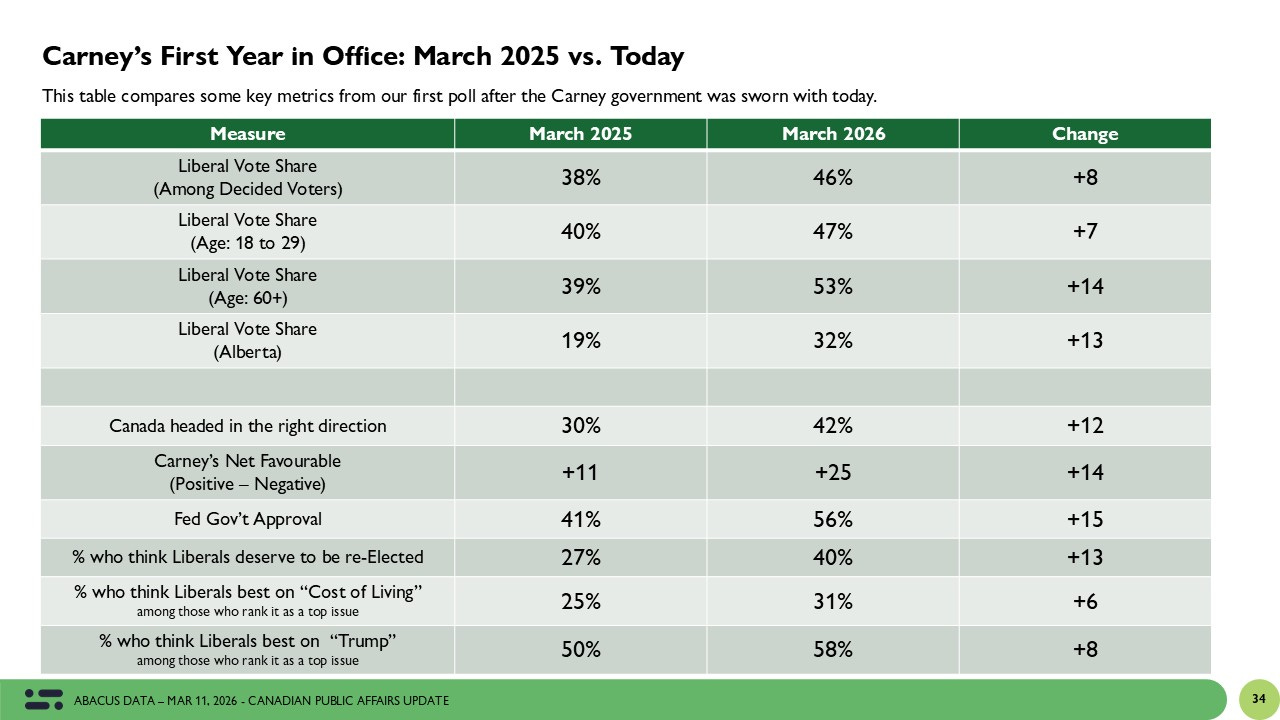
Our latest Abacus Data survey, conducted between March 4 and 11 among 1,931 Canadian adults, finds the Liberals holding an 11-point lead nationally over the Conservatives. Among decided voters, 46 percent say they would vote Liberal compared with 35 percent for the Conservatives. The New Democrats sit at 7 percent, the Bloc at 7 percent, and the Greens at 3 percent.
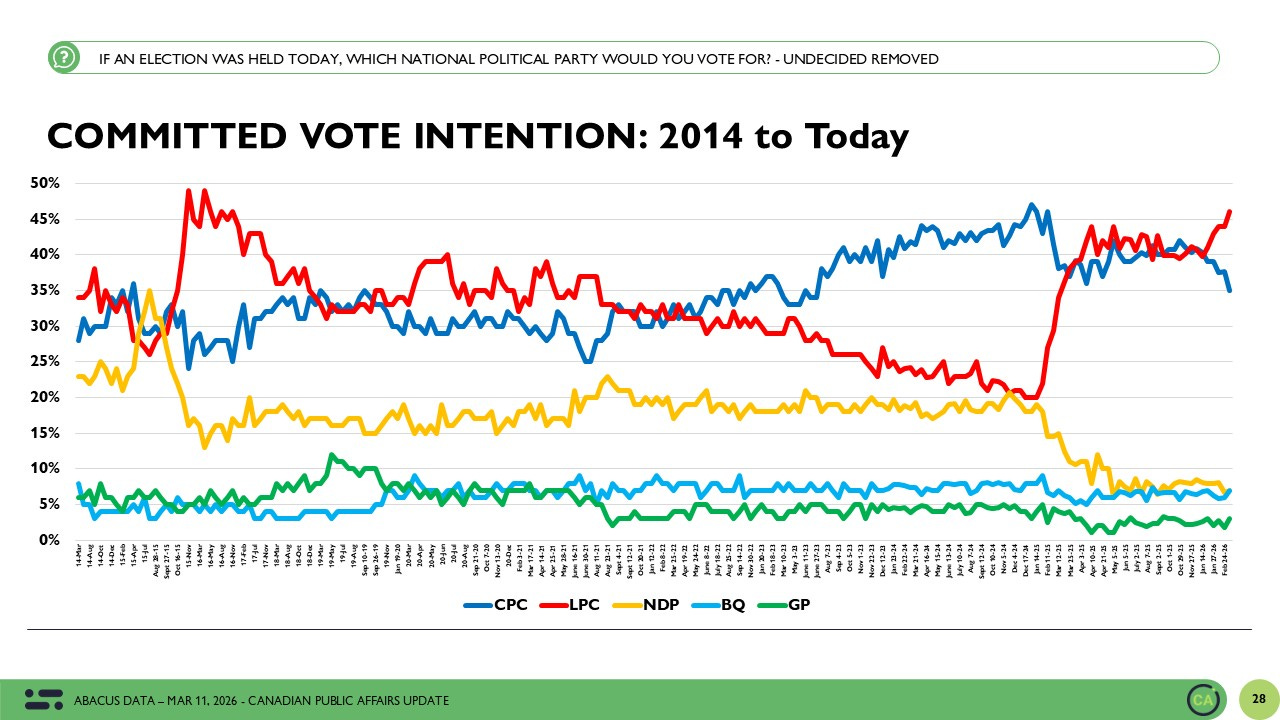
It is the largest Liberal lead we have measured since August 2021.
What stands out most, though, is not just the size of the lead. It is the broader shift in the political environment that seems to be unfolding around it.
For most of the past few years, Canadian politics has been shaped by deep pessimism. The country felt stuck. People believed things were headed in the wrong direction. That mood was one of the central drivers behind the appetite for change we saw leading into the 2025 election.
Today, the public mood looks noticeably different.
Right now, 42 percent of Canadians say the country is headed in the right direction while 43 percent say it is on the wrong track. That near-even split might not sound particularly upbeat, but compared with where things stood a year ago it represents a meaningful improvement.
At the same time, Canadians remain extraordinarily pessimistic about the world around them. Only 12 percent think the world is moving in the right direction. Nearly eight in ten say it is headed the wrong way. Views of the United States look almost identical, with only 13 percent saying it is moving in the right direction and 79 percent saying it is on the wrong track.
This gap between how Canadians view their own country and how they see the world has become one of the most interesting features of public opinion right now. It feels a bit like a split brain. People are uneasy about the global environment but somewhat more comfortable with Canada’s trajectory.
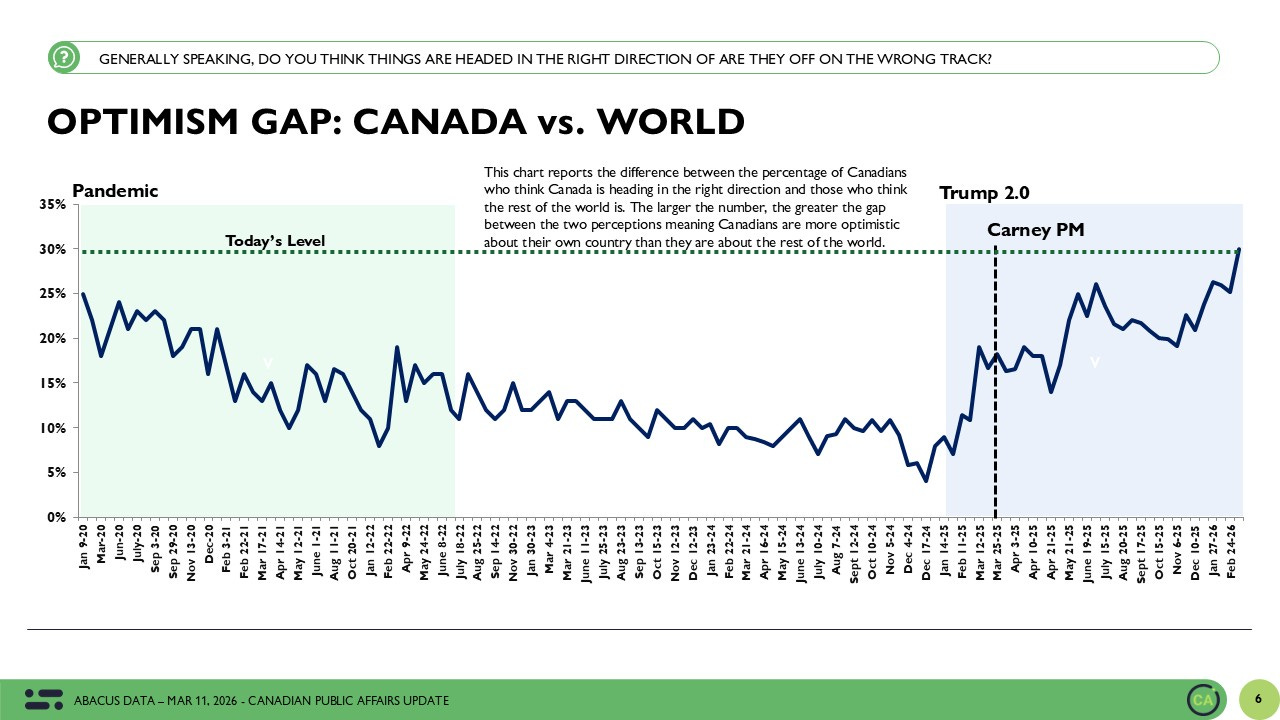
That distinction matters politically. Governments rarely thrive when the public mood is dark. When people begin to feel that things are at least somewhat steady at home, incumbents often benefit.
Another indicator of this shift appears in how Canadians answer a simple question we have been tracking for some time. Should the Liberals be re-elected, or is it time for change and there is a good alternative?
For the first time in our tracking, more Canadians say the Liberals deserve to be re-elected than say it is time for change and there is a good alternative government. Forty percent say the Liberals deserve another term while 36 percent say it is time for change and there is a good alternative. Another quarter say they want change but do not see a good alternative right now.
That last group is particularly important. It suggests that even among people who are uneasy with the government, the opposition has not yet convinced them that it is ready to take over.
None of this means the public has suddenly become carefree about the issues facing the country. The cost of living continues to dominate the agenda by a wide margin. Sixty-five percent of Canadians rank it among their top three priorities for the federal government.
But something else has been climbing the list over the past few months.
Donald Trump and his administration now rank as the second most frequently cited issue facing Canada. Forty-one percent of Canadians place it among their top three concerns. That level of salience would have seemed unlikely not long ago, but the geopolitical environment has shifted quickly.
And this is where the political terrain becomes especially interesting.
Among Canadians who say the cost of living is a top issue, the Conservatives hold a modest advantage on who they think would handle it best. The same is broadly true on the economy. Those advantages have shrunk.
But when the issue shifts to Donald Trump and the United States, the dynamic flips dramatically. Among Canadians who say Trump is one of the most important issues facing the country, the Liberals lead the Conservatives by forty points on which party people think would handle it best.
That advantage is enormous, and in a political environment where global instability is increasingly top of mind, it provides the governing party with a structural edge.
Leadership perceptions reinforce the pattern.
Mark Carney’s personal numbers have strengthened over the past year. About half of Canadians now say they have a positive impression of him, while fewer than three in ten hold a negative view. His net favourability sits at +25, up from +11 a year ago.
Pierre Poilievre’s numbers remain steady but more polarized. His net favourability stands at minus eight. Among those who view him positively, support for the Conservatives is very strong. The challenge is that the size of that positive universe is smaller than Carney’s.
When you put all of this together, the result is the electoral map we see today.
The Liberals hold a commanding lead in Ontario and remain dominant in Atlantic Canada. In Quebec they sit well ahead of the Conservatives, with the Bloc still competitive in its traditional space. British Columbia remains competitive but leans Liberal. Alberta continues to be overwhelmingly Conservative territory, though even there the Liberals are somewhat more competitive than they were a few years ago.
Demographically, the Liberal coalition is broad. They lead widely among younger and older Canadians, maintain a strong advantage among women, and remain competitive among younger voters.
None of this means the political landscape is locked in place. The cost of living is still the dominant issue in the country. Economic conditions could change.
But at this moment, one year after Mark Carney took office, the structure of the opinion environment is clearly tilted in the government’s favour.
The Liberals have not just stabilized their position since the 2025 election. They have expanded it.