Key Points
-
Nvidia seems to have made a solid start in the central processing unit (CPU) market.
-
The company anticipates strong revenue from sales of its server CPUs this year and has announced that it is moving into the client CPU market as well.
-
The share of Arm-based CPUs that Nvidia is designing is poised to grow remarkably in the coming years, and that doesn’t bode well for Intel and AMD.
- 10 stocks we like better than Nvidia ›
Nvidia (NASDAQ: NVDA) has been the top player in the artificial intelligence (AI) chip market over the years, thanks to its expertise in designing graphics processing units (GPUs).
These chips are ideal for processing huge amounts of data quickly. The massive parallel processing power of GPUs enables them to perform thousands of tasks simultaneously. As a result, GPUs have been widely used in gaming personal computers (PCs), content creation, AI, and machine learning. Nvidia has dominated the gaming GPU market for several years now, giving rivals Advanced Micro Devices (NASDAQ: AMD) and Intel (NASDAQ: INTC) very little room to grow in this space.
Will AI create the world’s first trillionaire? Our team just released a report on the one little-known company, called an “Indispensable Monopoly” providing the critical technology Nvidia and Intel both need. Continue »
In fact, Nvidia controlled a whopping 95% of the gaming GPU market at the end of 2025, according to Jon Peddie Research, leaving the rest for AMD. Nvidia has carried its PC GPU dominance into data centers as well. It is the go-to chip designer for hyperscalers and AI companies looking to train large language models (LLMs) that require massive datasets and need to perform a huge number of calculations simultaneously.
However, as AI moves from training to inference, Nvidia has now set its sights on the central processing unit (CPU) market as well. This doesn’t bode well for AMD and Intel. Let’s look at the reasons why.
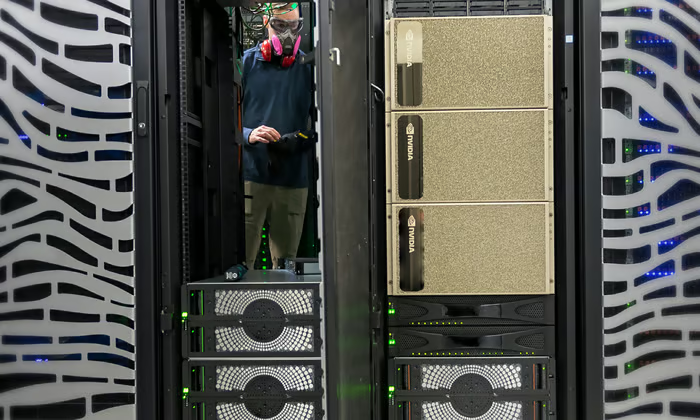
Image source: Nvidia.
Nvidia is going after AMD and Intel’s CPU business
CPUs aren’t as powerful as GPUs, as they have a significantly lower core count for performing calculations and carrying out tasks. Moreover, CPUs perform tasks sequentially, which is why they haven’t been preferred for training AI models. But the high clock speeds of the fewer cores used in CPUs mean that they can perform individual tasks quickly.
That’s why CPUs are now finding relevance in AI inference, a process that requires far less computing power than the training phase, since it involves substantially fewer calculations. As a result, AMD and Intel have been witnessing a solid uptick in demand for their server CPUs. Additionally, CPU demand is poised to improve significantly due to the growing adoption of edge AI devices, such as PCs, which can process AI workloads locally.
According to AMD, the server CPU market could grow at an annual pace of 35% through 2030, generating $120 billion in revenue by the end of the decade. Meanwhile, the generative AI PC market is anticipated to grow from an estimated $91 billion this year to $260 billion in 2031, according to a third-party research report available on Markets and Markets.
AMD and Intel are the biggest companies that sell server and client CPUs (used in PCs and laptops). AMD controlled just under 30% of the client CPU market in the first quarter of 2026, with Intel accounting for the rest. Meanwhile, Intel controlled just over two-thirds of the server CPU market at the end of Q1. Nvidia is now looking to dent their dominance.
The GPU specialist revealed last month that its Vera server CPU is already in strong demand and is poised to drive $20 billion in revenue for the company in the current fiscal year. Nvidia sees a $200 billion addressable market for its Vera server CPUs over the long term, suggesting a much larger opportunity.
And now, Nvidia has doubled down on its CPU efforts by launching the RTX Spark Superchip for laptops and PCs running on the Windows operating system. Nvidia points out that Spark will allow users to build AI applications and agents, play games, and create content, all while promising an all-day battery life. What’s more, Nvidia points out that the Spark Superchip will power PCs from Asus, Dell Technologies, Lenovo, MSI, Microsoft, and HP.
Importantly, Yahoo! Finance notes that Nvidia is reportedly working with game studios to ensure that games are compatible with the RTX Spark Superchip. The PC OEMs (original equipment manufacturers) partnering with Nvidia will launch laptops powered by this chip in the fall this year. So, it won’t be long before Nvidia dives into a market that has been the hunting ground of AMD and Intel so far.
AMD and Intel’s CPU market share is expected to shrink rapidly
AMD and Intel’s CPUs are based on the x86 architecture. However, processors designed using Arm Holdings‘ architecture have been gaining solid traction. Next Move Strategy Consulting reports that the market for Arm-based PC processors could be valued at $52.6 billion in 2030 as compared to $9.2 billion in 2023, clocking a compound annual growth rate of 28%.
Nvidia’s RTX Spark Superchip consists of a Grace CPU, designed using Arm’s architecture. Meanwhile, the company’s Vera CPU is also Arm-based. It is worth noting that the share of Arm-based CPUs and custom processors in servers is expected to jump to a whopping 90% by 2029, according to Counterpoint Research.
For comparison, Arm-based CPUs accounted for almost 18% of the server CPU market in the first quarter of 2026, according to UBS, up from 11.5% in the year-ago period. That was higher than the increase of 3.3 percentage points in AMD’s share. Intel had a forgettable Q1, with its share dropping by 9.5 percentage points from the year-ago period.
So, Nvidia could eventually make solid progress in the CPU market going forward, driven by the growing preference for processors designed using Arm’s technology. This should complement the phenomenal growth that the company is experiencing in the data center GPU market, putting Nvidia stock on track to significantly increase its market cap from current levels in the next three years.
Should you buy stock in Nvidia right now?
Before you buy stock in Nvidia, consider this:
The Motley Fool Stock Advisor analyst team just identified what they believe are the 10 best stocks for investors to buy now… and Nvidia wasn’t one of them. The 10 stocks that made the cut could produce monster returns in the coming years.
Consider when Netflix made this list on December 17, 2004… if you invested $1,000 at the time of our recommendation, you’d have $443,191!* Or when Nvidia made this list on April 15, 2005… if you invested $1,000 at the time of our recommendation, you’d have $1,258,838!*
Now, it’s worth noting Stock Advisor’s total average return is 941% — a market-crushing outperformance compared to 206% for the S&P 500. Don’t miss the latest top 10 list, available with Stock Advisor, and join an investing community built by individual investors for individual investors.
*Stock Advisor returns as of June 8, 2026.
Harsh Chauhan has no position in any of the stocks mentioned. The Motley Fool has positions in and recommends Advanced Micro Devices, HP, Intel, Microsoft, and Nvidia. The Motley Fool has a disclosure policy.
The views and opinions expressed herein are the views and opinions of the author and do not necessarily reflect those of Nasdaq, Inc.