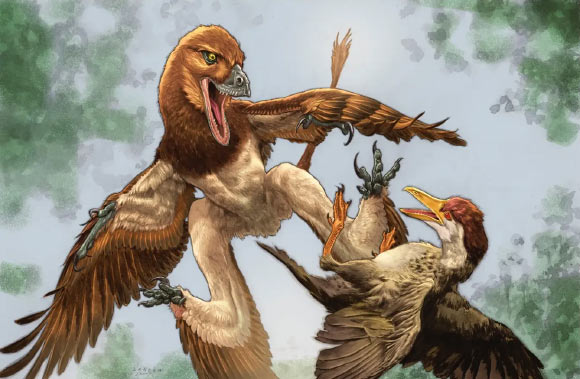
Jian changmaensis is the first non-avian dinosaur found at a paleontological site that has yielded more than 100 specimens of Early Cretaceous birds.
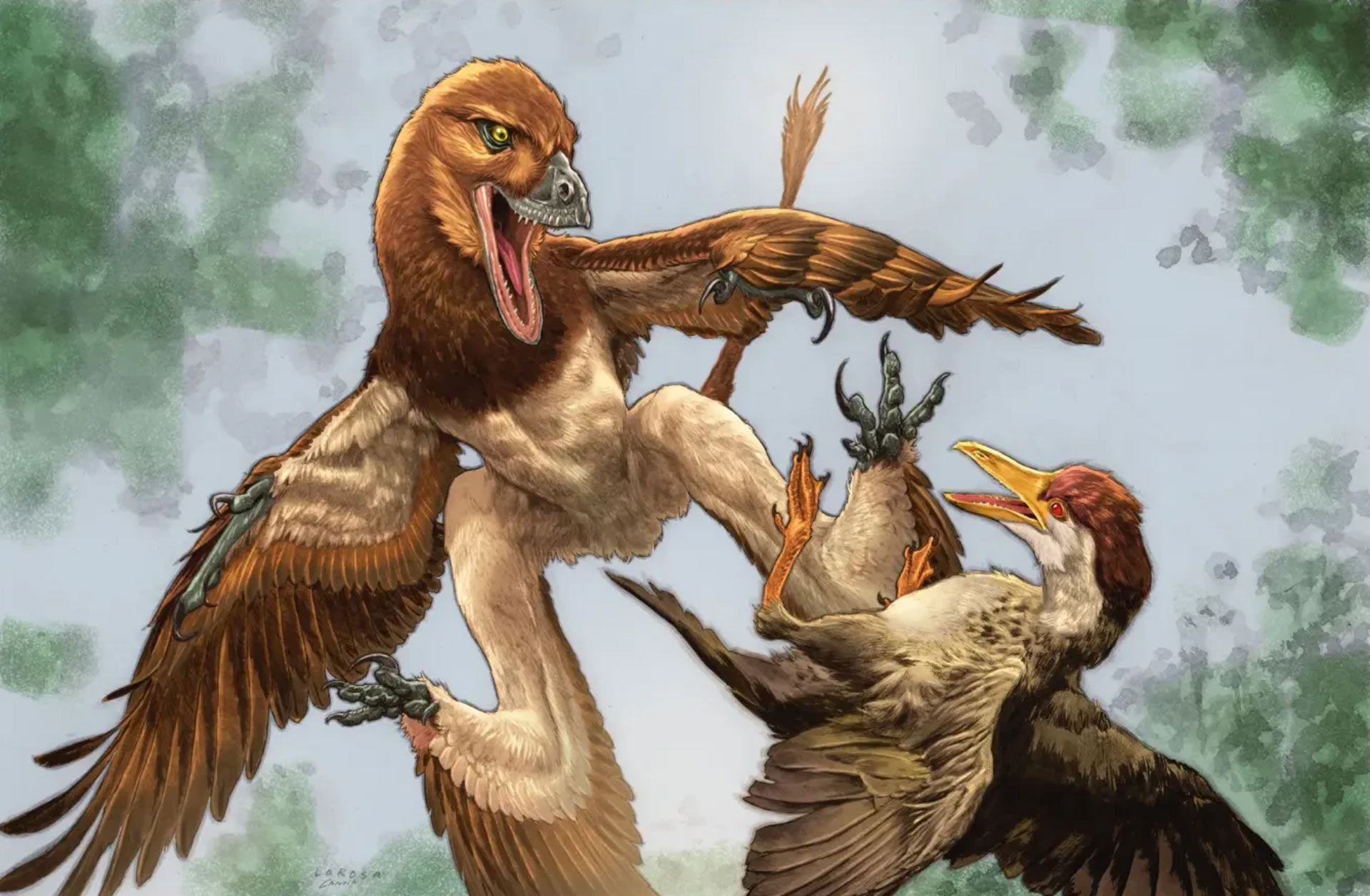
Jian changmaensis (left) attacks the early bird Gansus yumenensis (right) in what is now the Changma Basin of northwestern China approximately 120 million years ago. Image credit: Lewis LaRosa / Jão Canola.
Jian changmaensis lived in what is now northwestern China roughly 124 to 120 million years ago (Early Cretaceous epoch).
The species belonged to Microraptorinae, a subgroup of small feathered dromaeosaurid dinosaurs.
Members of this lineage include Microraptor, the four-winged dinosaur widely regarded as capable of gliding and possibly powered flight.
“Jian changmaensis is one of the biggest microraptor specimens that has ever been found,” said Dr. Jingmai O’Connor, a paleontologist with the Field Museum of Natural History and the Institute of Vertebrate Paleontology and Paleoanthropology at the Chinese Academy of Sciences.
“The piece of its upper arm bone that we have is about 10 cm (4 inches) long, so the entire dinosaur probably had something like a four-foot wingspan, around the size of a barn owl.”
“We suspect that Jian changmaensis, like its fellow microraptors, had long feathers on both its arms and its legs, giving it the appearance of having four ‘wings’ that it used to glide.”
“Jian changmaensis and the other microraptors probably weren’t capable of true, powered flight, but they could probably glide like a flying squirrel.”
The skeletal remains of Jian changmaensis were found in the Xiagou Formation, exposed near the village of Changma in the Changma Basin of northwestern Gansu province.
More than 100 skeletons of Early Cretaceous birds have been recovered there, many preserving soft tissues including feathers and skin.
Yet in all that time, not a single specimen of any non-avian dinosaur had ever been found at the site.
“Scientists have found these weird, broken-up clusters of bird bones at this site, and we didn’t know what made them,” Dr. O’Connor said.
“This new microraptor dinosaur, Jian changmaensis, is our best guess.”
“It’s the only dinosaur found at this site that wasn’t a bird, it was a carnivore, and it was much bigger than everything else that we’ve found there.”
The discovery of Jian changmaensis carries implications beyond the identification of a new species.
Until now, all unambiguous members of Microraptorinae had been found in the Jehol Group, a set of geological formations in northeastern China, roughly 2,000 km away from Changma.
Jian changmaensis pushes the confirmed range of the group into northwestern China.
“Jian changmaensis reveals that non-avian dinosaurs lived in what is now the Changma Basin, an area famous for its fossil birds,” said Dr. Matt Lamanna, a paleontologist at the Carnegie Museum of Natural History.
“Our team has recovered more than a hundred bird fossils at Changma, but only this single non-avian dinosaur specimen.”
“Jian changmaensis provides critical new insight into the biological history of the Changma region and the ecological context of the ancestors of today’s birds.”
“You cannot understand life on the planet today without looking at its origins.”
“Birds are arguably the most successful group of land-dwelling vertebrate animals on Earth today.”
“Learning about early birds and their close non-bird dinosaur relatives gives us a better understanding of what made the group of birds that survived so special.”
The team’s paper was published today in the Annals of Carnegie Museum.
_____
Ling-Qi Zhou et al. 2026. First Non-Avian Theropod (Dromaeosauridae, Microraptorinae) from the Bird-Bearing Lower Cretaceous Xiagou Formation of the Changma Basin, Gansu Province, Northwestern China. Annals of Carnegie Museum 92 (2): 89-110
