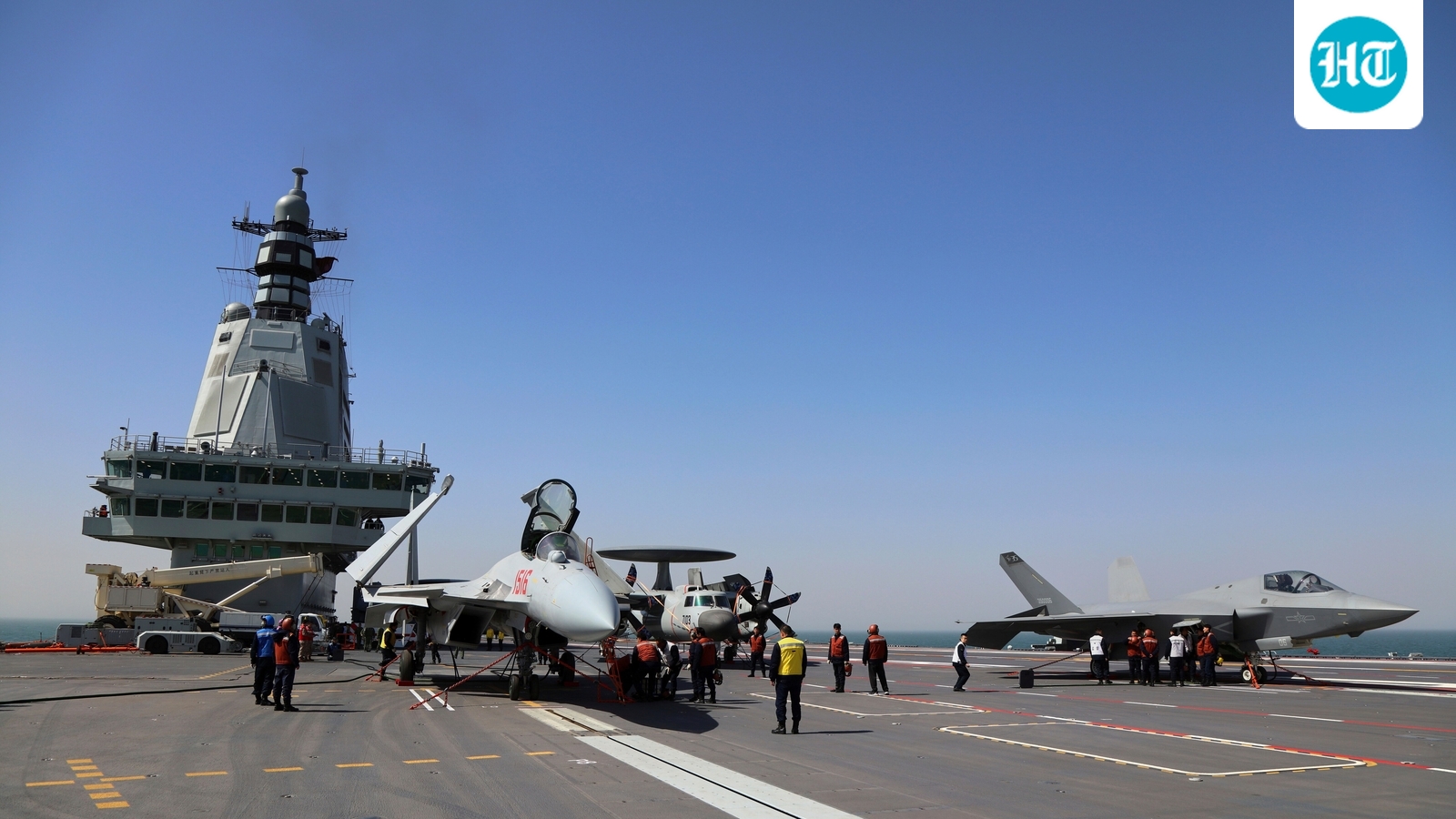
SINGAPORE—China has put its largest and most sophisticated aircraft carrier into active service, boosting Beijing’s quest to create a formidable oceangoing navy that can challenge U.S. power in the Asia-Pacific region and beyond.
Leader Xi Jinping presided over the commissioning ceremony this week for the Fujian, the country’s third aircraft carrier and the first to be fully designed and built in China.
More than 2,000 personnel attended the ceremony at a naval base in Sanya, on China’s southern island province of Hainan, the official Xinhua News Agency reported on Friday. Xi boarded the warship during the event on Wednesday to speak to its crew and inspect its systems, and activated the carrier’s catapult system as part of a demonstration, Xinhua said.
Named after the coastal province that sits closest to Taiwan, the island democracy that Beijing claims as its territory, the Fujian features electromagnetic catapults for launching aircraft, including new early-warning radar planes that China’s other two carriers can’t deploy.
China has the world’s largest navy, with more than 370 surface ships and submarines, according to Pentagon estimates, though the U.S. still operates the most aircraft carriers of any country.
Since taking power in 2012, Xi has directed an ambitious effort to modernize China’s military and turn it into a 21st-century fighting force that can take on Western powers—particularly at sea, where Chinese forces have confronted U.S. counterparts while asserting Beijing’s sovereignty claims over Taiwan and in the South China Sea.
Defense analysts say Beijing is still developing its ability to operate aircraft carriers. The Fujian will contribute to that process as both a combat platform and a test bed for refining Chinese naval tactics and strategy.
Putting the Fujian into service also boosts China’s ability to project power further from its shores, with three carriers that can be rotated to sustain naval operations over greater distances and for longer periods.
Beijing is already “carrying out more complex carrier drills further afield into the Western Pacific,” said Nick Childs, a senior fellow at the International Institute for Strategic Studies, a London-based think tank. “The new ship’s characteristics will allow it to provide a more rounded capability and operate more effectively in a wider range of scenarios.”
The Fujian represents a marked upgrade from China’s two other carriers, the first of which was refurbished from a Soviet-made hull bought from Ukraine in 1998. The second, commissioned in 2019, is a design based largely on the first.
These two older carriers lack catapults that are standard on American carriers and instead use “ski jump” ramps to deploy fixed-wing aircraft. This method limits the types of aircraft that a carrier can operate and the payloads that its planes can carry.
With its catapult systems, the Fujian can operate the domestically developed KJ-600 airborne early-warning aircraft—in addition to China’s new J-35 stealth fighter and updated variants of the J-15, the mainstay Chinese naval fighter developed from Russian Sukhoi models.
State media said in September that the Fujian had successfully launched and recovered these three models of aircraft during training voyages. The J-35, J-15 and KJ-600 all appeared on the carrier’s flight deck during Wednesday’s commissioning ceremony, according to Xinhua.
With the Fujian, analysts say, Beijing can now field a carrier with its own capabilities in airborne early-warning radar and electronic warfare, similar to what U.S. carriers have long been able to offer.
The Fujian’s ability to operate more specialized aircraft and conduct flight operations faster will enhance the striking power of a Chinese carrier battle group “when deployed to areas beyond the PRC’s immediate periphery,“ according to a 2024 Pentagon assessment on Chinese military power, which used an abbreviation for the People’s Republic of China.
While the Fujian represents a step up in Chinese naval power, it is conventionally powered and smaller than its nuclear-powered American counterparts. The Pentagon has estimated that the Fujian, which displaces more than 80,000 tons when fully loaded, can deploy up to 40 fixed-wing aircraft alongside a complement of helicopters.
Many Western military analysts consider the Fujian to be less capable than the U.S. Navy’s Nimitz and Gerald R. Ford-class carriers, which can carry more aircraft and sail far longer without refueling—though only one U.S. carrier, the USS Gerald R. Ford, uses electromagnetic catapults, with the others using steam-powered catapults.
The Fujian “has only three instead of four catapults” that U.S. carriers have, said Childs, the IISS analyst. “Its flight deck layout appears to limit its ability to carry simultaneous aircraft launches and recoveries so it probably won’t be able to generate as many aircraft missions over a given period.”
Washington has 11 aircraft carriers in active service, though one of them is scheduled to be decommissioned next year. The U.S. Navy also operates nine amphibious assault ships that can deploy aircraft.
“China’s got three carriers. We have more,” Rear Adm. Brett Mietus, one of the top U.S. commanders for Guam, said in an interview in September. “And the good news for us is that we’ve been operating them for a long, long time.”
“The ability to be able to operate safely and effectively at a high level of lethality is something we’ve just been doing for a long time, and China’s learning how to do,” Mietus said.
First launched in 2022, the Fujian started conducting sea trials last year to test its systems and operational capabilities. These maneuvers included a recent passage through the strategically important Taiwan Strait as the carrier headed to the South China Sea to carry out what Chinese officials described as “scientific research tests and training missions.”
Some analysts say Beijing appears to have started work on building a fourth aircraft carrier, citing satellite imagery of a major shipyard. The Fujian “will provide lessons for the next Chinese carrier, which is apparently in the early stages of construction, and is expected to be bigger still and possibly also have nuclear propulsion,” Childs said.
Write to Chun Han Wong at chunhan.wong@wsj.com
