An all-day prayer event on the National Mall on Sunday — backed by the White House through a mix of taxpayer funds and private donations — is the most recent flashpoint in the Trump administration blurring separation of church and state.
The event, dubbed “Rededicate 250: A National Jubilee of Prayer, Praise & Thanksgiving,” is part of a series of celebrations commemorating America’s 250th birthday, and is expected to feature remarks from government officials including Defense Secretary Pete Hegseth and House Speaker Mike Johnson and video messages from President Donald Trump and Secretary of State Marco Rubio. The event will bring together faith leaders, public officials and musicians to reflect and worship ahead of the anniversary of the nation’s founding.
Sunday’s event is the latest in a series of faith initiatives and policy moves championed by the White House that have bolstered an emphasis on Christianity in the government’s operations, culture and policy.
Freedom 250, a nonprofit subsidiary of the National Park Foundation, which functions as the National Park Service’s fundraising arm, organized the event.
“Rededicate250 will be a powerful moment to reflect on where we have been, recommit ourselves to the ideals that define us, and look toward the future with renewed hope and purpose,” said Freedom 250 senior adviser Danielle Alvarez.
While organizers are inviting Americans of every background to attend the event, the long list of faith leaders attending are largely evangelical Christians — except for one Orthodox rabbi and two conservative Catholic bishops. Brittany Baldwin, White House senior policy adviser and executive of the White House Task Force America 250, described a focus on “our heritage as a Judeo-Christian” nation in a since-deleted planning webinar that was posted ahead of Sunday’s event.
Experts CNN spoke with were split on whether the event is constitutional.
Andrew Koppelman, a professor at Northwestern University’s Pritzker School of Law whose areas of focus include constitutional law, said while he believes the event itself is probably constitutionally protected, it’s “contrary to the fundamental purposes of the Constitution.”
“This kind of divisive embrace of a particular religion and trying to associate the incumbent administration with that religion is bad for religion, bad for government and bad for America,” Koppelman said.
But Douglas Laycock, who specializes in religion and law at the University of Texas School of Law, said he believes this event is “flagrantly unconstitutional.”
“It is unconstitutional because it is explicit government promotion of religion, and not just religion in general, but of a fairly specific version of one particular religion,” Laycock said.
Meanwhile, Michael Mooreland, professor of law and religion at Villanova’s Charles Widger School of Law, argued there can be an intersection of religious faith and the public square, noting the prayers at open sessions of Congress and at the presidential inauguration.
“I think that it’s kind of overemphasizing that idea of separation to think that an event like this raises any constitutional problems,” Mooreland said, adding that it’s “too strong a separationist view of what the First Amendment requires.”
White House spokeswoman Taylor Rogers told CNN in a statement that Rededicate 250 will be a “beautiful and unifying moment” to reflect on America’s history that has been shaped by “great men and women of faith.”
“Rededicate 250 will be a fantastic event in our nation’s capital to celebrate freedom of religion for all people of faith — a cornerstone of the sacred principles enshrined in our Constitution by the founding fathers. Americans will come together on the National Mall to rededicate this country as ‘one nation under God,’” Rogers said.
Critics say the Trump administration is trying to reinforce Christian nationalism — the belief that the US was founded as a Christian nation and should be governed by Christian principles.
Rabbi Jonah Dov Pesner, director of the Religious Action Center of Reform Judaism, argued the term Judeo-Christian, which Baldwin used to describe the event, and which members of the Trump administration have repeatedly used to describe the nation’s values, does not serve Christianity, Judaism or other religions in America.
“Judeo-Christian is often used as a mash up to co-op Judaism and subsume it within a triumphal view of Christianity and feeds right into a White Christian nationalist narrative,” Pesner said at a media briefing ahead of Sunday’s event.
CNN reached out to the White House on criticisms about White Christian nationalism.
Various Trump administration officials have repeatedly tied the nation’s founding to Christianity. During a National Prayer Breakfast event this spring, Hegseth declared “America was founded as a Christian nation.” In one video promoting Sunday’s event, the defense secretary said, “Our founders knew two simple truths: Our rights don’t come from government, they come from God, and a nation is only as strong as its faith.”
But some historians disagree. Gregg Frazer, a professor of history and political studies The Master’s University, a Christian college in California, wrote in an online paper that while there were Christians among the Founding Fathers, “they did not intend to create a Christian nation.”
“They were religious men who wanted religion — but not necessarily Christianity — to have significant influence in the public square,” Frazer wrote.
The US Constitution’s First Amendment says that “Congress shall make no law respecting an establishment of religion.”
Other critics of the event, including Rachel Laser, president and CEO of Americans United for Separation of Church and State, have characterized “Rededicate 250” as a “government run-church service” on the National Mall that many Christians don’t agree with.
“It’s meant to establish this administration’s narrow view of Christianity as the American religion,” Laser said at a media briefing. “I can imagine that our founders are rolling over in their graves.”
A spokesperson for Freedom 250 told CNN the US has a long history of public prayer, dating to the Second Continental Congress.
Hegseth in February invited a controversial self-described Christian nationalist pastor who supports repealing women’s right to vote and who believes homosexuality should be a crime to lead a worship service at the Pentagon as part of a monthly prayer series he started.
The Pentagon is one of several government agencies that have moved to open meetings with a prayer, host regular faith services, and post Bible verses and Christian imagery on social media since Trump returned to office last year.
In April, Trump, alongside members of his Cabinet and faith leaders, participated in a marathon reading of the Bible, as part of a weeklong event offering what its organizers described as a “spiritual celebration” of the country’s 250th anniversary.
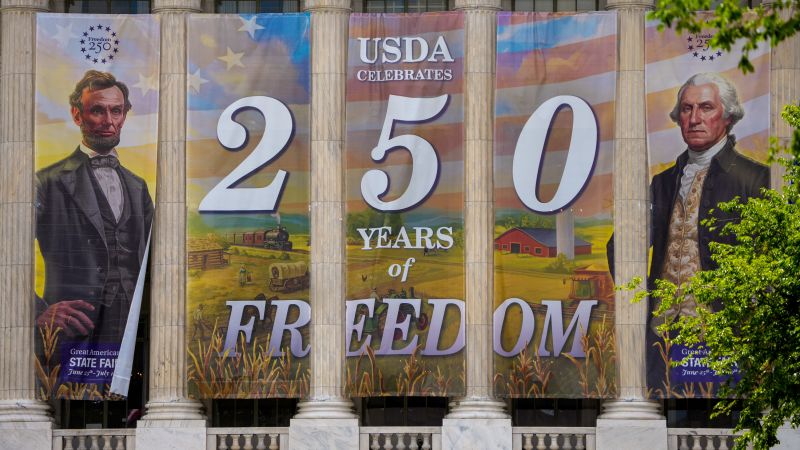
Earlier that month, Agriculture Secretary Brooke Rollins sent a “Christ is risen” Easter message to employees, sparking backlash inside the department, angering some of its nearly 100,000 employees and prompting a formal complaint against the secretary.
A union representing federal employees, including those at the Department of Agriculture, filed a lawsuit against the agency and Rollins last week over the Easter email, seeking to prevent the secretary from “further communicating proselytizing Christian messages to USDA subordinates.” When asked for comment on the lawsuit, a USDA spokesperson told CNN, “While we do not comment on pending litigation, we will keep the plaintiffs in our prayers during this process.”
A spokesperson for Freedom 250 told CNN the group puts on signature events for the nation’s 250th anniversary using private and public dollars.
Last year, Congress allocated $150 million toward the 250th in the “One Big Beautiful Bill Act.” Asked how much money the group is spending on Rededicate 250, CNN was not given a clear answer.
While Freedom 250’s setup means that it does not have to disclose its donors, Jeff Reinbold, president and CEO of the National Park Foundation, told lawmakers at a hearing in February that the foundation would disclose any donations to Freedom 250 as part of its normal reporting, unless anonymity is requested by the donor.
“Any donations to Freedom 250 follow our normal donation procedures,” he said, adding that the donors are also vetted by the National Park Service.
As the country prepares to turn 250, Robert P. Jones, president and founder of the Public Religion Research Institute, said his research shows Americans are embracing the view of a religiously diverse country.
“There is great diversity, not only in the country, but I would say … within Christianity itself, and I think that’s worth noting, and the thing that’s really quite absent if you look at this event,” Jones said.