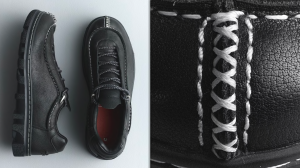
As leather hiking boots emerge as a retro fashion statement, the Spanish-Chinese label Od.a is pushing the concept further by combining historical shoemaking techniques, deep local supply chain knowledge — and documentary-style visuals that evoke cross-cultural nostalgia.
Od.a, which means “oath” in Spanish, pays tribute to the original leather hiking boots of the 1990s while elevating them with modern materials. Its debut model, the 001, features grained leather, hand-stitched raised seams, a chunky Vibram sole and teardrop-shaped steel eyelets that nod to the brand’s affinity for nature.
Also inspired by one-piece garment constructions championed by Issey Miyake, the 001 comes with an eyestay and a tongue made from a single piece of leather.

Od.a’s 001.
Courtesy
By blending heritage craftsmanship with a future-retro sensibility, the style reinterprets a familiar outdoor archetype through a luxury lens — “It’s about making certain techniques visible and paying tribute to them,” said Albert Arenas, a cofounder of the brand. Arenas and Jose Rosales, both footwear creatives based in Barcelona, cofounded the brand as a passion project with Shanghai-based Kim Kiroic and Daren Tao more than two years ago.
As proclaimed by Od.a’s motto “Nothing New,” the brand believes that access to robust supply chain in China means that creating a brand is no longer about bootstrapping and inventing new shapes, but productively piecing together carefully designed parts to reinvent the wheel.
“We focused on working with readily available materials and the capabilities of our supplier network, recombining those elements in a way that reflected our own design philosophy. The innovation wasn’t necessarily in creating everything from scratch, but in how we interpreted and assembled existing resources through our own creative language,” Kim Kiroic said.
With four styles priced from 329 to 349 euros in its initial drop, Od.a’s aesthetic harks back to the golden days of sneaker design in the 1990s and 2000s, when athletic styles were pioneered by the likes of ACG and Salomon.
To match its retro aesthetic, Od.a parts are made in various unconventional Chinese footwear factories that continue to create hand-stitched footwear, an increasingly marginalized practice in commercial footwear.
“Most of the high-quality boutique factories we come across that do handmade shoes don’t know how to do innovation — they only know how to make very classic styles. On the other end of the spectrum, the newer factories that now handle luxury brand orders are run by workers that don’t know the traditional handcraft process,” Kiroic explained. “That’s why we usually handle different parts of the shoe across factories just to get it right.”
That adherence to tradition also inherits the spirit of a stoic 80-year-old master shoemaker nicknamed “Rock.” Based in Dongguan, a manufacturing town in southern China, the shoemaker, which Kiroic calls the “spiritual lead” of the brand, is one of the unsung heroes of iconic footwear styles at Visvim, the cult-favorite Japanese menswear label.
“When we presented our designs to him, he ripped everything apart and said, ‘This is no good. This is really bad,’ so we were like his puppets,” Arenas said. “But thanks to him, we really got to a point where we have now something worth showing, which is why it took us almost three years to make the shoe,” he added.
Inside Od.a’s book zine.
Courtesy
The Chinese shoemaster, who works with leathers ranging from horsehide from Finland to reindeer leather from Mongolia, creates unparalleled designs with traditional tools that honor the raw material itself. “He’s the martial arts master of footwear,” Kiroic said. “He never tells you what to do exactly, he just tells us to trust our gut feelings, don’t try to emulate the Italians, and that we must survive with our own ideas,” Kiroic said.
“That’s why we are also invested in documenting his craft, even though we are not able to apply everything to our products directly,” Arenas added.
The brand launch also came with a book zine launch that laced together its visual mood board, archival footwear research, snippets of poetry and Od.a’s manifesto, stating its mission clearly — “We believe in a denial of fashion egotism, an ode to tradition, a quiet pact with nature, an exquisite fashion corpse,” Od.a wrote in the zine.
After a private showcase during Shanghai Fashion Week this March, Od.a will launch exclusively at Dover Street Market London this fall. In 2027, the brand will introduce women’s styles and expand its product line.
“I sent a pair to Dover and they liked the product, they liked the brand,” Arenas said of Od.a’s initial cold email pitch.
Od.a’s showcase during Shanghai Fashion Week.
Courtesy
As for the market opportunity, Od.a is poised to tap into a market opportunity driven by Chinese design at a favorable price point that appeals to a global audience — emerging success stories include the leather handbag company Songmont, the Shanghainese footwear brand Pane, and more.
As for Od.a, the goal might not be to open as many storefronts as Songmont or Pane, but to maintain its niche appeal and even explore “degrowth” business models — for starters, only 100 pairs of the 001 style will be made for its initial launch.
“As a small designer-driven company, we want to actually sustain ourselves more efficiently,” Arenas said. “We want to respect and pay tribute to the traditional manufacturing processes as well as to embrace the nature of creating a high quality product that’s means to slow down.”