Markets headed into the final US session of the week with a distinctly defensive tone as investors weighed two converging risks: a deepening global semiconductor selloff and growing concern that the US-Iran conflict could enter a far more dangerous phase over the weekend. While US equity futures pointed sharply lower after heavy losses in Asian technology stocks, broader cross-asset moves suggested investors were becoming reluctant to carry risk into the weekend amid heightened geopolitical uncertainty.
The semiconductor rout continued to pressure sentiment after spreading from South Korea to Japan and Taiwan, while NASDAQ futures points to notably lower open. Yet the technology selloff appeared to be only part of the story. Markets were also focused on developments in the Middle East, where the conflict broadened beyond military installations to include infrastructure targets. The latest US strikes reportedly hit bridges, a train station and an airport in southern Iran, while US Central Command referred to attacks on “military logistics infrastructure” for the first time in more than a week, signaling a widening scope of operations.
Iran responded by announcing strikes against US bases in Kuwait, Qatar and Bahrain, as well as a US radar station in Oman. Tehran also said it had targeted what it described as a US special forces base at Tanf in Syria, marking another geographical expansion of the conflict. Together with reports that power and desalination facilities in Kuwait had been hit, the latest exchanges suggested both sides were becoming more willing to target infrastructure with broader economic and logistical significance rather than focusing solely on military assets.
Even so, traditional defensive assets were moving only gradually. Dollar recovered broadly, oil edged mildly higher and remained on track for its strongest weekly gain since April, while Gold continued to decline. The restrained nature of these moves suggests investors have not yet priced in a worst-case scenario. Instead, many appear to be reducing exposure ahead of the weekend, aware that any significant geopolitical development could trigger a sharp repricing when markets reopen. In that sense, markets resemble a loaded gun—cocked, but still waiting for a trigger.
Currency markets reflected this cautious positioning. Canadian Dollar outperformed on support from firmer oil prices, while Australian Dollar and New Zealand Dollar came under renewed pressure as investors reduced exposure to risk-sensitive currencies. Sterling also lagged, while Euro, Swiss Franc and Yen traded more neutrally, highlighting that markets were not yet engaged in a full-scale flight to safety.
Whether that changes may depend less on Friday’s price action than on headlines emerging after markets close. With the conflict expanding both geographically and operationally, traders appear increasingly unwilling to head into the weekend with aggressive risk positions.
Chip Rout Spreads from KOSPI to Nikkei. Will NASDAQ Be Next?
KOSPI broke first, Nikkei followed, and NASDAQ could be next. The geographical spread of the chip rout suggests markets are reassessing the AI investment cycle rather than simply taking profits after a strong rally. Read More.
Ethereum Leads Bitcoin Again. Is Crypto Finally Turning the Corner?
Ethereum has emerged as crypto’s clear leader following softer US inflation data, outperforming Bitcoin by a wide margin over the past week and lifting the ETH/BTC ratio nearly 9% from its June low. While similar leadership has preceded previous crypto recoveries, the latest rally still lacks confirmation that a new bull market has begun. Read More.
Eurozone June CPI Confirms Inflation Cooled to 2.8%, Services and Core Price Pressures Moderate
Eurozone inflation slowed to 2.8% in June from 3.2% in May, confirming the flash estimate as underlying price pressures continued to ease. Core inflation and services inflation both moderated, reinforcing signs that domestic inflation is gradually cooling even as energy prices remain elevated. Read More.
AUD/USD Daily Report
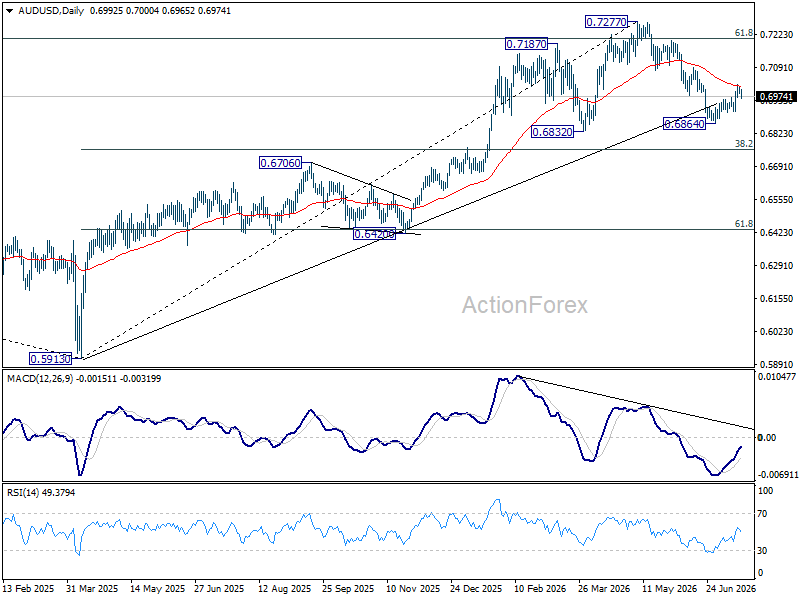
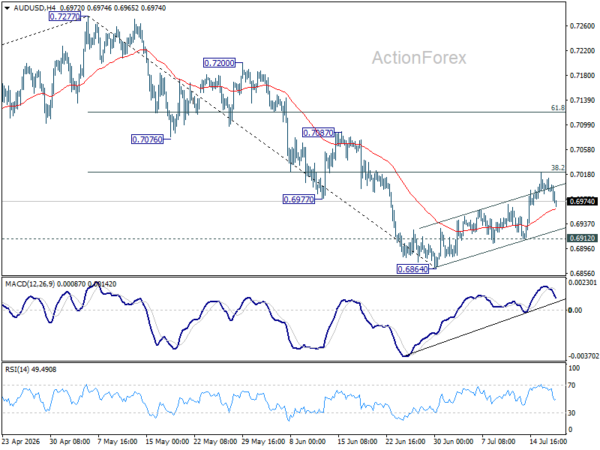
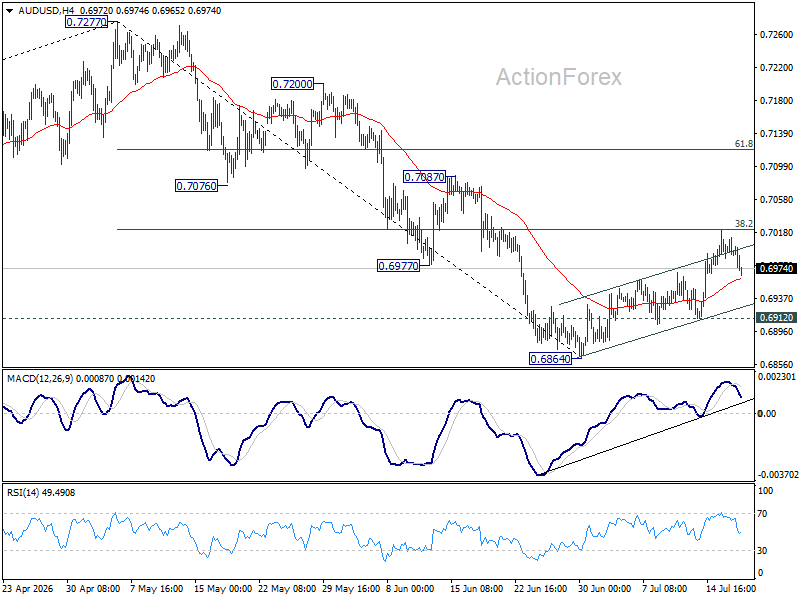
Intraday bias in AUD/USD is turned neutral with current retreat. On the upside, firm break of 38.2% retracement of 0.7277 to 0.6864 at 0.7022 will target 61.8% retracement at 0.7119 next. On the downside, however, below 0.6912 minor support will turn bias back to the downside for 0.6864 low.
In the bigger picture, considering bearish divergence condition in D MACD, a medium term top could be formed at 0.7277 after failing to sustain above 61.8% retracement of 0.8006 (2021 high) to 0.5913 (2024 low) at 0.7206. Deeper fall could be seen to 38.2% retracement of 0.5913 to 0.7277 at 0.6756 as a correction. But strong support should be seen there to bring rebound. Consolidations would continue below 0.7277 for a while.