Leaders from both sides of the Canada-U.S. border were in Toronto Thursday for a summit on the two countries’ relationship.
On Wednesday, U.S. President Donald Trump appeared to throw cold water on any expectations that his team would move to renew the North American free trade pact, which is up for review next month.
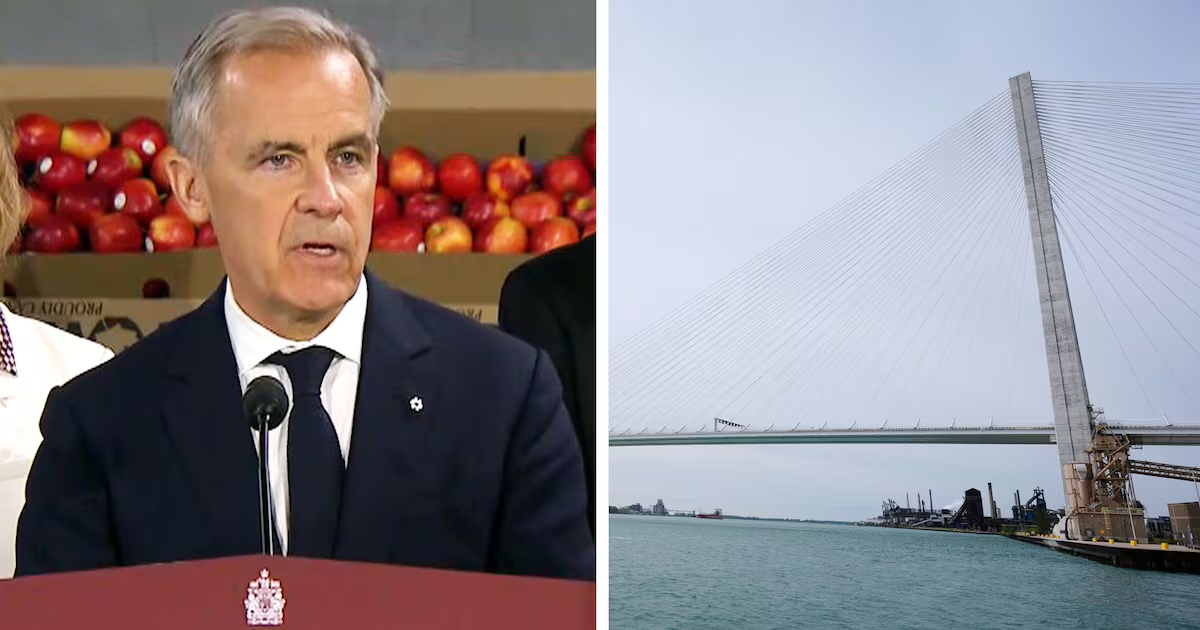
Meanwhile, Prime Minister Mark Carney said the delayed opening of the Gordie Howe International Bridge that connects Windsor, Ont., and Detroit is a collaborative approach between Canada and the U.S. and that there was no “great drama” in the postponement.
Follow for key updates:
No ‘great drama’ in bridge delay: PM Carney
Carney said Canada agreed to delay the opening of the Gordie Howe bridge at the request of the United States, adding the two countries would “take the necessary time” to resolve issues raised by the Trump administration.
“There’s not great drama here,” Carney told reporters at a food terminal in Toronto after the federal government unveiled its national food strategy. “We’re going to work through some issues that have come up for a bridge that’s going to be in place and serve Canadians, Americans and others for decades.”
Carney added that a delay of a few weeks is “time well spent.”
When pushed about what those issues were, the prime minister called them “a series of technical aspects” that the two countries will work through.
Hunter Crowther, CTVNews.ca journalist
Gordie Howe bridge opening delayed
Canada and the United States have agreed to postpone the opening of the Gordie Howe International Bridge.
According to a statement from the Windsor-Detroit Bridge Authority, the decision is to allow more time to address outstanding issues.
Chuck Andary, interim chief executive officer and chief legal officer of the authority, said the decision reflects a joint commitment to ensure the cross-border span is ready before it begins operations.
“The Gordie Howe International Bridge will be a vital economic link for Canada and the United States,” Andary said in a statement. “As we work towards an opening date, we are taking a collaborative approach, reflecting our shared ambition for this trade corridor.”
Kristylee Varley, CTVNewsWindsor.ca journalist.
A strong Canada ‘probably good for the world’
Ambassador Hoekstra says the United States’ push to reshore domestic manufacturing could also invigorate Canadian industries.
“I think some of that will be on-shored and come back into Canada, because of the relationships we already have,” he said.
Trump’s tariffs have already sent shockwaves through Canada’s manufacturing industry. More than 1,000 workers were laid off at the General Motors Oshawa Plant in January – a move which Unifor called a “clear decision to cave to Donald Trump.”
Stellantis postponed production of the Windsor-built Daytona R/T last year, allowing time to “assess the effects of U.S. tariff policies.”
“We want a strong Canada, OK?” said the ambassador. “We think a strong Canada, across the board, is good for the United States, it’s good for North America and it’s probably good for the world.”
“And who knows, if Canada is a rich country, maybe a few of those dollars will actually flow south … If you didn’t know, we have some great places that you might want to visit,” he added, mentioning Florida and Arizona, in reference to plummeting rates of Canadian visits to the U.S.
Luca Caruso-Moro, CTVNews.ca journalist
U.S. needs potash
In response to Trump saying “we don’t need anything that Canada has,” U.S. Ambassador Hoekstra said there’s a “tremendous amount of things” America needs, citing potash used to produce fertilizer as an example.
“We need potash” Hoekstra said, “because there’s not lots of other places that you can get it.”
Hoekstra added that it’s up to Canada to convince the president that Canada is the best place from which to buy.
Canada is the leading exporter of potash, shipping about 22.9 million tonnes in 2024, accounting for over 39 per cent of global exports according to the Government of Canada. The leading destination of Canadian exports of potash is the U.S.
Kayla Thompson, CTVNews.ca journalist
Mexico: Trade pact will remain
Mexican President Claudia Sheinbaum told reporters in Mexico City she believes the trilateral free trade deal, which is due for review by July 1, will be renewed.
“What the United States wants is certain conditions for Mexico and certain conditions for Canada, that is my point of view,” she said in Spanish.
Luca Caruso-Moro, CTVNews.ca journalist

Carney strengthens ties with Europe
Prime Minister Mark Carney is seeking to diversify Canada’s trade and security partnerships during a weeks-long visit to France and Ireland, where he will wrap up by attending the 2026 G7 leaders’ summit.
According to the Prime Minister’s Office, Carney is set to meet with President Emmanuel Macron in France to discuss partnerships in key sectors such as trade, defence, AI, quantum technologies, and critical minerals.
In the first visit to Ireland by a Canadian prime minister in nearly a decade, Carney will focus on expanding ties with the country across agri-food, digital innovation, AI, pharmaceuticals, and climate.
Kayla Thompson, CTVNews.ca journalist
Trade lead is still optimistic
Canada-U.S. Trade Minister Dominic LeBlanc reiterated his optimism for future negotiations with the White House.
Leblanc met with U.S. Trade Representative Jamieson Greer last week, he said, and the two have been exchanging messages since. They’ll meet again on the margins of the G7 next week.
During the sit-down meeting in Washington, LeBlanc said he and his counterpart went through a
number of issues within the trade relationship that Canada has already addressed.
LeBlanc said he also spoke to Greer about headwinds on the U.S. side, adding “it’s not a one-way street.”
Luca Caruso-Moro, CTVNews.ca journalist
3,000 LeBlancs
LeBlanc also spoke about the “decades” of economic integration between Canada, the U.S. and Mexico, which has resulted in “greater prosperity and sustained economic growth.”
“I don’t think there is any Canadian who doesn’t have a personal connection to the United States,” he added.
He mentioned his cousins who live stateside, and “about 3,000” people he met during a picnic in Louisiana who share his last name “LeBlanc” – a reference to the shared lineage of Acadians and Cajuns.
Luca Caruso-Moro, CTVNews.ca journalist

Hoekstra: Be aggressive, Canada
In reference to Trump’s rhetoric from the Oval Office on Wednesday, where the president repeated the U.S. doesn’t need “anything” from Canada, U.S. Ambassador Pete Hoekstra added some nuance.
“The president is a business guy,” said Hoekstra. “When Trump says, ‘We don’t need cars from Ontario,’ the Canadians say ‘Ah! How can you say that’?”
“Well, because we can get them from Japan, we can get them from Mexico, we can get them from South Korea. But if Canada puts on their sales hat, they can make a very compelling case,” he continued. The ambassador pointed to the similarities between the two countries’ economies, mentioning labour laws and environmental regulations.
“Go into these negotiations very aggressively, (and say) ‘we are the best place for America to fill these needs.’”
Luca Caruso-Moro, CTVNews.ca journalist

Canada-U.S. relationship strong behind the scenes
Despite occasional rough waters on the surface, the behind-the-scenes relationship between Canada and the U.S. is healthy, according to Canada’s newly-minted ambassador to the U.S., Mark Wiseman.
That relationship is built in part by the CSIS, RCMP and Canadian Armed Forces staff in the Canadian embassy who are in direct communication with their American counterparts every day, he said.
He said that relationship has been exemplified in recent months as the two countries prepared to host the FIFA World Cup.
“It works really, really, really well,” he said.
Luca Caruso-Moro, CTVNews.ca journalist
U.S. becomes world’s top oil exporter
The United States has become the world’s largest oil exporter, upending a decades-old order long dominated by Saudi Arabia and Russia, a shift that tightens American companies’ grip on energy markets as Washington’s war with Iran reshapes global energy trade.
America’s ascendancy to the top spot marks a stunning reversal for a country that was dependent on Middle Eastern oil for decades and suffered from an oil embargo imposed by some OPEC (Organization of the Petroleum Exporting Countries) members in 1973 to retaliate against U.S. support for Israel.
U.S. fortunes began to change after 2010, when oil and gas output from its shale formations soared, first making it the world’s top gas and then the world’s top oil producer.
Reuters. Read the full story here.