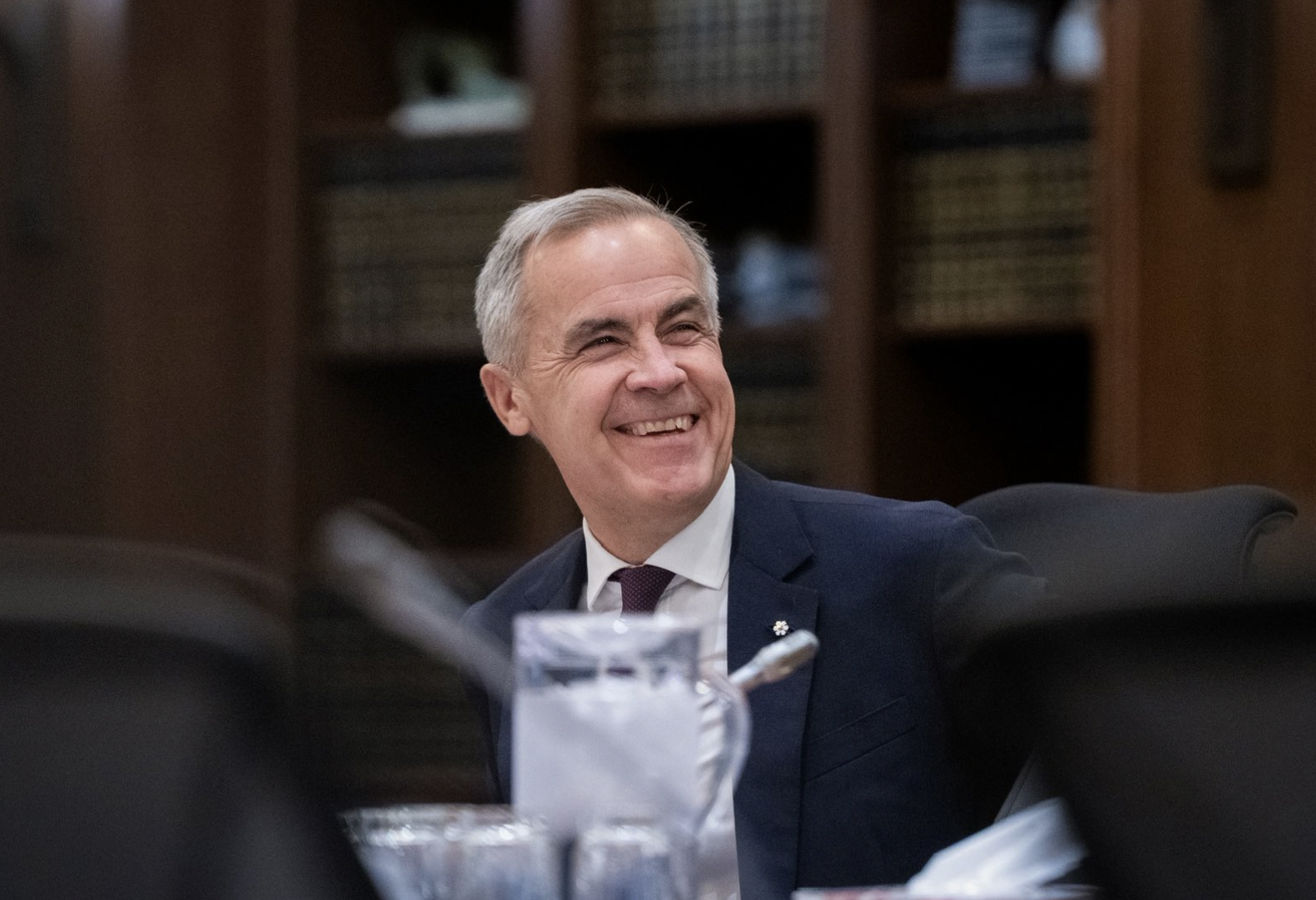
 Prime Minister Mark Carney in his Parliament Hill office/PMO
This piece is part of our Policy series Carney’s Canada: One Year Later.
By John Delacourt
April 21, 2026
We are now officially one year into what we’ll likely call, by 2029, the Carney era.
The Liberal party and caucus that Carney leads do not have to look too far back in time to process what a head spinning transformation this has been for their political capital. Indeed, with an analogy that would probably resonate strongly with Carney himself, it was less a merger of two leadership regimes, with two very different approaches to the retail side of politics, than an acquisition.
An enterprise that was poised to sell the shop for parts, with pink slips for virtually everybody on the floor but a skeleton crew, is — just 16 months — later scaling up and looking for new markets for business around the world.
Perhaps the best way to account for this transformation of Liberal fortunes is to return to a theory made famous by essayist, options trader and risk analyst Nassim Nicholas Taleb, with his book The Black Swan: The Impact of the Highly Improbable. The book garnered a lot of attention after the 2008 financial crisis, when a certain governor of the Bank of Canada burnished his reputation for steering a steady course through a tsunami of risk and uncertainty. Taleb’s theory, summarized for clarity’s sake by the author himself, concerns one central phenomenon: “Our blindness with respect to randomness, particularly large deviations.”
If you were a Liberal toiling away in government after five years of polycrisis, you’d think you’d be well acquainted with the impact of random events and large deviations: a pandemic, a Russian invasion of Ukraine, the attempted occupation of not only Washington but Ottawa, a crisis in the Middle East … the now all-too-familiar shitstorm that scattered certainties to the wind. The Conservative Opposition, with leader Pierre Poilievre drawing unprecedented support in the polls, looked set to win their own majority. Taleb’s “large deviations” had already done their worst to darken Prime Minister Justin Trudeau’s “sunny ways.”
If you were a Liberal who played the parlour game of Who’s Next? in those grey months that followed Trudeau stepping down, Carney did not rank highly as a contender. There were concerns that while he was arguably overqualified, Carney had no retail politics experience, and the combination of his UK celebrity and intellectual mien recalled ill-fated Liberal Leader Michael Ignatieff’s framing as a tourist.
The widely accepted explanation for Carney’s breakaway from the pack of Liberal contenders and his eventual election victory is that the black swan — the large deviation from the expected — was Trump’s stunning transformation of the United States from a reliable ally into an economic threat.
And yet, aside from Poilievre’s reticence to come down too harshly on Trump and his conservative base, which cost him boomer voters who’d once been willing to see him as PM, it is instructive to remember a significant percentage of Canadians still voted for and elected Conservatives last year — the best showing for the party in 40 years.
No, the real Black Swan, the great deviation, is the remarkable political nous of a first-time politician, a globalist technocrat and finance bro, who’d never be able to connect with “regular Canadians.” This superficial take on Carney was never really true.
 Early goalie: Carney went on to Harvard on a hockey scholarship/Carney 2025 campaign
So, one year in — with apologies to a Wallace Sevens and his blackbird — here are three ways of looking at a Black Swan Prime Minister:
The Goalie Prime Minister
Early on in his run for Liberal leader, Carney was asked how he was different from Trudeau. His response was telling: “I’m a goalie. He’s a snowboarder.”
The late Ken Dryden, a one-time Liberal leadership contender himself, described the traits of those brave enough to lace up the skates and take their place between the pipes: concentration and focus, an unerring ability to be at the right place at the right time, superior analysis of the flow of the game, and resilience. In my own conversation with another former goalie and current Cabinet Minister, he added another important trait: “You’re part of the team but you’re both inside the game and outside of it.”
In his first year in office, Carney demonstrated how much of an insider-outsider team player — and team builder — he was with a few key appointments. Janice Charette, former high commissioner to the UK and clerk of the Privy Council (and Jean Charest’s Chief of Staff at one point) led Carney’s transition team and is now Carney’s chief negotiator for Canada-US trade relations. There is arguably no one with better institutional memory of the last three decades of governing in Canada. If Carney hadn’t spent more than two decades inside of government, it is unlikely that he would have understood all Charette brought to the table.
It is also that experience and knowledge that led to him luring Michael Sabia back to Ottawa from his position at Hydro Quebec to head up the Privy Council. Sabia not only knows how budgets and other key legislation are crafted but he’s a famously impatient, results-focused dynamo who can be an inspiring mentor.
From his time outside of government, Carney’s also brought a few luminaries from corporate Canada to take on some pivotal roles: Natural Resources Minister Tim Hodgson, Doug Guzman, formerly Deputy Chair at RBC and now CEO of the new Defense Investment Agency, and Dawn Farrell, the former CEO of TransAlta, who heads up the Major Projects Office. Carney has looked outside Ottawa while also turning a high-resolution lens on those who’ve worked inside and understand that, while government by intent and design can’t be run like a business, it can still deliver on effective, transformative policy design.
 Mark Carney at the 2025 Vancouver Pride Parade/Harrison Ha Shutterstock
The Generation Jones Prime Minister
Much has been made of the particular divide in sensibilities between the Baby Boomers and Generation X, but, as the Atlantic writer Jonathan Pontell identified, there is a transitional cohort, “Generation Jones,” born between ’57 and ’65, who came of age in the years where the tie dyed colours of sixties idealism had darkened into more subdued, sober hues through the years of stagflation, unemployment, sudden fears of precarity and notably, the so-called “end of history” with the fall of the Berlin Wall.
Generation Jones (named for the aspirational “jonesin’” of the 60s and the generic value of the surname) leaders were “pragmatic idealists,” a little more cynical, detached and more adept in crisis situations; the best examples of Generation Jones leaders on this continent would be Barack Obama and Stephen Harper.
Until now, the Liberals had leapfrogged past Generation Jones. From Paul Martin to Justin Trudeau, there was a profound shift in sensibility and style of governing. Trudeau and his inner circle made a concerted effort, with only a few exceptions, to make a clean break from Boomer-era Martin politicos. Intent on looking forward rather than back, their Gen-X idealism was focused on delivering for Millennial and Gen Z concerns: homeownership, social equity policies through a vaunted intersectional lens, a more leftward tilt on immigration as a driver of economic development. Defence? Agricultural policy? Economic sovereignty? Those were grandpa Liberal issues, from the boomer era when we couldn’t conceive of Canada as post-national.
Carney the Generation Jones Prime Minister has bridged three generations more effectively and authentically. His PhD thesis foregrounded the importance of pragmatism over economic orthodoxies. His education and his years at the Bank of England gave far greater credence to his citing Havel’s “living in truth,” when he spoke at Davos. And despite his European bona fides, his perspective on Canadian culture and identity seems bred in the bone.
Whether it’s paying tribute to Joni Mitchell or the team behind Heated Rivalry, he’s revealed a deep understanding of what makes these artists uniquely Canadian. He wears his Albertan beginnings as comfortably as his bespoke suits. And of course, he’s brought that worldly but grounded pragmatism to foreign affairs, taking the world as it is while middle-power coalition building and forging new trade relationships with China and India.
The Wartime Prime Minister
Even before Carney’s speech at Davos, it was clear that he grasped the stakes for Canada in what Russia expert Fiona Hill, among others, has dubbed a third world war in progress. His grasp of defence priorities and how they intersected with digital and Arctic sovereignty, critical minerals and resource development reinforced both his assertion at Davos that resiliency is the new efficiency and the running theme of his “Canada Strong” programs that building Canada is defending Canada.
And, in the fashion of wartime leaders like Roosevelt and Churchill, Carney has realized that a foundational piece of his agenda is building the narrative itself. Rolling out regular 10-minute videos to keep Canadians informed is a bold commitment in an attention economy where most content is distilled into product that rarely exceeds 30 seconds.
But bold, resolute and defiant is the post-Davos Carney brand. He’s clearly wagering that it can be part of Canada’s too, once again.
Policy Contributing Writer John Delacourt is Senior Vice President of Counsel Public Affairs in Ottawa and a veteran Liberal strategist. He is the author of several novels.